


India’s Non-Fossil Power Capacity Crosses 300 GW
Solar accounts for the largest share in non-fossil capacity at 164.59 GW
August 10, 2026

Follow Mercom India on WhatsApp for exclusive updates on clean energy news and insights
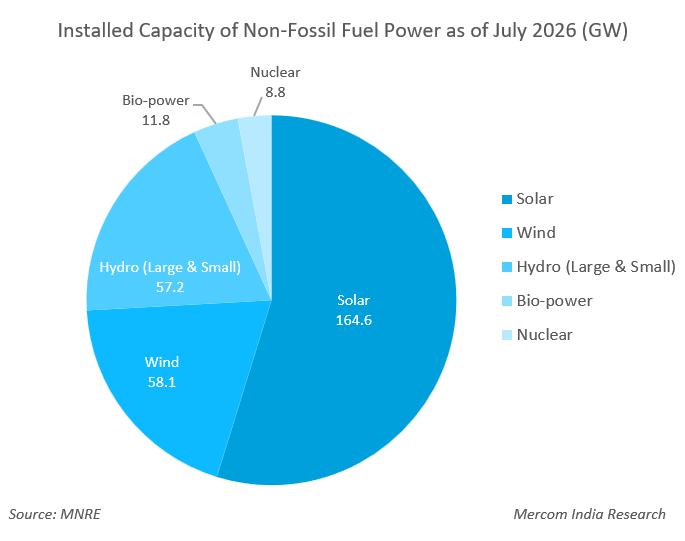
India’s installed non-fossil fuel-based electricity generation capacity reached 300.5 GW as of July 31, 2026, crossing 60% of the country’s target of 500 GW by 2030, according to the Ministry of New and Renewable Energy.
Non-fossil fuel sources now account for more than 54% of India’s total installed electricity generation capacity of around 552 GW.
Solar accounts for the largest share of the non-fossil fuel capacity at 164.59 GW, followed by wind at 58.14 GW. Large and small hydropower projects account for 57.24 GW, while bio-power and nuclear power contribute 11.75 GW and 8.78 GW, respectively.
During the financial year (FY) 2025-26, India installed a record 55.29 GW of non-fossil fuel-based electricity generation capacity. Solar accounted for 44.6 GW of the additions, while wind contributed 6 GW.
Renewable energy generation increased from 190.96 billion units in FY 2014-15 to 477.79 billion units in FY 2025-26.
India generated approximately 62.8 billion units (BU) of solar power in Q2 2026, increasing 45.9% year-over-year from 43 BU in Q2 2025, according to the Central Electricity Authority.
Besides utility-scale projects, India’s renewable energy capacity additions and generation have been aided by growing installations under the PM Surya Ghar: Muft Bijli Yojana. The program has so far commissioned a total rooftop solar capacity of 14.8 GW since its launch in February 2024.
Recently, the Union Cabinet approved the Pradhan Mantri Surya Sarovar Yojana, a ₹50.7 billion (~$530.20 million) program to develop 5 GW of floating solar projects with co-located energy storage systems across India.
The strong solar demand is supported by robust policy support for domestic manufacturing such as the Approved List of Models and Manufacturers (ALMM), with the cumulative enlisted solar module capacity rising to 215.5 GW and cell capacity growing to 31.76 GW
The government has also made sourcing of domestically produced solar ingots and wafers mandatory from June 2028 to enable a fully self-reliant solar manufacturing ecosystem.


Melvin Mathew
More articles from Melvin Mathew.