


Daily News Wrap-Up: India’s Floating Solar Potential Assessed at 102 GW
ONGC announces winner of 250 MW wind auction
June 12, 2026

Follow Mercom India on WhatsApp for exclusive updates on clean energy news and insights
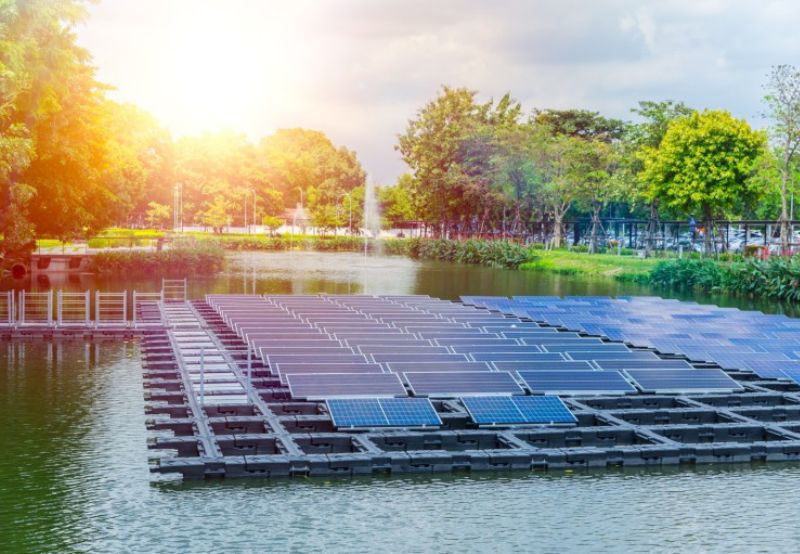
The Ministry of New and Renewable Energy (MNRE) assessed India’s floating solar potential at over 102.18 GW and said it is working on a dedicated program to promote floating solar deployment nationwide. Union Minister for New and Renewable Energy and Consumer Affairs, Food and Public Distribution, Pralhad Venkatesh Joshi, released the Report on Floating Solar PV Potential Assessment of India on June 10, 2026
Oil and Natural Gas Corporation (ONGC) announced the winner of the auction for 250 MW captive interstate transmission system-connected wind power projects.
Renewable energy industry associations have filed a writ petition before the Karnataka High Court to set aside the MNRE mandate requiring solar cells to be sourced from the Approved List of Models and Manufacturers List-II (ALMM-II) from June 1, 2026. The petitioners sought that enforcement of the ALMM List-II be deferred until India’s installed solar cell manufacturing capacity is sufficient to meet demand for projects covered by the ALMM framework.
The Delhi Electricity Regulatory Commission allowed distribution companies in the national capital to recover fuel and power purchase adjustment surcharges (FPPAS) above the 10% ceiling for April 2026. The Commission permitted BSES Rajdhani Power to recover the total FPPAS of 17.94% and BSES Yamuna Power to recover 17.43% for April 2026.
The Meghalaya State Electricity Regulatory Commission issued the draft Meghalaya State Electricity Regulatory Commission (State Grid Code) Regulations, 2026, which set out guidelines for the planning, operation, scheduling, and protection of the state power grid. Stakeholders can submit their feedback until June 29, 2026.
The Tamil Nadu Electricity Regulatory Commission issued draft regulations to create a comprehensive framework for battery energy storage systems in the state. The draft Tamil Nadu Electricity Regulatory Commission (Battery Energy Storage Systems) Regulations, 2026, aim to promote the deployment of battery energy storage systems to support grid stability, peak load management, congestion management, frequency management, voltage control, reactive power services, and the integration of renewable energy.
Facing high electricity costs and unreliable power supply, a leading pharmaceutical company in Himachal Pradesh’s Baddi saw a way out with a customized 1.122 MW rooftop solar leasing solution. Developed by Two Point O Capital, the solution had the potential to reduce costs with cheaper power and more reliability.
The Kerala State Electricity Board invited bids to select a consultant to conduct technical feasibility and commercial viability studies for setting up utility-scale battery energy storage systems in the state over the next 10 years. The studies will assess the state’s battery energy storage requirements, optimal sizing and siting, and economic viability, and prepare an implementation roadmap.
NTPC Green Energy invited bids for the engineering, procurement, and construction of a 50 MW/200 MWh grid-connected battery energy storage system in Jhansi, Uttar Pradesh. The project will be connected to a solar project, which is being developed separately. Bids must be submitted by July 10, 2026. Bids will be opened on the same day.
The U.S. added several solar and energy storage companies to its list of designated “Chinese military companies,” which will face defense-contracting restrictions effective June 30, 2026. Among Chinese companies added to the blacklist by the U.S. Department of Defense across various sectors are eight companies, including JA Solar and Trina Solar in the clean energy sector.
The U.S. solar industry installed 7.8 GW of capacity in the first quarter (Q1) of 2026, a 27% decline from Q1 2025 and a 42% decline from Q4 2025, according to a report by Wood Mackenzie and the Solar Energy Industries Association. Solar and storage accounted for 91% of all new electricity-generating capacity additions in the U.S. during the quarter, with solar contributing 60%.


Mercom Staff
More articles from Mercom Staff.