


Daily News Wrap-Up: India Adds 7.1 GW of Rooftop Capacity in 2025
Rooftop solar installers raise alarm over Maharashtra’s solar policy tweak
February 27, 2026

Follow Mercom India on WhatsApp for exclusive updates on clean energy news and insights
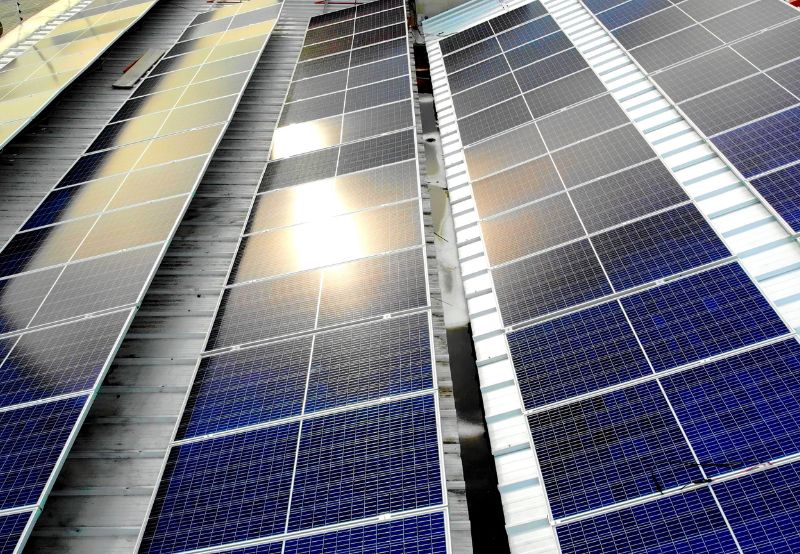
India’s rooftop solar capacity grew to 7.1 GW in the calendar year 2025, an over 123% year-over-year (YoY) jump from 3.2 GW in 2024, according to Mercom India Research’s newly released Q4 & Annual 2025 India Rooftop Solar Market Report. Rooftop solar accounted for more than 19% of the total solar installations in the year. Residential consumers accounted for almost 76% of the total rooftop solar installations in 2025.
Rooftop solar installers in Maharashtra are up in arms over a reported change in capacity approval criteria by Maharashtra State Electricity Distribution Company, calling it a move to restrict system sizing. Multiple installers told Mercom India that rooftop solar approvals from February 13 are being processed based on the average electricity consumption over the past 12 months rather than the sanctioned load/contract demand.
Vismaya Renewables India Project, a subsidiary of UPC Renewables, Hexa Climate Solutions, Purvah Green Power, and Sprng Energy, won Calcutta Electric Supply Corporation’s auction to develop 600 MW of interstate transmission system-connected wind-solar hybrid projects across India under a build-own-operate model.
The Odisha government announced additional state support of up to ₹4.95 billion (~$54.445 million) to accelerate the growth of rooftop solar projects under the PM Surya Ghar: Muft Bijli Yojana in the 2026-27 state budget. The state-backed capital support for the Surya Ghar program will be disbursed through the Odisha Akshaya Shakti Bikash Yojana.
The Appellate Tribunal for Electricity dismissed an appeal filed by solar prosumers challenging the Kerala State Electricity Regulatory Commission’s (KSERC) order on the levy of fixed charges. The Tribunal declined to interfere with KSERC’s interim arrangement requiring domestic solar prosumers to pay fixed charges, either based on total electricity consumption or at ₹47(~$0.516)/kWh per month, based on their total connected load.
Telangana Electricity Regulatory Commission issued a resource adequacy framework outlining a mechanism for electricity generation, transmission, and distribution planning to reliably meet the projected power demand. The Telangana Electricity Regulatory Commission (Framework for Resource Adequacy) Regulation, 2026, will apply to generating companies, distribution licensees, the state load dispatch center, transmission companies, and other grid-connected entities.
The Tamil Nadu Electricity Regulatory Commission approved the procurement of 270 MW of firm, dispatchable renewable energy by the Tamil Nadu Power Distribution Corporation from the Solar Energy Corporation of India. The procurement has been approved for 25 years at the discovered tariffs of ₹5.06 (~$0.0557)/kWh for 120 MW and ₹5.07 (~$0.0558)/kWh for 150 MW.
Hyderabad-based Bondada Engineering received approval for credit facilities of ₹5 billion (~$55.01 million) from Canara Bank to fund the debt portion of its 200 MW/400 MWh standalone battery energy storage system project with Tamil Nadu Green Energy Corporation.
Kolkata Metro Rail Corporation deployed a 4 MW/6.4 MWh battery energy storage system (BESS) to enhance operational resilience by providing immediate traction power support during grid failures, enabling trains to safely reach the nearest station. The BESS also supports peak power management, power factor improvement, and overall energy efficiency.
The Tripura State Electricity Corporation issued an expression of interest to set up 50 MW/200 MWh of standalone battery energy storage systems at suitable 33/11 kV substations. The storage projects will be set up to support renewable energy integration, enhance grid stability, and manage peak demand, which has reached 378 MW and is expected to grow to 690 MW by 2030.
The Andhra Pradesh Power Generation Corporation invited bids for the design, engineering, manufacturing, and commissioning of three 238/270 MW and two 118/135 MW vertical Francis reversible pump turbines and synchronous motor-generator sets for the 950 MW Kamalapadu pumped storage project in the Ananthapuramu district. The last date to submit bids is March 13, 2026. Bids will be opened on April 6, 2026.
Data center provider, Digital Edge, announced the signing of a renewable energy power purchase agreement with Hexa Climate Solutions for up to 83 MW of solar capacity to support the first phase of its 350 MW AI-ready hyperscale campus under development in Navi Mumbai, Maharashtra.
Shoals Technologies Group, a supplier of electrical balance of system solutions, reported revenue of $148.3 million in the fourth quarter (Q4) of 2025, an increase of 39% YoY from $107 million, on the back of higher product sales to utility-scale solar projects. Profit rose 3.8% to $8.1 million from $7.8 million in the same quarter last year.
U.S.-based module manufacturer First Solar’s net sales in Q4 of 2025 rose 11.1% YoY to $1.68 billion from $1.51 billion. Net income grew 32.5% YoY to $520.88 million from $393.12 million, aided by improved sales performance.
The U.S. Energy Information Administration (EIA) forecast that 86 GW of new utility-scale electric generation capacity will be added in 2026, with solar accounting for 51%, battery storage for 28%, and wind for 14%. EIA also notes that 53 GW of new capacity was added in 2025, the largest single-year addition since 2002.


Mercom Staff
More articles from Mercom Staff.