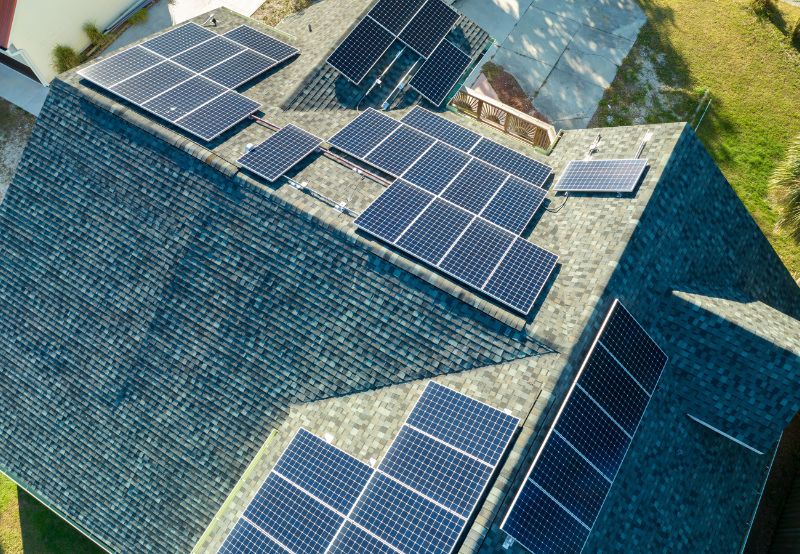
Maharashtra’s Rooftop Solar Policy Tweak Faces Heat
Installers criticize consumption-based rooftop solar approvals
February 26, 2026
Follow Mercom India on WhatsApp for exclusive updates on clean energy news and insights
Rooftop solar installers in Maharashtra are up in arms over a reported change in capacity approval criteria by Maharashtra State Electricity Distribution Company Limited (MSEDCL), calling it a move to restrict system sizing.
Multiple installers told Mercom India that rooftop solar approvals from February 13 are being processed based on the average electricity consumption over the past 12 months rather than the sanctioned load/contract demand.
Earlier, consumers were allowed to install systems up to the load approved by the distribution company. This was linked to the maximum demand allowed for households to plan installations based on expected increases in electricity usage.
Under the revised procedure, system size is capped based on the average monthly consumption over the past 12 months, including summer, monsoon, and winter usage. Installers said this significantly reduces the eligible system capacity for many households.
The change in procedure has been implemented through the online application portal without a formal circular or stakeholder consultation. Applicants are now being required to revise system sizes to align with historical consumption data.
Infrastructure Limitations
Installers understand that the restriction stems from infrastructure limitations. In several areas, transformer capacity was originally designed for 40 to 50 consumers, but connections have increased to over 200. With rising rooftop solar penetration, daytime voltage levels have increased to 290-300 volts, compared with earlier low-voltage issues.
Approximately 40 to 50 residential rooftop applications are filed per month, with 3 kW being the most preferred system size. In cases where higher capacity is genuinely required, approvals are given after technical scrutiny and site inspection. If the current rule continues, the demand may shift toward hybrid or off-grid systems.
Installers have urged the Ministry of New and Renewable Energy to look into the issue, voicing concern that the move could slow the progress of the government’s ambitious PM Surya Ghar: Muft Bijli Yojana, which aims to install rooftop solar systems in 10 million households by 2027.
Samir Gandhi, CEO at Greenenergy Sustainables, said that the MERC (Grid Interactive Rooftop Renewable Energy Generating Systems) Regulation 2019 clearly states that the maximum rooftop solar capacity for any consumer is limited to the consumer’s sanctioned load/contract demand.
“MSEDCL has arbitrarily brought in changes with rooftop solar capacity now linked to the usage over the last year. This is totally unlawful … There is no notice or any circular from MSEDCL.”
According to Gandhi, the change is not limited to PM Surya Ghar but extends to rooftop solar applicants under all programs. “The portal does not allow submission of applications beyond the consumption-linked limit. If a consumer intends to apply for 145 kW, the system does not permit that capacity. Instead, it allows capacity based on last year’s electricity usage, calculated through an undefined formula. There is no clarity on whether the calculation is based on a six-month or a twelve-month average consumption. Nothing has been officially communicated,” he said.
Policy Change to Hit Rooftop Solar Adoption
Installers say that since there is no official notification from MSEDCL, it is difficult to formally challenge the change before the Maharashtra Electricity Regulatory Commission without documentary evidence. At present, the only evidence available is the portal screen reflecting the revised capacity restriction. “MSEDCL must clarify whether the restriction is a policy decision or a software issue, and if it is deliberate, the utility should explain the legal basis for implementing it,” Gandhi said.
The All India Renewable Energy Association (AIREA) stated that this change is affecting 50–60% of booked residential rooftop solar projects in Maharashtra. It noted that households planning future load additions, including to accommodate electric vehicles and additional appliances, are unable to size their systems to meet anticipated demand.
It also highlighted that newly constructed homes with limited consumption history are receiving approvals for smaller capacities despite having adequate rooftop space and approved load.
Mahesh Kulkarni, Partner at MNM Solar Power Systems, highlighted that the revised approach compares 24-hour average consumption with solar generation limited to 10–12 daylight hours, which is not technically consistent.
He said ongoing applications are reportedly being downsized under the new framework, a change that could adversely impact rooftop solar adoption.
Maharashtra is one of the leading states in installing rooftop solar systems under the PM Surya Ghar program. As of January 27, 2025, Maharashtra accounted for the second-highest number of installations under the program at 192,936 (22.79%). Gujarat was in first place with 351,273 beneficiaries.
Practical Difficulties
Installers said the revised approach has created challenges for new homeowners and consumers in developing residential areas.
Pranay Vijaykar, Director at My Solar Plant, said, “Since approvals are now linked to 12 months of historical consumption, newly constructed houses and recently occupied flats without sufficient billing records are unable to apply. In cases where households operate multiple meters, capacity is assessed per meter rather than on combined consumption, resulting in smaller approvals than required.
He said penalties were also being imposed for minor excess capacity installations. Earlier, small deviations above sanctioned limits were common, but now even excess capacities of 100–120 W are attracting penalties ranging from ₹10,000 (~$110) to ₹70,000 (~$770).
“The business impact has been immediate. Monthly installations, which earlier ranged between 70 and 80 sites, are declining substantially. Inventory procured in advance, including modules stocked in megawatt quantities, is currently on hold due to reduced approvals. Industrial and commercial applicants are also receiving lower approved capacities compared to proposed project sizes.”
Another installer, Jaysingh Baliram Mote from Akshay Energy, said many applicants are now getting approvals for only 1 kW systems based on past average consumption. A 1 kW system generates about 100-120 units per month. After accounting for fixed charges and minimum billing, the usable benefit is lower, which may not be sufficient for a household with multiple appliances.
He added that installation costs, including wiring and earthing, remain largely the same regardless of system size. “Limiting capacity reduces consumer value without reducing installation complexity. Smaller systems become less practical.”
Jaywant Naik, CEO at Shree Sadguru Solar, said restricting capacity to 1 to 1.5 kW for households consuming 100 to 150 units per month creates practical and financial challenges. Many consumers install larger systems in anticipation of future load growth, such as adding air conditioners. Limiting capacity based only on current consumption prevents future planning. Installers also noted that limited compensation for exported surplus power reduces the financial attractiveness of small systems.
According to some industry insiders, the change stems from concerns about grid management. Peak demand in many urban areas occurs during the morning and evening hours, when solar generation is low, while higher daytime rooftop generation during relatively lower-demand periods may create voltage management challenges at the transformer level.
They suggested that time-of-day tariffs encouraging daytime consumption, along with storage deployment and grid strengthening, could address such issues more effectively than restricting system sizes.
Installers also expressed concern that energy-efficient households may be disadvantaged by the new framework, as lower historical consumption could result in reduced approved capacity. They alleged that constraints were being imposed on multiple rooftop installations within the same premises, even though separate meters were in place.
However, not all installers share the same view. Zuber Khan, Director at Solbright Infrastructure, supported the revised framework, stating that the approved load reflects infrastructure capacity and does not necessarily correspond to actual electricity consumption in kWh. He said that in many cases, approved load values were outdated, while consumption patterns had changed over time. According to him, approvals based on historical consumption better reflect real energy usage and net metering set-off.
He added that obtaining higher approved load approvals was often a lengthy and complex process and that the revised system could simplify applications and make implementation smoother for rooftop solar installers.
MSEDCL officials have, for now, indicated that the concerns raised by stakeholders will be reviewed.