


Solar Market Hits Record 664 GW Globally in 2025 Amid Fears of Slow Growth
China remained the dominant solar market, adding 382 GW in 2025
June 24, 2026

Follow Mercom India on WhatsApp for exclusive updates on clean energy news and insights
In 2025, a record 664 GW of new solar capacity was installed globally, taking the total operating capacity worldwide to about 2.9 TW, according to SolarPower Europe’s Global Solar Market Outlook 2026-2030.
The report stated that solar generated 2,778 TWh of power and supplied around 9% of global electricity. It was also the first time that solar power overtook wind energy, while accounting for 77% of renewable capacity additions globally.
However, the report predicted a tepid 2026 for solar growth. Annual solar growth fell from 85% in 2023 to 32% in 2024 and 12% in 2025.
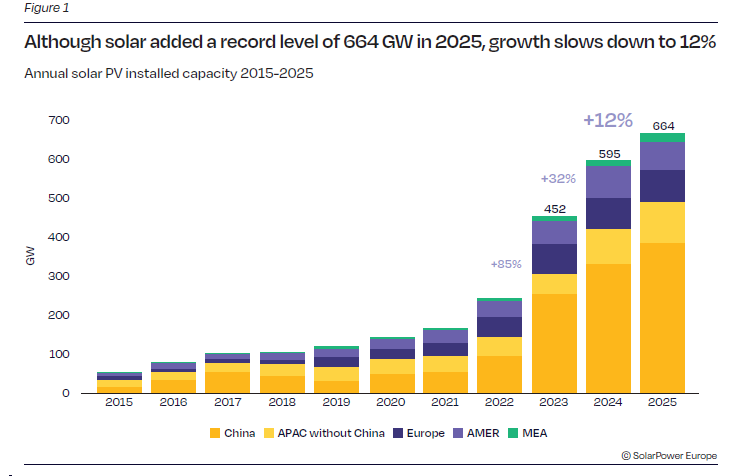
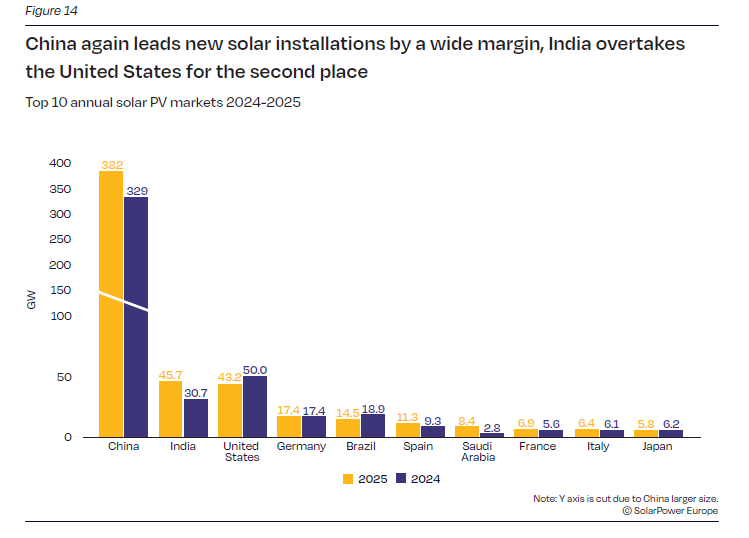
China continued to dominate the solar market, adding 382 GW in 2025, or 57% of all global installations. India was the second-largest market with 45.7 GW installations, overtaking the United States, which added 43.2 GW. The Top 10 markets together accounted for 82% of global solar additions.
Regionally, Asia-Pacific led the market, accounting for 73% of additions in 2025, mainly due to China. Europe became the second-largest region with 81.6 GW but recorded slower growth at just 3%. The Americas also witnessed a 13% decline. Meanwhile, the Middle East and Africa remained the smallest region but grew the fastest at 51% in 2025.
Global Solar Installations to Decline in 2026
Global installations are expected to fall 8% in 2026 to 612 GW, mainly due to forecasts suggesting a 24% decline in China’s market following changes in the country’s feed-in tariff system. The decline is described as a temporary adjustment rather than a long-term one, with growth expected to resume in 2027. Annual additions are also expected to reach 864 GW by 2030, according to the report.
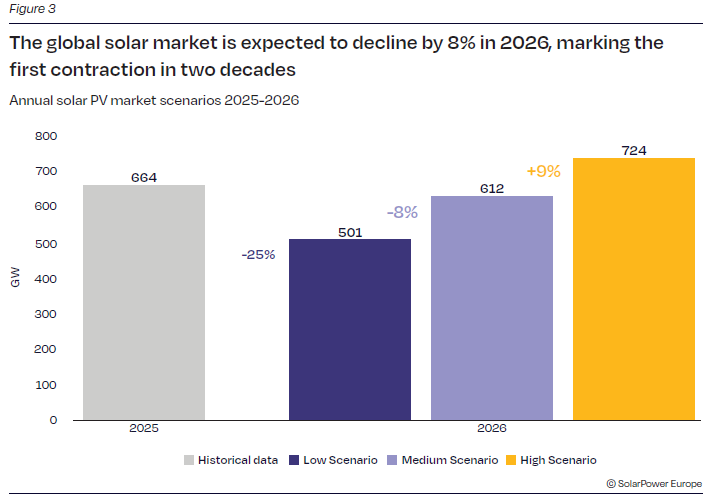
By 2030, global solar capacity is expected to reach 6.6 TW under the Medium Scenario, more than double its 2025 level. Under the High Scenario, stronger deployment of storage, grid upgrades, and policy support could lift capacity to 7.6 TW. Solar is expected to provide about 60% of the global renewable capacity needed to meet the COP28 target of tripling renewables to 11 TW by 2030.
Solar Surpasses Wind
In 2025, solar reached a new milestone in the energy transition, becoming the leading contributor to global primary energy demand growth for the first time. Solar was the largest contributor to global energy demand growth, totaling 2,222 TWh and accounting for 27% of the total.
China Continues Its Dominance
With 382 GW installed in 2025, China further cemented its position as the world’s largest solar market. However, several shifts occurred in the other Top 10 markets. After a leap from the fifth to the third position in 2024, India surpassed the U.S. in 2025 to become the second-largest solar market.
The U.S. market decreased by 14%, from 50 GW in 2024 to 43.2 GW in 2025. Similarly, Brazil dropped to fifth place after being overtaken by Germany. Spain stood strong in sixth place in 2025 as well, followed by Saudi Arabia, which tripled its market size in a year and became the only country from the Middle East and Africa (MEA) region represented in the Top 10. France climbed two positions to eighth, while Italy slipped to the ninth slot. Down two places from 2024, Japan closed the top 10 with 5.8 GW.
By 2030, the share of renewable power generation is expected to reach around 30%, advancing in tandem with the goal of raising the share of non-fossil energy consumption to 25%. China aims to achieve a total installed capacity of 3,600 GW for wind and solar power nationwide by 2035.
India Scaling Fast
India, APAC’s second-largest solar powerhouse, is moving in the opposite direction, with new installations expected to rise from 45.7 GW in 2025 to 57.2 GW in 2026. The growth in the Indian market was supported by a sustained pipeline of utility-scale projects and expanding activity in the commercial and industrial segments.
At the system-level, India’s total non-fossil fuel capacity stood at 283 GW, with renewable energy accounting for 275 GW.
Solar power alone contributes over 54% of the country’s total renewable energy capacity, underscoring its central role in India’s clean energy transition. Utility-scale solar projects remained the dominant segment, accounting for approximately 110 GW (75%) of total installed capacity as of March 2026.
U.S. Solar Market
In 2025, the U.S. solar industry added 43.2 GW of new capacity, a 14% decline compared to the 50 GW installed in 2024. Solar made up 54% of all new electricity-generating capacity added to the U.S. grid in 2025. Combined, solar and energy storage accounted for 79% of all new capacity during this period.
While energy demand remains a strong driver of growth, shifting federal policy continues to pose challenges for the American solar industry. The One Big Beautiful Bill Act (OBBB), passed in July 2025, accelerated the phase-out of solar tax incentives and introduced new restrictions on tax credits for foreign entities of concern (FEOC).
2027-2030 Global Solar Demand
Global solar demand is expected to resume its normal trajectory during 2027-30 following the 2026 hiccup. Solar remains a versatile and cost-competitive energy source with short development timelines, enabling countries to respond quickly to fuel supply shortages or fuel price volatility.
Overall, in the Medium Scenario, the solar market will improve to 689 GW in 2027, 742 GW in 2028, 804 GW in 2029, and 864 GW in 2030.
Rooftop Solar and Utility-Scale Segments
Both rooftop solar and utility-scale segments grew in 2025, but to different degrees. With 372 GW added in 2025, utility-scale installations increased by 7% from 2024. Rooftop solar saw a 17% year-over-year increase, with 292 GW installed. By the end of 2025, utility-scale accounted for 55% of the total, while rooftop solar accounted for 44%.
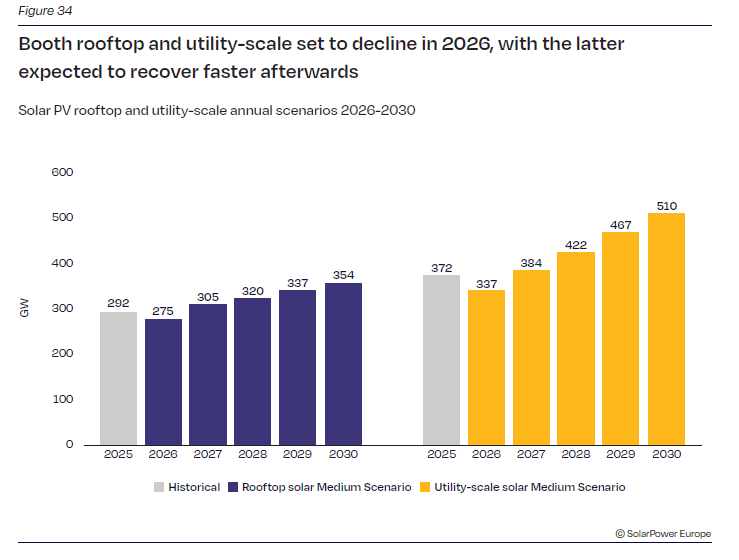
Post-2026, the utility-scale segment is expected to resume growth, with installations rising from 337 GW in 2026 to 510 GW in 2030. The rooftop segment will also grow, albeit at a slower rate, with installations expected to reach 354 GW by 2030.
Pakistan’s Solar Boom
Pakistan has become one of the fastest-growing solar markets globally, driven by a response to high electricity rates and pressure from fossil fuel imports.
This solar boom is reflected in the growth of solar exports from Pakistan, which has reached 50 GW by early 2026, from 1 GW in 2018. The expansion has been primarily driven by distributed rooftop solar.
Renewables with Storage in Australia
Australia’s solar journey has been extraordinary. From a modest cumulative base of 5.1 GW at the end of 2015, the country added more solar capacity over the following decade than many countries’ total solar installations. With around 4.8 GW added in 2025, Australia’s total solar capacity surpassed 45 GW by the end of 2025.
The report says renewables and storage supplied 51% of demand in Australia’s National Electricity Market in Q4 2025. Australia added about 4.8 GW of solar in 2025, with rooftop solar still dominant, and has seen rapid growth in battery storage through the Cheaper Home Batteries Program.
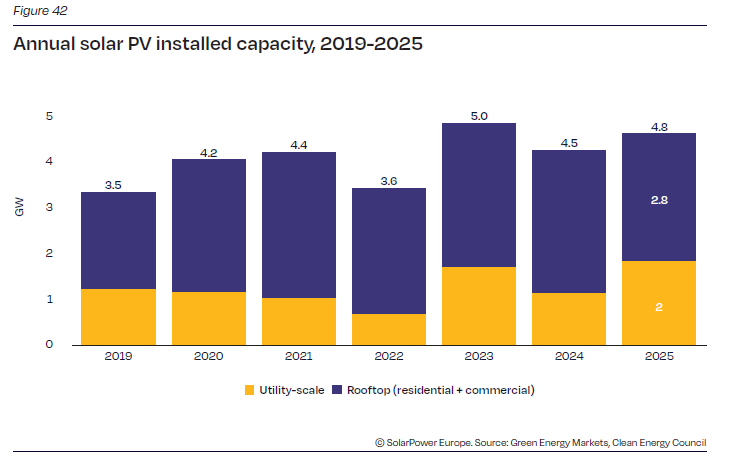
Australia aims to achieve its 82% renewables target by 2030, with the expected retirement of much of the coal fleet by 2035.
The report observes that solar’s next phase depends on policy and infrastructure. Governments must accelerate grid investment, deploy battery storage, reform electricity markets, reduce financing costs, expand access for low-income consumers, strengthen supply chains, and coordinate solar with wider electrification of transport, heating, and industry.
According to a recently published report by Ember, clean energy sources met all global electricity demand growth in 2025, marking a structural turning point for the power sector and halting the long-standing expansion of fossil fuel generation.


Rakesh Ranjan
More articles from Rakesh Ranjan.