


Project Structuring, Supply Chain Depth Key for Better Storage Deployment
Scalable deployment requires bankable contracts and stronger policy support
July 2, 2026

Follow Mercom India on WhatsApp for exclusive updates on clean energy news and insights
Battery energy storage deployment in India might be expanding at scale, but the market still needs better project structuring, realistic tariffs, supply chain localization, and clearer revenue mechanisms to support long-term growth, panelists said at Mercom India’s Renewable Energy Summit 2026.
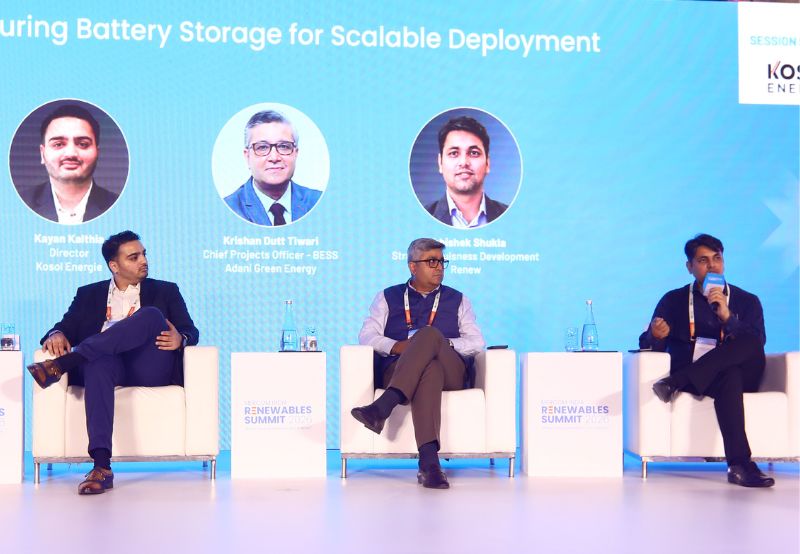
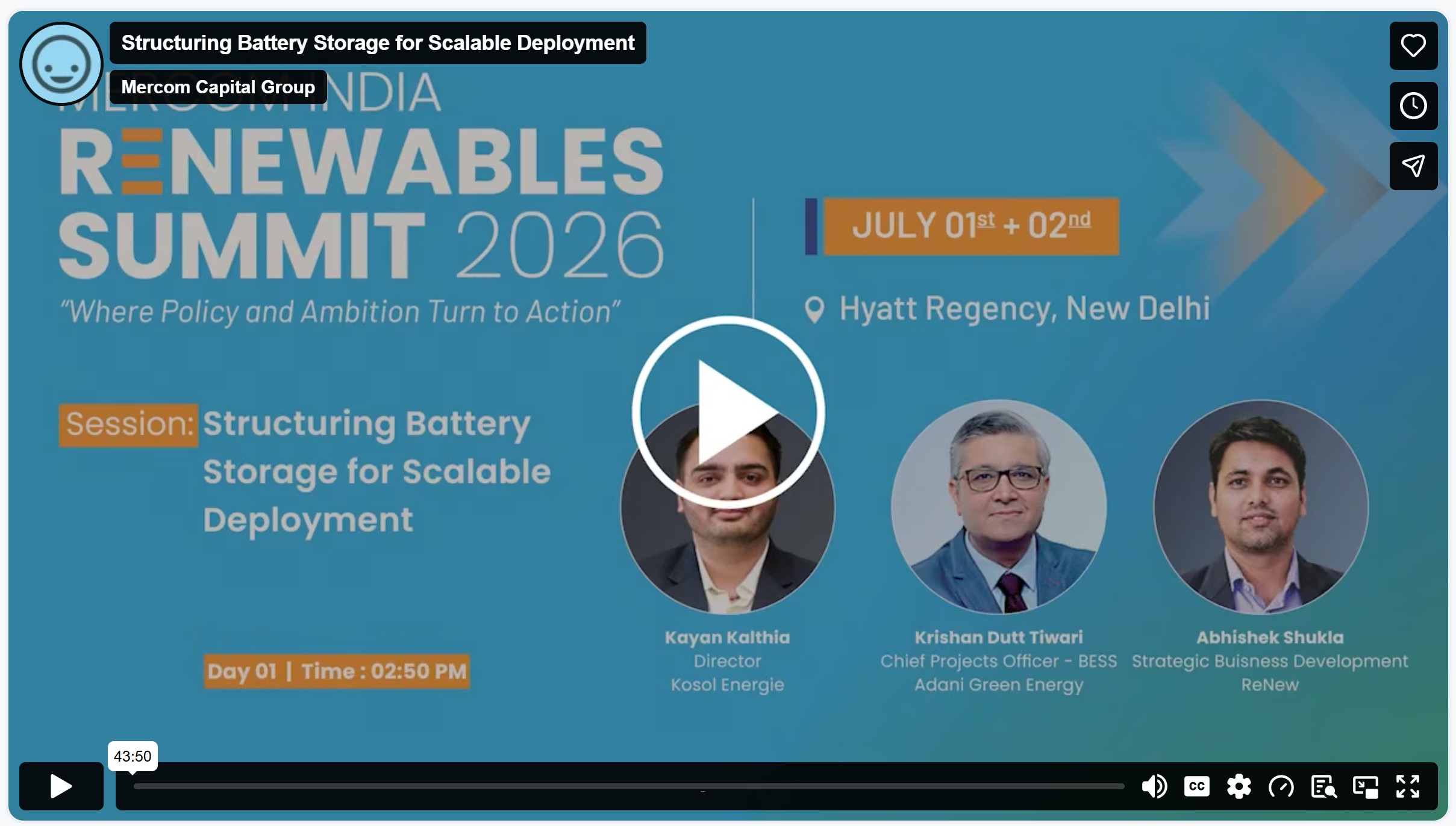
The session, titled “Structuring Battery Storage for Scalable Deployment,” was moderated by Wendy Prabhu, Co-Founder, Mercom Capital Group. It featured Kayan Kalthia, Director at Kosol Energie; Krishan Dutt Tiwari, Chief Projects Officer, Battery Energy Storage Systems at Adani Green Energy; and Abhishek Shukla, Strategic Business Development at ReNew.
Prabhu opened the session with the market overview, noting that global energy storage installations are expected to scale rapidly through 2030, led by China and the U.S., while India is gaining momentum from a smaller base. States like Rajasthan, Gujarat, Karnataka, Tamil Nadu, and Andhra Pradesh already have a high share of solar and wind projects in their power mix, underscoring the need for storage to manage surplus generation, maintain grid stability, and meet peak-hour demand.
She said India’s power system is showing a camel curve, with low overnight demand, high midday solar generation, and a sharp increase in the evening demand. The widening gap between midday generation and evening peak demand is strengthening the case for storage and hybrid renewable energy projects.
Battery storage installations in India increased sharply in the first quarter of 2026, with cumulative capacity reaching nearly 5.9 GWh in March 2026. Rajasthan and Gujarat accounted for the largest share of the installed capacity, driven by standalone storage projects, stronger procurement activity, and rising grid flexibility needs.
Kalthia said Kosol Energie’s move into battery storage was a continuation of its work as a solar solutions provider. He said the company’s U.S. arm has worked on microgrid projects since 2015, giving it experience in commercial, industrial, and utility-scale storage applications.
He said battery storage carries higher operational risk than solar modules because faults can emerge sooner and have more serious consequences. The market needs reliable products, especially as tariffs become increasingly competitive and developers seek lower upfront costs.
Shukla said battery storage has shifted from a good-to-have technology to a necessary component of renewable energy projects. India’s evening demand ramp makes storage essential for meeting peak demand and supporting grid stability.
He said ReNew commissioned one of India’s first large-scale battery installations above 100 MW in 2024 as part of a hybrid project and now has nearly 250 MWh of operating storage capacity. The company has a battery storage portfolio of nearly 5 GWh planned for deployment over the next few years.
Shukla added that three major changes have shaped the market in recent years: storage is now treated as essential infrastructure, the sharp fall in battery prices and discovered tariffs, and developers are evaluating storage beyond basic peak-shifting and energy-shifting applications.
He said that government-backed tenders and commercial and industrial (C&I) projects require different approaches. Government auctions generally involve long-term power purchase agreements and focus on peak demand management and grid stability. C&I projects require customized solutions because each customer has different requirements for reliability, cost, backup power, and risk mitigation.
He said a data center needs a reliable power supply with redundancy, while a manufacturing facility may prioritize cost reduction. Hospitals may need both reliable and affordable power. The common trend, he said, is that customers increasingly need integrated renewable energy solutions with storage.
Tiwari said the central question around battery storage has changed from whether storage is needed to how much storage is needed and when it should be deployed. He said Adani Green Energy has already commissioned 3.37 GWh of battery storage at Khavda and is commissioning another 10 GWh.
He said multiple factors, including curtailment reduction, better utilization of renewable energy and transmission assets, round-the-clock power supply, grid stability, frequency regulation, voltage control, and ramping support, drove the decision to deploy storage at Khavda.
Tiwari said the model can be replicated across other renewable energy parks, but the ecosystem must evolve. The industry is entering a mass-deployment phase, and developers are learning to improve system efficiency, optimize capacity, and reduce costs.
On whether battery storage can support round-the-clock renewable energy, Tiwari said the answer depends on the capacity deployed. Battery storage provides dispatch flexibility that solar and wind cannot provide on their own, allowing power to be supplied during nighttime and peak-load hours.
Kalthia said Kosol Energie’s battery storage manufacturing facility will be located in Gujarat. He said the company plans a 5 GWh plus 1 GWh production structure, with 5 GWh dedicated to utility-scale applications and 1 GWh kept flexible for residential, C&I, and cabinet-based storage requirements. Operations are expected to begin around December or January, with external sales likely to start around February or March after internal testing and ramp-up.
He said distributed storage could become an important opportunity in India, especially when paired with rooftop solar at hospitals and educational institutions. City-level distributed battery systems could support critical infrastructure during outages.
Shukla said government procurement has been the biggest driver for India’s storage industry so far. He said India has deployed nearly 7.6 GWh of battery storage, with most of the capacity coming online in recent months.
He said storage still needs policy support to attract more capital, expand participation, and build the supply chain from manufacturing to end-of-life management. On the C&I side, incentives could help industries that currently struggle to justify the cost of batteries, especially when seeking firm power with high capacity utilization.
Shukla said more market-reflective electricity tariffs and wider implementation of time-of-day tariffs could improve storage economics. The difference between solar-hour and evening tariffs will influence whether customers deploy storage or continue drawing power from the grid.
He also called for viability gap funding for battery storage co-located with solar and wind projects. Future storage capacity will largely come from co-located projects, but current support is focused mainly on standalone storage tenders.
Tiwari said several battery storage tenders have been bid at prices that may not be executable. Developers assumed battery prices would continue to fall, but they later rose sharply, making some contracts unviable. He said the sector needs a stronger supply chain ecosystem before business models can stabilize.
On safety, Tiwari said he does not expect developers to compromise because state governments, the central government, fire departments, and safety agencies are becoming more active. He said Gujarat is moving quickly to develop a policy framework for battery storage safety, and that Adani Green Energy is working with the state’s fire department.
Panelists said India remains dependent on imported battery cells and several critical storage components. Kalthia said domestic manufacturing will follow a path similar to solar but at a faster pace because the government has shown support for local manufacturing. Cell manufacturing is on the horizon for storage companies, but domestic content will take time to scale.
Tiwari said India has significant catching up to do in storage manufacturing. He said the industry often focuses on cells and chemistry but gives less attention to power conversion systems and energy management systems, where system control is concentrated. He said India must localize PCS, EMS, controllers, and related components.
Kalthia said India can create immediate value by localizing battery and energy management systems, as the country has the technical talent in software and controls.
The panel also discussed the role of artificial intelligence and data centers in storage demand.
Shukla said storage can both support artificial intelligence-led power demand and benefit from AI-based optimization. He also said that AI can also help forecast market conditions and optimize bidding into day-ahead and term-ahead markets.
Tiwari said AI-driven analytics could improve storage operations by supporting better optimization of system calls and performance.


Arjun Joshi
More articles from Arjun Joshi.