


Higher Storage System Deliveries Drive Eos Energy’s Revenue Up 351% in Q2
The company’s net loss widened by 24% YoY
August 7, 2026


Follow Mercom India on WhatsApp for exclusive updates on clean energy news and insights
U.S.-based energy storage solutions provider Eos Energy Enterprises reported a revenue of $68.8 million in the second quarter (Q2) of 2026, a 351% year-over-year (YoY) increase from $15.24 million. The growth was driven by a 207% increase in its Cube energy storage system deliveries.
The revenue for the quarter beat analysts’ expectations by $95,110.
During the quarter, Cube output increased 20% sequentially, reaching an annualized production rate of approximately 1.5 GWh in June.
Eos said that as volumes rise, utilization is expected to improve, fixed costs should be spread across higher production, and the operating leverage built into the Thorn Hill facility should become increasingly evident.
Eos’ net loss attributable to shareholders widened by 24% YoY to $275.71 million from $222.94 million, primarily due to mark-to-market fair-value adjustments on certain liabilities linked to changes in the company’s share price.
Its adjusted earnings before interest, taxes, depreciation, and amortization (EBITDA) loss increased by 38% YoY to $71.36 million from $51.63 million.
The EBITDA loss widened by 22.5% YoY to $261.3 million, from $213.4 million.
The earnings per share (EPS) loss sit at $1.2, compared with an EPS loss of $1.05 in Q2 2025, missing analysts’ expectations by $0.35.
1H 2026
In the first half (1H) of 2026, Eos reported a revenue of $125.74 million, a 389% YoY increase from $25.69 million in 1H 2025.
During the first half of 2026, the company’s Cube production was 17% higher than the total recorded in all of 2025. Eos was able to match last year’s full-year production volume in just 164 days.
The company said its revenue in 1H 2026 exceeded its revenue for all of 2025.
Eos clocked a net income attributable to shareholders of $233.17 million in 1H, compared with a net loss of $207.8 million last year.
The adjusted EBITDA loss widened by 46.9% to $139.37 million from $94.86 million in 1H 2025.
The EBITDA was $262.4 million against an EBITDA loss of $189.6 million in 1H 2025.
The EPS loss came in at $0.26, compared with $0.66 in the same period last year.
Business Highlights
Eos’ fleet of energy storage systems completed more than 3.9 million cycles and discharged 6.5 GWh of energy at the end of Q2. The Z3 system alone has completed over 1.1 million cycles and is approaching 1 GWh of discharged energy.
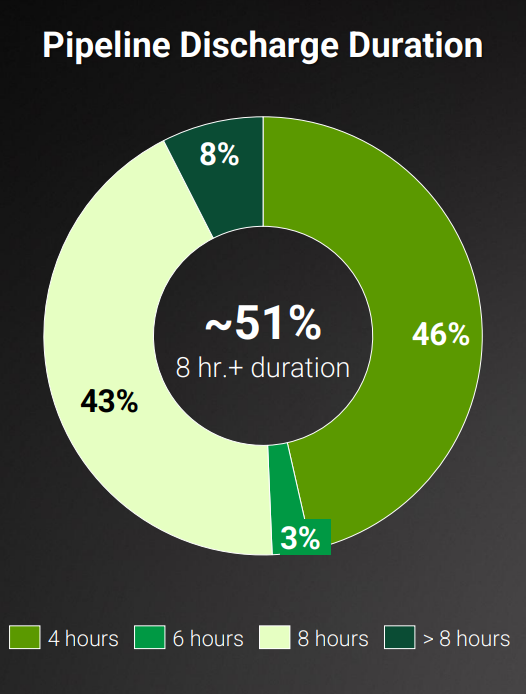
As of June 30, 2026, Eos had a record backlog of $807 million, representing 3.4 GWh. The backlog increased 25% sequentially, while the company’s commercial opportunity pipeline stood at $24.6 billion.
The opportunity pipeline rose 31% year-over-year to $24.6 billion, representing nearly 112 GWh, with 51% comprising projects with durations of eight hours or longer. The investment vehicle has a 16 GWh opportunity pipeline, including 5 GWh of projects that have been acquired, selected, or are under active due diligence.
Another 1.8 GWh of projects are under construction or approaching full notice-to-proceed. The first set of projects under the vehicle are expected to come online by the third quarter of 2027.
After the quarter, Eos also booked a $100 million purchase order for Phase I of the Blanquilla project under Frontier Power USA’s 2 GWh Capacity Reservation Agreement. The company also secured $263 million in gross proceeds for the Frontier Power USA (FPUSA) joint venture.
In July 2026, Eos Energy Enterprises announced a $75 million equity investment from Hudson Bay Capital Management to support its investment in FPUSA.
Eos launched commercial production on Line 2 at its Thorn Hill manufacturing facility, recording an initial 10% improvement in battery cycle time and an 11% improvement in bipolar-line cycle time compared with Line 1.
The company said that rising electricity demand from data centers and broader electrification is accelerating capacity requirements, outpacing the rate at which new generation can be connected to the grid. In regional transmission organization PJM Interconnection, which serves 65 million people and operates the largest power market in the U.S., capacity prices have reached the ceiling in three consecutive auctions.
Outlook
For 2026, the company tightened its full-year revenue guidance to $300 million-$350 million from the earlier range of $300 million-$400 million, citing the timing of a proposed consolidation of its manufacturing operations at the Thorn Hill facility.
The company expects more than 200 MWh of additional capacity to come online over the next six months, based on current customer project schedules.
In Q1 of 2026, Eos Energy Enterprises’ revenue jumped 444.7% YoY to $57 million from $10.5 million.


Melvin Mathew
More articles from Melvin Mathew.