


Global Energy Transition Investments Could Reach $189 Trillion by 2060
Electrification and infrastructure to account for over 50% of investments
November 25, 2026

Follow Mercom India on WhatsApp for exclusive updates on clean energy news and insights
Global energy transition investments could reach $189 trillion between 2026 and 2060 under a net-zero scenario, which assumes the achievement of the 1.5 degree Celsius trajectory outlined under the Paris Agreement, according to a Wood Mackenzie report.
The report estimates cumulative global capital expenditure of $151 trillion under the base case, $157 trillion under the energy security scenario, $147 trillion under the growth-first scenario, and $168 trillion under the country pledges scenario.
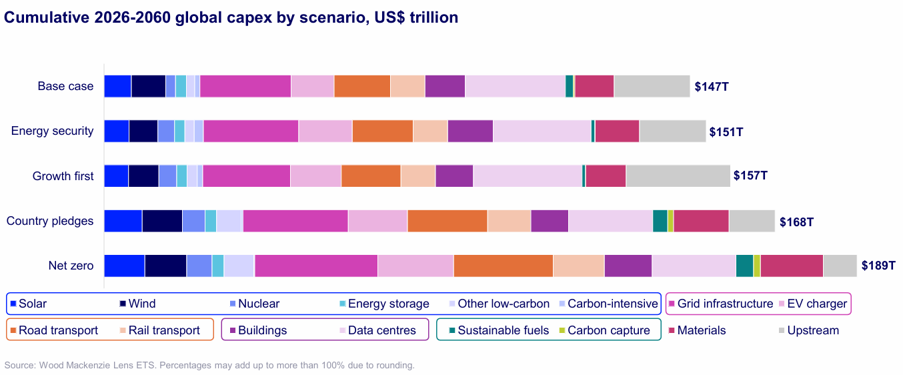
Electrification and infrastructure account for more than half of cumulative capital expenditure across the scenarios. The report includes solar, wind, energy storage, grid infrastructure, and electric vehicle chargers among the investment categories.
The report identifies substantial raw material demand associated with renewable energy, energy storage, grid infrastructure, and data centers.
Energy Transition Scenarios
Wood Mackenzie presents five scenarios for the energy transition: Growth First, Base Case, Energy Security, Country Pledges, and Net Zero.
The Growth First scenario assumes high economic growth and AI-related energy demand, with renewables unable to keep pace. It corresponds to approximately 3°C of warming.
The Base Case assumes that renewables expand but do not displace fossil fuels until the mid-2030s. It corresponds to approximately 2.6°C of warming.
The Energy Security scenario emphasizes domestic supply and resilience and corresponds to approximately 2.5°C of warming.
The Country Pledges scenario assumes announced climate targets are achieved. Renewables become the backbone of new power supply, supported by interconnections, grids, and storage. The scenario corresponds to approximately 2°C of warming.
The Net Zero scenario assumes renewables drive power system operation, with other generation providing balance and backup. It corresponds to approximately 1.5°C of warming.
The report identifies grid infrastructure readiness, low-carbon technology deployment, and global trade and supply-chain integration among the factors differentiating the scenarios.
To align with the 1.5 °C climate pathway, global installed renewable energy capacity must increase from approximately 5.2 TW in 2025 to 18.4 TW by 2035 and 38.2 TW by 2050, according to the International Renewable Energy Agency.
Global Electricity Demand
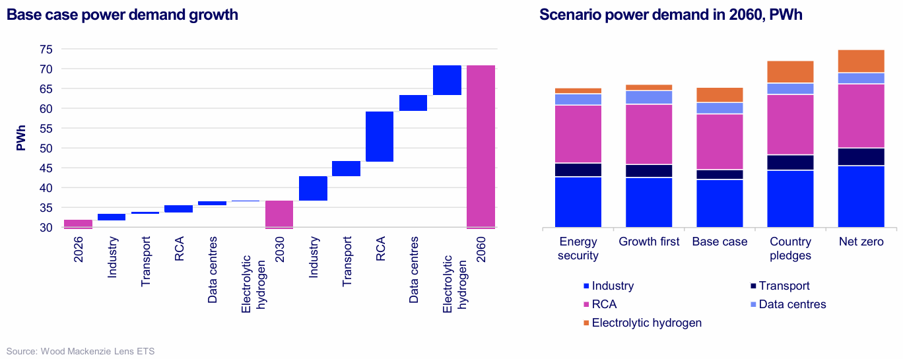
Wood Mackenzie projects that global electricity demand will double by 2060, supported by economic development and artificial intelligence (AI).
Under the base case, global electricity demand is expected to reach approximately 71 petawatt-hours (PWh) by 2060.
China, India, and the U.S. are projected to account for more than half of global electricity demand growth over the next three decades.
The report identifies technology and data center demand in the U.S. and rising incomes in India and China as drivers of electricity demand growth.
Between 2026 and 2030, electricity demand is expected to grow at a compound annual growth rate (CAGR) of 4.9% in India and China, 4.8% in Southeast Asia, and 3.7% in the U.S.
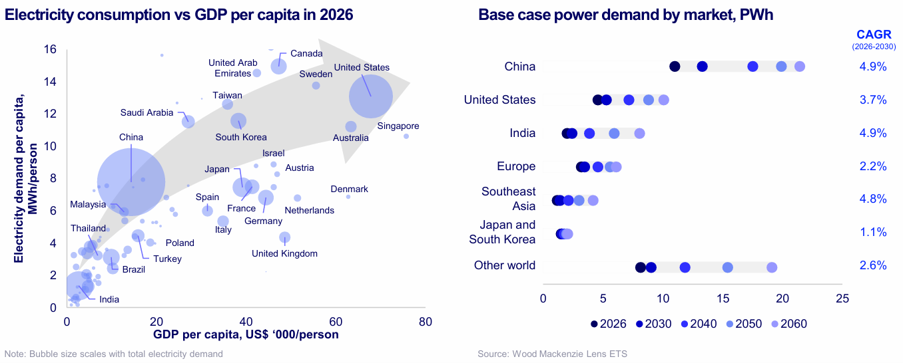
Europe’s electricity demand is projected to grow at a CAGR of 2.2%, while Japan and South Korea’s at 1.1%.
Data centers are projected to account for a fifth of global electricity demand growth by 2030.
Renewable Energy Growth
Global solar power generation is projected to double by 2032, surpassing coal-fired generation in 2034 and natural gas-based generation in 2035.
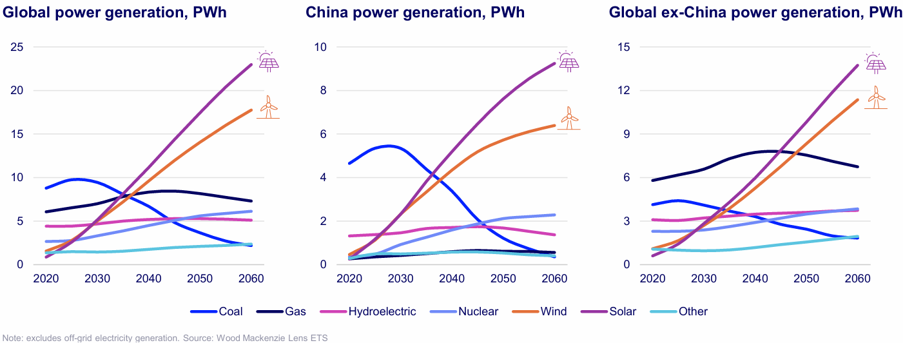
Under the base case, variable renewables are projected to generate half of global power in 2043.
Wood Mackenzie projects declining solar and wind generation costs and rising thermal generation costs.
The report identifies storage, grid expansion, and reliable backup supply as areas requiring substantial investment as renewables expand.
Grid Infrastructure and Energy Storage
Wood Mackenzie identifies the grid as a bottleneck for electricity supply amid rising AI demand, equipment shortages, and climate shocks.
The report identifies grid equipment shortages and climate shocks as challenges to grid reliability.
In the U.S., power generation projects face grid connection waiting periods of up to 10 years, highlighting infrastructure constraints. The report notes that rising electricity demand, equipment shortages, and climate shocks are reducing spare grid capacity. Grid bottlenecks, renewable energy integration challenges, and high capital costs in emerging markets are also slowing the energy transition.
Clean Energy Manufacturing and Supply Chains
The report projects that China will retain substantial shares of solar module, wind nacelle, and lithium-ion battery manufacturing capacity in 2030.
Its share of global solar module manufacturing capacity is projected to decline from 84% in 2025 to 80% in 2030.
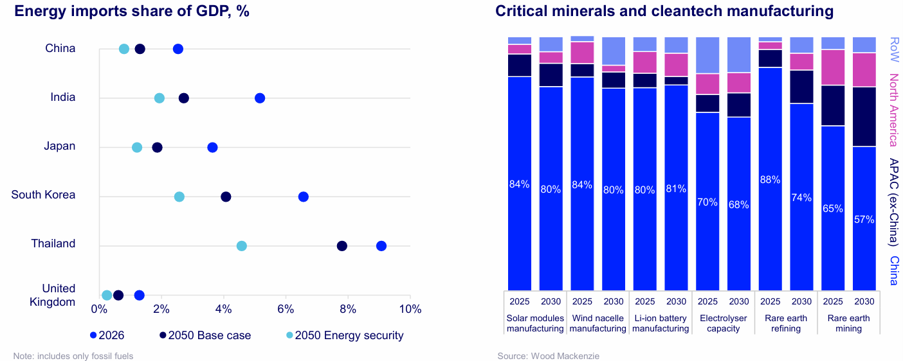
China’s share of wind nacelle manufacturing capacity is projected to decline from 84% in 2025 to 80% in 2030, while its share of lithium-ion battery manufacturing capacity is projected to rise from 80% to 81%.
The report projects that China will account for 80% of solar module manufacturing capacity, 80% of wind nacelle manufacturing capacity, and 81% of lithium-ion battery manufacturing capacity in 2030.
The global energy transition is falling behind as the world drifts further from its climate goals, according to Wood Mackenzie’s Energy Transition Outlook 2025–26. It warned that net-zero targets are unlikely to be met before 2060.


Parth Shukla
More articles from Parth Shukla.