


Global Renewable Energy Capacity Must Reach 18.4 TW by 2035: IRENA
The energy transition will require over $256 trillion in cumulative spending through 2050
October 27, 2026

Follow Mercom India on WhatsApp for exclusive updates on clean energy news and insights
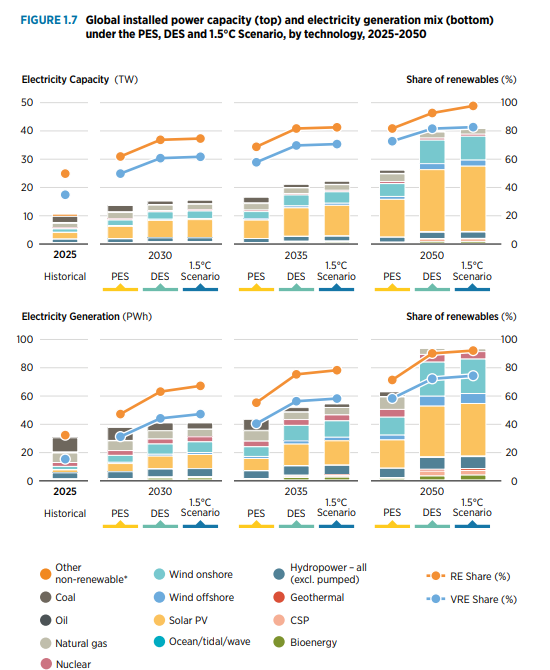
To align with the 1.5 °C climate pathway, global installed renewable energy capacity must increase from approximately 5.2 TW in 2025 to 18.4 TW by 2035 and 38.2 TW by 2050, according to the International Renewable Energy Agency (IRENA).
Achieving these targets would require average annual net renewable capacity additions exceeding 1.3 TW between 2026 and 2035, with additions remaining at similar levels thereafter. Solar and wind energy would account for the largest share of the expansion.
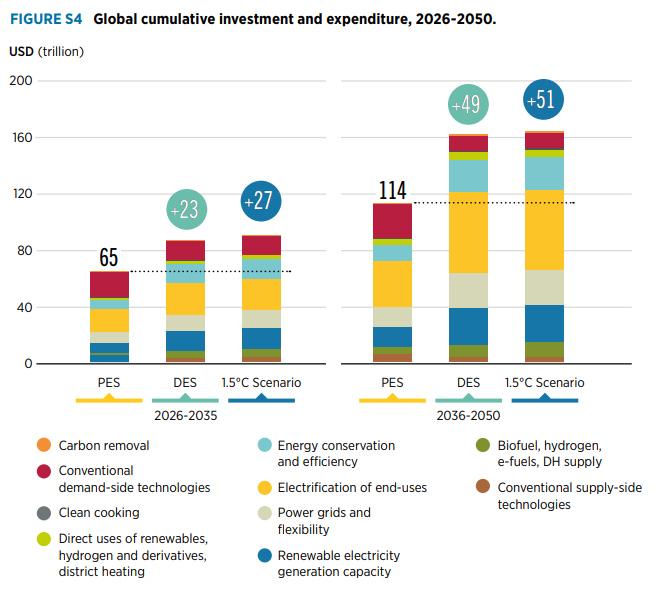
IRENA estimates that cumulative global investment and expenditure requirements under the 1.5°C Scenario would exceed $256 trillion between 2026 and 2050, equivalent to approximately $10.3 trillion annually. This is approximately $78 trillion higher than the requirement under existing government energy plans.
The agency warned that inadequate electricity grid infrastructure, insufficient energy storage, and slow improvements in energy efficiency could constrain renewable energy deployment even as generation capacity continues to expand.
Renewable Energy Capacity
Under IRENA’s 1.5°C Scenario, global renewable power capacity would increase from 5,155 GW in 2025 to 18,393 GW by 2035 and 38,232 GW by 2050.
East Asia and the Pacific would account for the largest regional renewable capacity, expanding from 2,540 GW in 2025 to 7,563 GW in 2035 and 11,815 GW by 2050.
The rest of Asia would expand capacity from 316 GW to 2,674 GW by 2035 and to 6,378 GW by 2050. This region would require approximately $7.5 trillion in cumulative renewable power investment during 2026 to 2050.
North America’s renewable capacity would increase from 612 GW in 2025 to 2,240 GW by 2035 and 4,292 GW by 2050, requiring $4.7 trillion in investment.
Europe would expand its renewable capacity from 1,071 GW to 2,418 GW by 2035 and 4,271 GW by 2050, with cumulative investment requirements of approximately $5.9 trillion.
Africa would require particularly rapid expansion, with renewable capacity increasing from 82 GW in 2025 to 607 GW by 2035 and 2,510 GW by 2050. This would require approximately $3.2 trillion in investment.
The Middle East’s renewable capacity would rise from 57 GW in 2025 to 1,064 GW by 2035 and 2,962 GW by 2050.
IRENA estimates that renewable power generation capacity alone would require approximately $41.7 trillion in cumulative global investment between 2026 and 2050.
Grid and Energy Storage Requirements
The report identifies electricity transmission and distribution infrastructure as a growing constraint on renewable energy deployment.
Annual investment in electricity grids must increase from approximately $500 billion in 2025 to $1 trillion between 2026 and 2035. The annual requirement would subsequently increase to $1.2 trillion between 2036 and 2050.
Cumulative electricity grid investment would reach almost $29 trillion through 2050.
Under the 1.5 °C Scenario, global installed energy storage capacity would need to increase from 416 GW in 2025 to 2,530 GW by 2035 and 6,860 GW by 2050.
Battery storage deployment has accelerated. Approximately 112 GW of battery storage capacity was added globally in 2025, a 48% increase from 2024 and the first-time annual additions exceeded 100 GW.
New utility-scale battery storage projects commissioned in 2025 had an average storage duration of approximately three hours, compared with two hours in 2023. An increasing proportion of projects are being developed with storage durations of four hours or longer.
Global installed pumped hydropower storage capacity reached approximately 160 GW in 2025.
IRENA estimates that the share of daily electricity system flexibility would need to increase from 7% in 2019 to more than 13% by 2035 and 30% by 2050.
The agency emphasized the need to coordinate investments in renewable generation, transmission infrastructure, storage, and system flexibility to reduce congestion and renewable energy curtailment.
Increasing electricity demand from artificial intelligence, data centers, electric mobility, and cooling systems is placing additional pressure on grid infrastructure and generation adequacy.
Electrification and Energy Efficiency
Electricity’s share of global total final energy consumption would rise from about 23% currently to 35% by 2035 and over 50% by 2050 under the 1.5°C Scenario.
Electrification would expand across transport, buildings, and industry through electric vehicles, heat pumps, electric industrial equipment, and other technologies.
IRENA estimates that renewable-based electrification and energy efficiency improvements together could account for approximately one-third of cumulative carbon dioxide emission reductions between 2026 and 2050.
However, global energy intensity has improved by slightly less than 2% annually over the past three years, compared with the approximately 4% annual improvement required to meet the global objective of doubling energy efficiency by 2030.
Under existing government plans, annual energy intensity improvements would reach approximately 3% during 2026 to 2030.
The 1.5°C Scenario requires annual improvements exceeding 4% through 2030 to compensate for recent shortfalls.
IRENA cautioned that slower energy efficiency improvements would increase the renewable generation capacity, electricity infrastructure, and investment required to meet growing energy demand.
Investment and Economic Impact
The report assesses three pathways: the Planned Energy Scenario (PES), reflecting government plans and policies through 2025; the Decarbonizing Energy Scenario (DES), which assumes accelerated renewable deployment and electrification; and the 1.5°C Scenario, which requires deeper emissions reductions.
The estimated annual investment and expenditure requirement under the 1.5°C Scenario has increased by approximately $3.8 trillion compared with IRENA’s 2023 outlook.
The agency attributed the increase to delayed implementation, updated technology costs, and additional decarbonization measures.
Under DES, average global gross domestic product would be approximately 0.7% higher than under PES through 2050, generating cumulative economic gains of approximately $32 trillion.
The 1.5°C Scenario would increase average annual global GDP by approximately 1.1% compared with PES, producing cumulative gains of approximately $47 trillion by 2050.
Average end-user electricity prices under DES would be approximately 9% lower than PES levels by 2035 and 15% lower by 2050, supported by increased renewable electricity generation and reduced exposure to fossil fuel costs.
Under DES, global renewable energy employment would reach about 84.2 million jobs by 2050, around 60% higher than under PES.
Solar energy would remain the largest renewable energy employer, accounting for approximately 38.3 million jobs.
However, the report cautioned that economic benefits would be unevenly distributed, particularly in developing economies facing high financing costs, currency risks, and limited access to capital.
Emissions and Energy Access
IRENA estimates cumulative energy-related carbon dioxide emissions between 2026 and 2050 at approximately 840 gigatons under PES, compared with 480 gigatons under DES and 400 gigatons under the 1.5°C Scenario.
The report also highlighted the role of decentralized renewable energy in expanding electricity access.
More than 565 million people in Sub-Saharan Africa remain without electricity. Approximately 60% of the additional electricity connections required by 2030, covering around 401 million people, could be provided most economically through mini-grids and standalone solar systems.
IRENA called for coordinated renewable energy deployment, electricity grid expansion, energy storage development, affordable financing, and stronger industrial policies to accelerate the transition while maintaining electricity affordability and energy security.
In a September report, IRENA estimated that global renewable energy capacity additions must more than double to achieve the target of 11.2 TW by 2030. The agency projected that maintaining the 2025 growth rate would leave the world approximately 600 GW short of the target. Meeting the target would require average annual additions of approximately 1.2 TW between 2026 and 2030.
According to an earlier IRENA report, global renewable energy capacity reached 5,155 GW at the end of 2025, following annual additions of 693 GW. Solar accounted for 514 GW of the additions, while wind contributed 158 GW. Together, the two technologies accounted for 96.9% of net renewable capacity additions.


Arjun Joshi
More articles from Arjun Joshi.