


EU Solar-Storage Jobs Near 1 Million Mark, Manufacturing Employment Dips
October 9, 2026

Follow Mercom India on WhatsApp for exclusive updates on clean energy news and insights
The European Union’s (EU) solar and battery energy storage sectors supported approximately 982,000 full-time equivalent (FTE) jobs in 2025, driven by continued solar installations and growing battery storage deployment, according to SolarPower Europe’s Solar Jobs Report 2026.
Solar accounted for 874,000 jobs, while battery energy storage systems (BESS), included in the report for the first time, contributed another 108,000 jobs.
Direct employment accounted for 44% of the combined workforce, while indirect employment across supply chains and supporting activities represented 56%.
Manufacturing employment declined by approximately 3,000 jobs from 2024.
Solar Employment
Solar employment increased by 1% year-over-year to 865,000 jobs in 2024, compared with 0.5% growth across the wider EU economy.
Solar deployment accounted for approximately 742,000 jobs, representing 85% of the sector’s workforce in 2025.
Operations and maintenance (O&M) supported a record 78,000 jobs, or 9% of total solar employment, reflecting the expansion of Europe’s installed solar capacity.
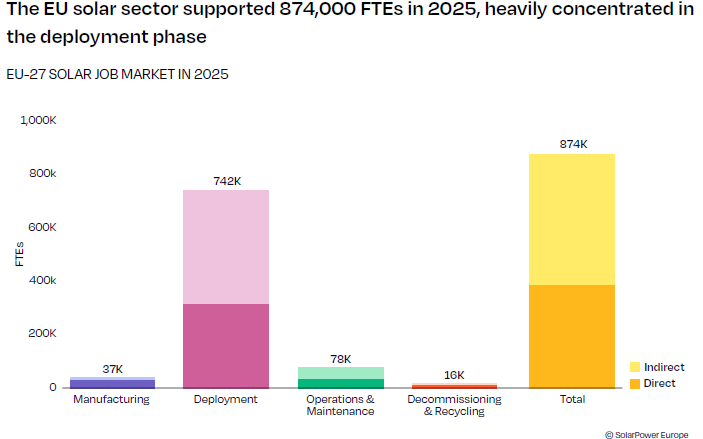
Manufacturing contributed about 37,000 jobs, or 4% of the workforce, while decommissioning and recycling supported 16,000 jobs, or 2%.
Despite the increase in overall employment, manufacturing continued to face challenges from international competition, global production overcapacity, factory closures, insolvencies, and low-capacity utilization.
Solar Manufacturing
Inverter manufacturing remained the largest source of solar manufacturing employment in the EU, supporting approximately 33,000 jobs, or 90% of total manufacturing employment.
The EU’s inverter manufacturing capacity increased by 4% in 2025 to 96.4 GW. Approximately 10 to 15 inverter manufacturers operate in Europe, with most based in Germany.
Solar module manufacturing capacity increased by 13% to 10.6 GW by the end of 2025.
However, module manufacturing employment declined from approximately 3,500 jobs in 2024 to 2,000 in 2025.
The decline was attributed to competition from imported modules, limited demand for higher-cost domestically manufactured products, and low operating margins.
Polysilicon manufacturing supported approximately 1,400 jobs, accounting for around 4% of EU solar manufacturing employment.
Solar cell manufacturing remained limited, with the EU having approximately 2.1 GW of capacity.
Germany retained specialized cell manufacturing activities through Azur Space and Oxford PV, while Meyer Burger’s insolvency affected efforts to expand domestic cell production.
Ingot and wafer manufacturing remained virtually absent.
Together, cell, ingot, and wafer manufacturing supported fewer than 500 jobs, accounting for approximately 1% of solar manufacturing employment.
Country-Wise Solar Employment
Germany remained the EU’s largest solar employer in 2025, supporting about 165,000 jobs, or 19% of total solar employment.
Spain followed closely with just under 165,000 jobs, while Italy ranked third with about 85,000.
Together, these three countries accounted for nearly half of the EU’s solar workforce.
France supported approximately 80,000 jobs, followed by Romania with 64,000, Poland with 63,000, and Bulgaria with 35,000.
Utility-Scale Solar Overtakes Rooftop Jobs
Utility-scale solar accounted for 50.2% of EU solar deployment and O&M employment in 2025, overtaking rooftop solar for the first time since SolarPower Europe began publishing its annual solar jobs report in 2021.
The utility-scale share increased from 32% in 2023 to 41% in 2024 and 50.2% in 2025.
Large-scale solar installations increased, while rooftop deployment slowed across several European markets.
Spain remained the largest utility-scale solar employer, supporting more than 120,000 jobs in the segment. Utility-scale activities accounted for 85% of Spain’s solar workforce, up eight percentage points from 2024.
Germany’s utility-scale employment share increased from 39% in 2024 to 48% in 2025, while Italy’s share rose from 33% to 42%.
2030 Solar Jobs Outlook
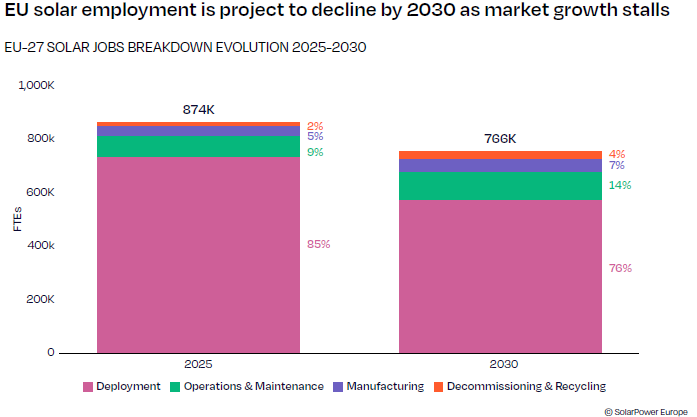
SolarPower Europe expects the EU solar workforce to decline from 874,000 jobs in 2025 to approximately 766,000 by 2030 under its medium scenario.
Annual solar installations are projected to reach approximately 70 GW in 2030, marginally higher than the 69.1 GW installed in 2025.
The report attributed the projected decline in employment to slower installation growth, rising labor costs, and productivity improvements.
Deployment employment is expected to fall by 22%, from 742,000 jobs in 2025 to 578,000 in 2030.
The segment’s share of total solar employment is projected to decline from 85% to 76%.
Unlike deployment, employment in other solar value-chain segments is expected to increase.
O&M employment is projected to rise from 78,000 jobs in 2025 to 109,000 in 2030, supported by an increase in cumulative EU solar capacity from 411 GW to 739 GW.
Manufacturing employment could rise from 37,000 to 49,000 jobs if announced manufacturing projects are commissioned and scaled successfully.
Country-Wise Employment Outlook
Germany is expected to remain the EU’s largest solar employer in 2030, with approximately 153,000 jobs, accounting for 20% of the workforce under the medium scenario.
Italy is projected to have the strongest employment growth among the leading markets, rising 24% from 85,000 jobs in 2025 to 105,000 in 2030.
Spain’s solar employment is projected to decline to approximately 102,000 jobs from nearly 165,000 in 2025.
Spain’s utility-scale employment share is projected to decline to 76%, while Romania’s is expected to increase to 52%.
Italy’s utility-scale share is projected to reach 47%, while rooftop solar is expected to account for 54% of Germany’s workforce, 64% of France’s, and 66% of Poland’s.
Battery Storage Employment
The EU battery storage sector supported approximately 108,000 jobs in 2025, according to SolarPower Europe’s first dedicated assessment of BESS employment.
Direct employment accounted for about 48,000 jobs (44%), while indirect employment accounted for 60,000 jobs (56%).
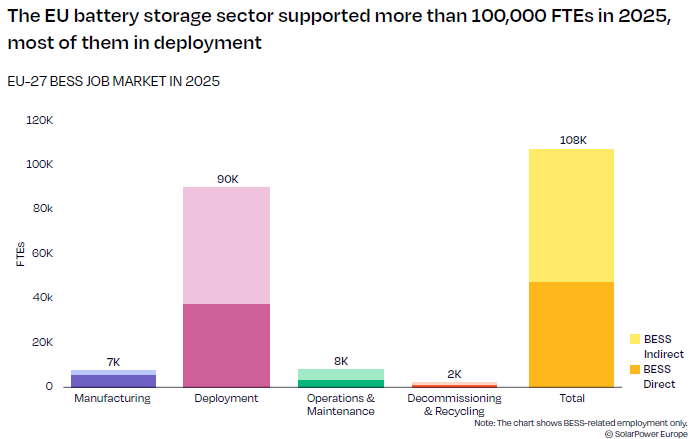
Deployment supported approximately 90,000 jobs, accounting for 84% of the sector’s workforce.
O&M contributed about 8,000 jobs, while manufacturing supported 7,000. Decommissioning and recycling accounted for approximately 2,000 jobs.
The EU added 27 GWh of battery storage capacity in 2025, bringing cumulative installed capacity to nearly 80 GWh.
Battery Manufacturing
Battery manufacturing specifically attributable to stationary storage supported about 7,000 jobs in 2025.
However, the EU’s broader battery manufacturing sector, including electric vehicle (EV) batteries and other applications, supported approximately 64,000 jobs.
Of these, 47,000 were direct jobs, and 17,000 were indirect.
EV batteries accounted for most manufacturing employment, particularly in cell production and module and pack assembly.
Together, these two manufacturing stages accounted for more than 80% of BESS manufacturing employment, supporting over 6,000 jobs.
The EU added at least 33.8 GW of solar capacity in the first half of 2026, up 1.9% from 33.2 GW during the same period last year, according to SolarPower Europe’s Market Update.
Another report says Europe installed 36 GWh of battery energy storage system capacity in 2025, marking the 12th consecutive year of record annual additions.


Rakesh Ranjan
More articles from Rakesh Ranjan.