


Europe’s Battery Storage Market Crosses 100 GWh in 2025
Europe added 19 GWh of utility-scale projects in 2025
June 30, 2026

Follow Mercom India on WhatsApp for exclusive updates on clean energy news and insights
Europe installed 36 GWh of battery energy storage system capacity in 2025, marking the 12th consecutive year of record annual additions, according to a report by SolarPower Europe.
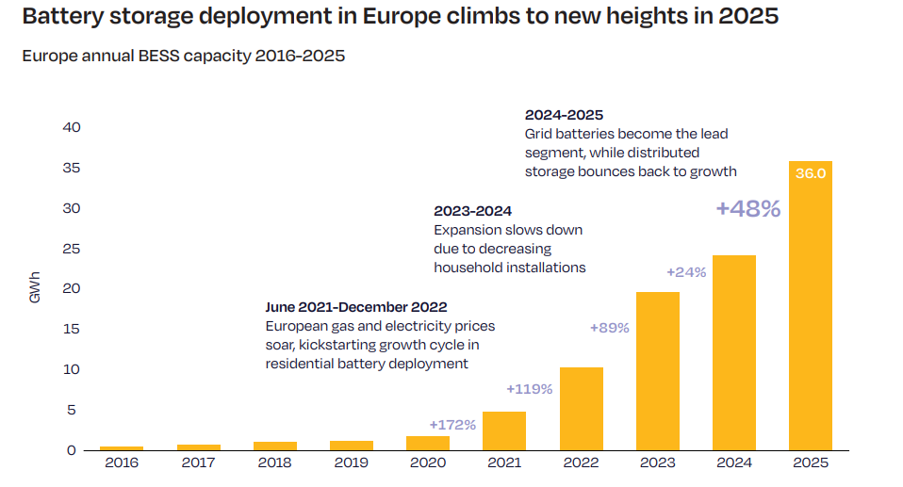
The new installations pushed the continent’s total operational battery storage capacity past the 100 GWh milestone by the end of 2025.
Annual installations grew 48% in 2025, as the contraction in the residential segment was offset by the strong growth in utility-scale storage. In 2025, utility-scale batteries led the market with 19 GWh installed, up from 9.7 GWh in 2024
The report noted that the shifting power price dynamics, supportive policy frameworks, and improving financing conditions increasingly favored utility-scale battery deployment.
A fundamental driver of battery storage deployment across both distributed and utility-scale applications is the steep decline in the production and selling prices of lithium-ion batteries, which today account for over 90% of the global stationary storage market.
The report also highlighted that hybrid projects are gaining significant traction in the European Union (EU), with around 20% of new battery energy storage system (BESS) capacity paired with solar PV, up from 6% in 2024.
Germany, the UK, and Italy remained Europe’s three largest battery storage markets in 2025, while Ukraine and Bulgaria emerged to complete the top five.
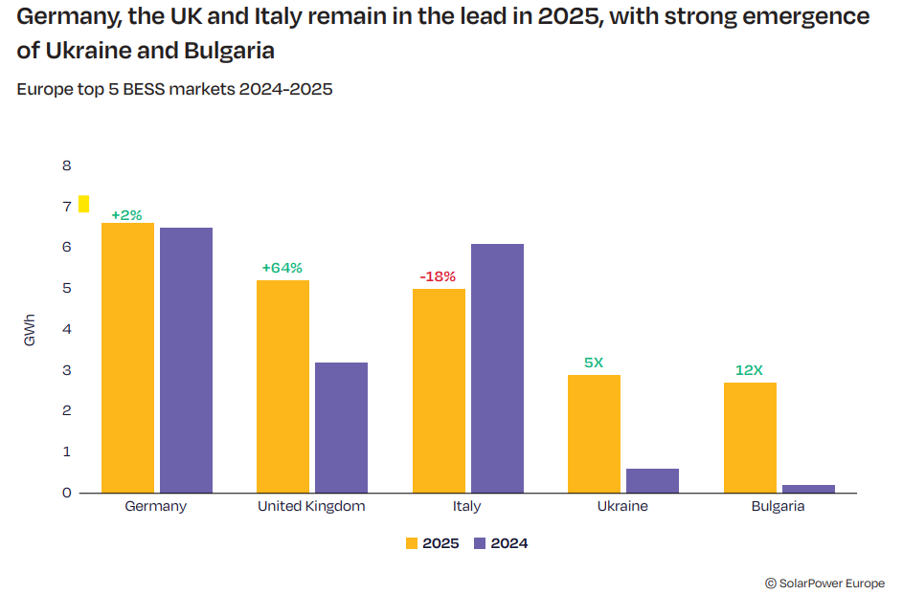
The two countries added nearly 3 GWh of battery storage capacity each in 2025.
Residential storage still accounts for the largest share of installed capacity, but its dominance is weakening. Utility-scale storage has grown rapidly, becoming the second-largest segment and is on track to overtake residential storage in 2026. The commercial and industrial (C&I) segment remains comparatively small and stable, accounting for 11% of cumulative capacity.
Despite this progress, the report highlighted that the EU continues to face a significant flexibility gap, with the EU’s solar-to-battery ratio standing at 8:1, improving from 10:1 in 2024.
Outlook
Europe’s BESS market is expected to enter a new phase of rapid expansion from 2026 onward.
Under the medium scenario, annual battery storage installations are projected to exceed 50 GWh in 2026 for the first time, representing a 44% increase from 2025.
Growth of the energy storage market will be led by the utility-scale segment, which is expected to account for nearly two-thirds of annual installations. Distributed storage is also expected to continue growing, though at a slower pace.
Residential installations are projected to regain momentum, reaching 13.2 GWh in 2026, slightly above their 2023 peak.
The C&I segment is expected to add nearly 6 GWh in 2026, reflecting strong annual growth of 26%.
Growth will be supported by the wider availability of dynamic tariffs, lower export remuneration for solar electricity, grid congestion, and rising consumer interest in energy self-sufficiency.
However, BESS cell prices are signaling an upward trend in the coming quarters, with cell prices increasing by 9% from $47/kWh at the end of 2025 to around $51/kWh by April 2026.
Since the fourth quarter of 2025, battery storage prices in Europe have started to increase due to three main factors.
First, since early 2026, some component prices have grown by more than 50%, driving an increase of over 15% in mainstream residential storage cell prices. Second, utility-scale storage demand in emerging markets such as Australia, Latin America, and the Middle East has accelerated. Third, China’s export value added tax rebate for battery products was reduced from April 2026 and is set to be phased out in 2027.
Beyond 2026, the market is projected to maintain a steep growth trajectory, with annual installations expected to reach 138 GWh by 2030. This represents a compound annual growth rate of 28% between 2026 and 2030.
By the end of the decade, Europe’s annual battery storage additions are expected to be around four times higher than in 2025.
In another report, SolarPower Europe had stated that the accelerated deployment of solar systems, combined with battery energy storage, offers the fastest and most cost-effective pathway for the EU to reach its 2030 climate and renewable energy targets.


Melvin Mathew
More articles from Melvin Mathew.