


Domestic Solar Component Manufacturing is Ramping Up Fast: Interview
Policy certainty, backward integration, and localization will strengthen India's solar manufacturing ecosystem
July 29, 2026

Follow Mercom India on WhatsApp for exclusive updates on clean energy news and insights
India has made significant headway in expanding its solar module and cell manufacturing capacities over the years. However, a globally competitive manufacturing ecosystem also requires a robust domestic supply chain for balance-of-system (BoS) and bill-of-materials (BoM) components, such as junction boxes, connectors, cables, and aluminum frames.
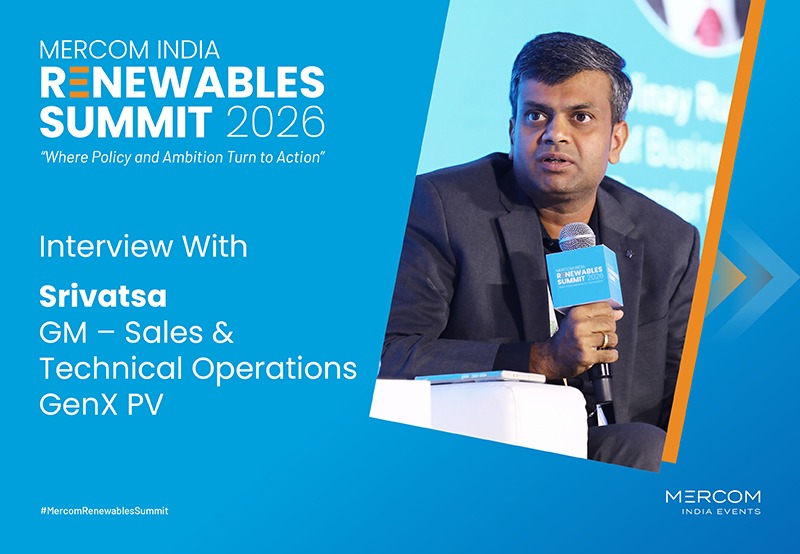
According to Srivatsa, General Manager, Sales and Technical Operations at GenX PV, the biggest advantages of India’s domestic manufacturing ecosystem are shorter lead times and easy access to technical support. Additional financial and policy support could pave the way for a scale-up in the domestic solar component manufacturing ecosystem.
In an interview on the sidelines of the Mercom India Renewables Summit 2026 on July 1 and 2 in New Delhi, Srivatsa shared his insights on localization, backward integration, domestic manufacturing, policy support, and the future of India’s solar component ecosystem.
Edited excerpts from the interview:
India has made significant progress in module and cell manufacturing. How important is it now to strengthen the domestic manufacturing of BoS and BoM components?
If you look at the industry today, India has installed module manufacturing capacity of more than 200 GW. With around 30 GW of operational capacity, cell manufacturing is catching up rapidly, and several new projects have been announced.
For junction boxes, India already has around 120-150 GW of domestic manufacturing capacity. We are seeing a clear shift from imported products to domestically manufactured components.
One of the biggest advantages of manufacturing in India is shorter lead times and readily available technical support. If any issue arises in the field, our engineering teams can visit the site and resolve it much faster than imported suppliers can.
GenX PV has expanded from manufacturing junction boxes and connectors into aluminum frames. What drove this backward integration strategy?
Backward integration has always been part of our long-term strategy.
We started with junction boxes and subsequently integrated plastic molding. We are now moving towards cable manufacturing. Over the coming years, we plan to expand to diode manufacturing. Our objective is to establish an integrated manufacturing facility where all these components are produced under one roof.
We identified aluminum frames as another opportunity because domestic manufacturing capacity in this segment is relatively limited. We plan to establish a complete manufacturing chain, from aluminum billets and extrusion to finished module frames.
Backward integration improves cost competitiveness while providing better control over quality and delivery timelines.
Today, the pricing difference between domestic products and Chinese imports has narrowed considerably. The larger concern is product dumping rather than manufacturing competitiveness.
Do you believe that India can localize the entire solar components ecosystem within the next few years?
Absolutely. For junction boxes alone, localization has already reached around 50% to 70%.
The remaining components, particularly diodes, will require additional investment and time. Over the next two years, we expect manufacturers to continue integrating backward and substantially increase localization across the value chain.
How competitive are domestically manufactured components compared to Chinese products?
From a manufacturing perspective, we are already competitive with Chinese suppliers.
The challenge arises when products are dumped into the Indian market at artificially low prices.That is where additional policy support could help domestic manufacturers compete on a more level-playing field.
What kind of policy support would benefit component manufacturers?
Junction boxes are among the few component categories for which policy protection remains limited. Currently, they attract only a 7.5% Basic Customs Duty (BCD), unlike components such as encapsulants, backsheets, or solar glass, where stronger protective measures already exist.
Additional policy support would encourage further domestic investment and accelerate manufacturing scale-up.
Module technologies continue to evolve toward TOPCon and HJT. How is GenX PV adapting to these technology transitions?
Our product portfolio has evolved with module technologies. We currently manufacture junction boxes supporting current ratings from 20 A to 35 A, covering conventional monocrystalline modules, TOPCon, M10, G12, HJT, and other advanced technologies.
We are also prepared for higher system voltages. Our products are already designed for applications up to 2,000 VDC, reflecting the way the industry is moving beyond the traditional 1,500 VDC standard.
Continuous investment in research and development enables us to keep up with evolving market requirements rather than reacting after technologies are commercialized.
Beyond financial incentives, what additional reforms would strengthen India’s component manufacturing industry?
A key area is the mandatory use of Bureau of Indian Standards (BIS)-certified DC cables. While several large projects already specify BIS-certified cables, currently there is no universal requirement across the industry.
Making BIS-certified cables mandatory would improve product quality, strengthen domestic manufacturing, and create a more uniform market for Indian suppliers.
How do you see India’s BoS component manufacturing industry evolving over the next few years?
The industry is expanding rapidly. As annual solar installations continue to increase, more domestic manufacturers are entering the market and building local production capacity.
Although component manufacturing still has room for growth, we expect domestic participation to increase significantly over the next two to five years.
How is the relationship between module manufacturers and domestic component suppliers evolving?
Initially, there was considerable resistance because module manufacturers had relied on imported components for many years.
Changing established procurement practices takes time.
However, once manufacturers began using domestically produced components and observed their field performance, their confidence gradually improved.
Being an Indian manufacturer gives us an important advantage. We can provide technical assistance, engineering support, and after-sales service whenever required.
Our products comply with all relevant IEC and BIS standards, undergo additional in-house testing, and have performed reliably in the field over the past five years. That performance has helped build customer confidence.
How do you ensure your products can withstand India’s diverse climatic conditions?
Every junction box is designed to operate under a wide range of environmental conditions. We conduct extensive temperature cycling and environmental testing to ensure reliable operation regardless of whether the modules are installed in Rajasthan, Karnataka, or any other climatic region.
These qualification tests ensure long-term reliability under real-world operating conditions.
What are GenX PV’s growth plans over the next five years?
Our primary focus is backward integration.
Today, we have nearly 50 GW of junction box manufacturing capacity. Plastic molding has already been integrated, cable manufacturing will commence shortly, and diode manufacturing will follow.
All these operations will eventually be consolidated into an integrated manufacturing facility in Bengaluru.
We are also expanding into aluminum frame manufacturing. Beyond that, we will evaluate additional diversification opportunities as the market evolves.
Do you believe India can establish a fully integrated domestic solar manufacturing ecosystem?
Yes, I believe we are already well on our way.
Most of the BoM components required for junction box manufacturing are already produced domestically.
The remaining challenge is scaling the capacity to meet growing demand.
Consistent government policy, without major changes or reversals, will enable manufacturers to invest with confidence and accelerate the development of a fully integrated domestic manufacturing ecosystem.


Rakesh Ranjan
More articles from Rakesh Ranjan.