

Daily News Wrap-Up: Key Events that Impacted India’s Solar Sector in 2025
Lowest 2025 Energy Storage Auction Tariffs [Infographics]
December 24, 2025

Follow Mercom India on WhatsApp for exclusive updates on clean energy news and insights
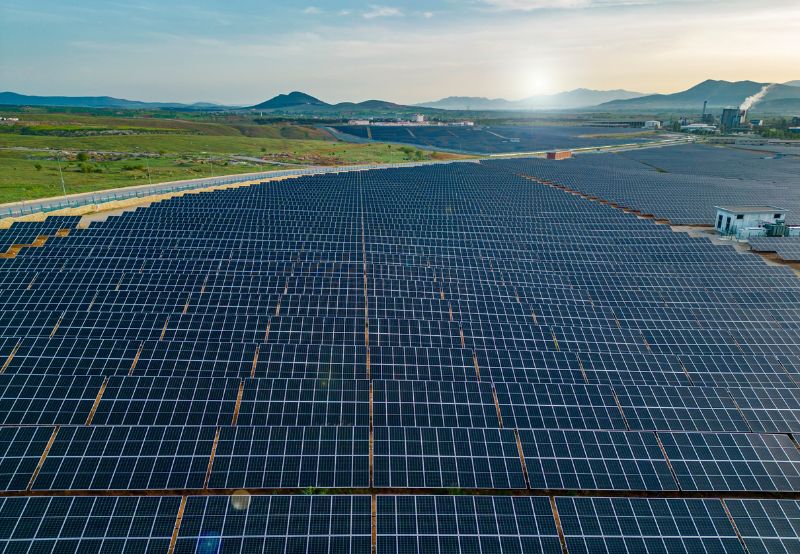
India added 26.6 GW of solar capacity in the first nine months of the calendar year 2025, an increase of 53.7% year-over-year from 17.3 GW, according to the Q3 2025 India Solar Market Update Report by Mercom India Research. Large-scale solar accounted for 81.5% of the capacity commissioned in 9M 2025, while rooftop solar contributed 18.5%.
Energy storage in India was long viewed as a niche and costly solution, with limited deployment until around 2018. High costs, immature technologies, and regulatory uncertainty constrained adoption during the early years. Since then, growing government focus, stronger policy support, and the rapid scale-up of renewable energy targets have brought energy storage into sharp focus.
The Ministry of New and Renewable Energy (MNRE) asked all state and electricity regulatory commissions to adopt machine-to-machine SIM–based remote monitoring systems for recording rooftop solar generation, potentially eliminating the need for separate solar generation meters. MNRE cited the Odisha Electricity Regulatory Commission’s recent amendment to its net metering framework as a model that other states should replicate.
The Karnataka Electricity Regulatory Commission clarified that consumers who have rooftop or distributed solar photovoltaic systems need not sign new power purchase agreements (PPAs) if they reduce or increase their contracted demand or approved load. Their existing PPA tariffs and terms will remain in effect.
The Delhi Electricity Regulatory Commission (DERC) proposed amendments to the DERC (Group Net Metering and Virtual Net Metering for Renewable Energy) Guidelines, 2019, expanding the applicability of virtual net metering to all consumers. Stakeholders can submit their objections/suggestions by December 24, 2025. The draft guidelines extend the applicability of VNM to all consumers in the National Capital Territory of Delhi, including single-point-of-supply consumers.
Kerala State Electricity Board invited expressions of interest from charge point operators for setting up electric vehicle public charging stations (EVPCS) under Category C of the PM E-DRIVE program. Bids must be submitted by January 5, 2026. Charge point operators interested in setting up EVPCS at Category C locations, such as city streets, shopping malls, market complexes, highways, and expressways with public access, can submit bids.
Energy equipment manufacturer GE Vernova’s electrification systems business won a contract from Adani Energy Solutions to supply high-voltage direct current (HVDC) technology for the 2.5 GW Khavda–South Olpad renewable energy transmission corridor in Gujarat. GE Vernova will provide advanced HVDC technology designed to operate at scale and with high reliability. This will include supplying a high-capacity ±500 kV, 2,500 MW (2 × 1,250 MW) voltage-sourced converter-based bipolar HVDC system for the point-to-point link.
GRE Renew Enertech won the Solar Energy Corporation of India’s auction to set up 1 MW rooftop solar systems at the Rashtrapati Bhavan under Tranche III of RTSPV under the renewable energy service company model. GRE Renew Enertech quoted a tariff of ₹2.7 (~$0.03)/kWh to win the entire tendered capacity. The systems will be set up in five buildings in Rashtrapati Bhavan.
Langfang Sol-Bright New Energy signed a contract with Rays Power Infra to supply water-free robotic cleaning systems for NTPC’s 250 MW solar project in Bikaner district of Rajasthan. Last January, NTPC Renewable Energy invited bids for the engineering, procurement, and construction of 500 MW (2×250 MW) grid-connected solar power projects, in which Rays Power Infra emerged as the successful bidder for a 250 MW capacity.
Luxembourg-based steel and mining company ArcelorMittal announced it will set up three renewable energy projects in India totaling 1 GW of solar and wind capacity. The three projects are expected to cost $900 million. Two of the projects will have a cumulative 800 MWh of battery energy storage capacity. All three projects are planned for implementation in Rajasthan, Gujarat, and Maharashtra.
Bondada Engineering secured an engineering, procurement, and construction order from NLC India Renewables for balance-of-systems works for setting up 810 MW solar projects at the Rajasthan Rajya Vidyut Utpadan Nigam’s solar park in Bikaner, Rajasthan. The order consists of separate BoS works for 400 MW and 410 MW. The contract’s estimated cost is ₹9.45 billion (~$105.47 million).
United Kingdom-based solar module manufacturer, Awendio Solaris, announced plans to build a multi-gigawatt TOPCon solar cell and module manufacturing facility in Canada’s Montréal-Est, Québec, with an investment of CAD1 billion (~$727.65 million). The company targets achieving 2,500 MW of annual production in the facility’s first phase. It aims to scale this capacity up to 5,000 MW in the future.
Denmark-based A.P. Moller Capital, an institutional fund manager, announced its first renewable energy investment in India through the A.P. Moller Capital – Emerging Markets Infrastructure Fund II. The investment is being made through a newly established joint venture with Rays Power Infra, a solar engineering, procurement, and construction company.
France installed 29.7 GW of solar capacity from over 1.3 million installations as of September 30, 2025, according to the country’s Statistical Data and Studies Department. This was a 10.5% year-over-year growth compared to 26.8 GW from nearly 1.2 million installations. Approximately one-third of the newly-connected capacity in 2025 comprised solar installations larger than 500 kW.


Mercom Staff
More articles from Mercom Staff.