


US Clean Energy Manufacturing Investments Plummet to $758.3 Million in Q1 2026
The country invested $3.45 billion in clean energy manufacturing in Q1 2025
June 5, 2026

Follow Mercom India on WhatsApp for exclusive updates on clean energy news and insights
Clean energy manufacturing investment in the U.S. continued to slow in the first quarter (Q1) of 2026, with businesses announcing $758.3 million in funding across 12 new electric vehicle (EV), solar, battery, and grid projects between January and March, according to a report by E2. This is a decline from the $3.45 billion invested in Q1 2025.
The investments reached $10.37 billion in 82 projects in 2025.
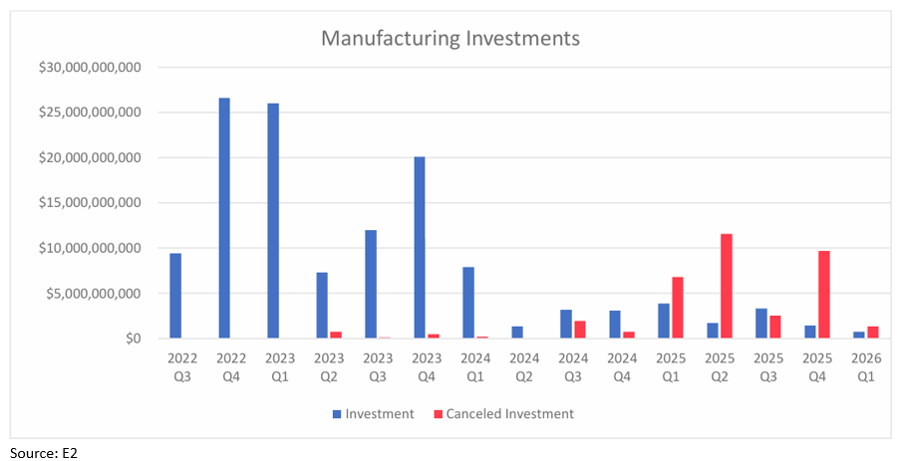
E2 attributed the decline in investment to legislation and executive orders that ended key clean energy and EV incentives and created new barriers for wind and solar projects.
Last July, President Donald Trump signed an executive order directing the Treasury Secretary to terminate clean electricity production and investment tax credits for wind and solar facilities and implement enhanced foreign entity-of-concern restrictions under the One Big Beautiful Bill Act.
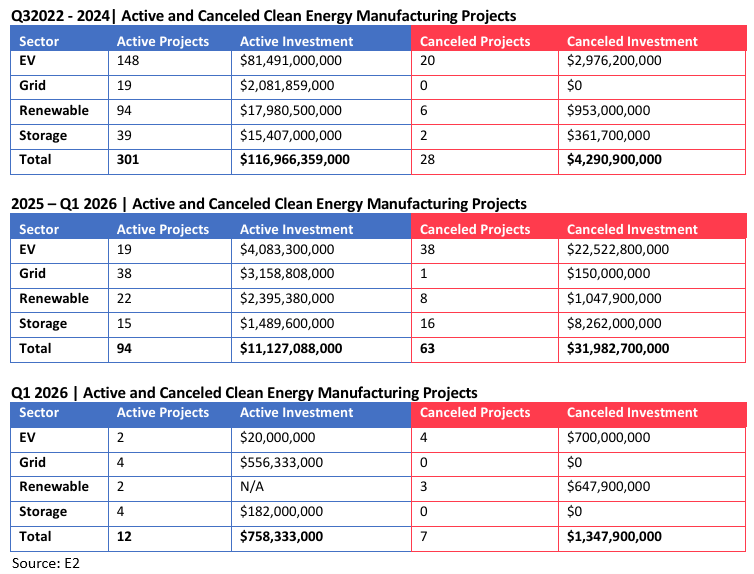
Clean energy manufacturing project reversals outpaced new investment since the beginning of 2025. During this period, companies announced 94 projects totaling $11.13 billion and 26,114 jobs, while 63 projects involving nearly $32 billion and 46,003 jobs were canceled or scaled back.
E2 had earlier reported that over 3.5 million Americans were employed in clean energy occupations across renewable energy generation, battery and storage, energy efficiency, biofuels, grid modernization, and clean vehicle industries by the end of 2024.
EV assembly and parts supply were the most volatile segments, with major downsizing by EV manufacturers, reflecting instability in the sector’s supply chains and slower market growth after domestic EV incentives were eliminated.
In contrast, grid equipment manufacturing, particularly transformers and distribution equipment, experienced stable growth due to continued demand for grid modernization and transmission infrastructure.
Manufacturing by State
During Q1, manufacturing announcements were concentrated primarily in North Carolina, South Carolina, Indiana, Mississippi, and Arizona.
Many of these states also witnessed significant cancellations or downsizes, however, specifically in the EV and battery segments.
In states such as North Carolina, several companies announced new transformer and solar manufacturing facilities. In contrast, EV production and component companies announced significant downsizes.
Differing Market Trends
EV manufacturing led the growth in announced investment from the passage of the federal energy tax credits to the end of 2024, accounting for roughly $81.5 billion, followed by renewable energy manufacturing and battery storage supply chains.
E2 tracked 301 planned and still-active manufacturing projects during this period, representing nearly 117 billion in announced investment.
Cancellations were limited to 28 projects with $4.3 billion in abandoned investment.
E2 recorded only 94 announced projects, worth approximately $11.1 billion, from the beginning of 2025 through Q1 2026. During this period, 63 projects were canceled, closed, or downsized, resulting in nearly $32 billion in abandoned investment.
In contrast to growth through the end of 2024, EV and battery-related manufacturing experienced the largest losses from 2025 onward. This includes over $22.5 billion in canceled EV investment and over $8.2 billion in battery and storage investment.
During Q1 2026, seven projects worth nearly $1.35 billion were canceled, closed, or downsized.
Grid equipment manufacturing was one of the few segments to expand during the quarter.
Q1 2026 Generation Overview
However, despite rising uncertainty in the clean energy sector, announcements of utility-scale clean energy generation continued to increase during Q1 2026. This was driven by developers rushing to begin construction before federal tax credits for solar and wind projects expired.
Clean energy developers announced 54 utility-scale generation and storage projects totaling 12.36 GW during the quarter. This was nearly double the 28 active projects announced in all of 2025. Developers sought to qualify clean energy projects before the July 4, 2026, construction-eligibility deadline under the One Big Beautiful Bill Act.
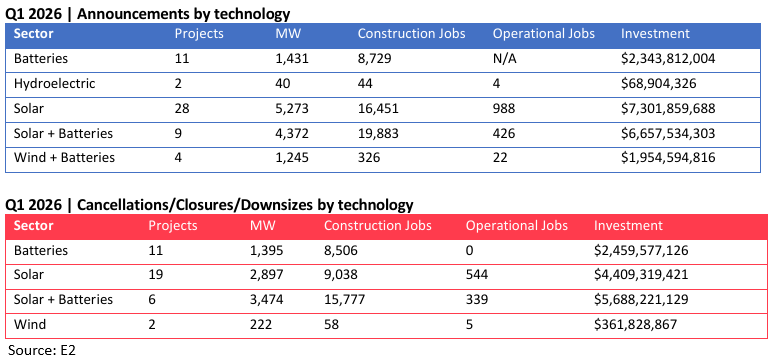
The announced projects in Q1 2026 represented $18.33 billion in investment, 45,433 construction jobs, and 1,440 operational jobs. Solar led with 28 projects, totaling 5.27 GW of capacity and $7.3 billion in investment. It was followed by nine solar-plus-storage projects totaling 4.37 GW and $6.66 billion in investment. Battery storage accounted for 11 projects totaling 1.43 GW and an investment of $2.34 billion.
However, cancellations also accelerated during the quarter. Clean energy project developers canceled or downsized 38 generation and storage projects totaling 7.99 GW, $12.92 billion in lost investment, and 33,379 lost construction jobs.
Solar, battery storage, and hybrid projects accounted for most of these losses, including 19 solar projects totaling 2.9 GW and six solar-plus-storage projects totaling 3.47 GW.
Market Changes by Geography
Texas remained the leading market for both new generation announcements and cancellations, with over 3 GW of new solar and storage announcements and more than 1.6 GW of cancellations across solar and storage projects.
In California, announcements for major projects, including the Darden Solar project and Grace Energy Center, would add 3.5 GW of planned capacity and approximately $5.5 billion in estimated investment from just the two projects.
In North Carolina, Siemens Energy and TSEA Energy announced more than $165 million in manufacturing investments and 627 jobs in Q1. However, VinFast’s downsizing and other reversals pushed cumulative statewide manufacturing job losses above 7,600 since 2022.
In Ohio, Honda canceled two supply chain projects valued at $700 million and over 560 jobs. However, it secured investment in generation through Harvey Solar and in two hydroelectricity projects.
New York witnessed the cancellation of over 400 MW of solar and storage projects, valued at approximately $625 million. This included the cancellation of the 300 MW Hecate Grid Intrepid project.
According to E2, battery storage announcements in some regions were nearly offset by cancellations elsewhere. Since 2025, 123 generation and storage projects totaling 21.35 GW have been canceled.
However, compared to all of 2025, utility-scale solar and storage project announcements improved in Q1 2026.
Clean energy investments during the quarter remained concentrated in Republican-held Congressional districts. These districts recorded 44 project announcements worth $8.8 billion, totaling 5.5 GW.
Democrat-held districts announced 22 projects valued at $10.2 billion, also totaling 5.5 GW in capacity.
Republican districts witnessed 36 project cancellations, resulting in $12 billion in losses and 6.6 GW of clean energy capacity. However, Democrat-held districts saw nine cancellations, resulting in $2.1 billion in investment and 1.3 GW of clean power generation capacity lost.
Since 2025, Republican districts have attracted $21 billion in clean energy investment but have lost over $49 billion due to project cancellations. Democrat-held districts gained and lost $16 billion each.


Parth Shukla
More articles from Parth Shukla.