Upcoming Noida Airport to Meet 50% Power Needs with Renewables
The airport will procure 23.8 MW of renewable energy to run its daily operations
Follow Mercom India on WhatsApp for exclusive updates on clean energy news and insights
Clean energy and sustainability are at the core of the upcoming Noida International Airport (NIA) in Jewar, Uttar Pradesh. The airport plans to meet at least 50% of its electricity needs from renewable energy.
To reach this target, NIA will procure a cumulative 23.8 MW of renewable power to meet its massive power needs.
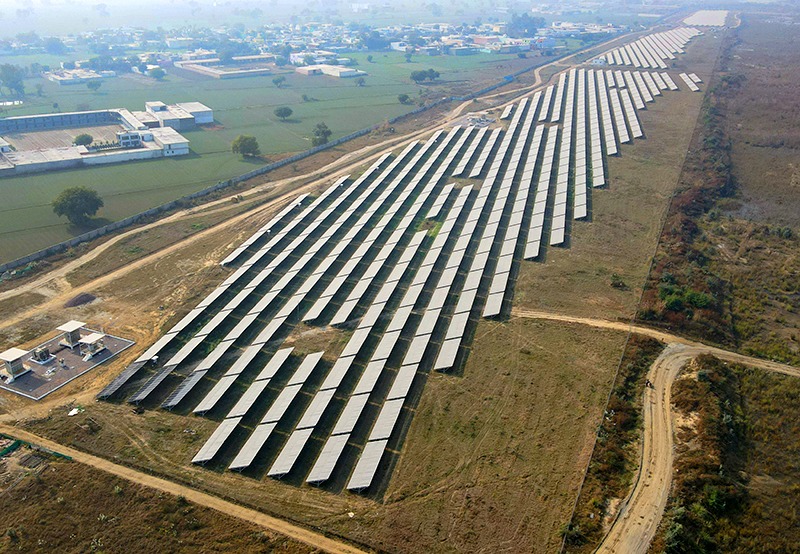
To meet its renewable goals, NIA has signed a power purchase agreement with Tata Power Trading Company (TPTCL) to procure 13 MW of solar power from an on-site solar project and 10.8 MW from an off-grid wind project.
The on-site solar project comprises 23,000 installed bifacial solar modules. To avoid reflections that could affect flight safety, the panels have an anti-reflection coating.
The solar system is supported by 34 maximum-power-point-tracking inverters operating on a 1,500 V DC system.
Power generated by the solar facility is consumed on-site to support the airport’s operational requirements during solar generation hours, reducing dependence on the conventional grid.
The renewable energy project at NIA has been structured under a build–own–operate–transfer model, eliminating the need for upfront capital expenditure.
NIA said the main challenge in setting up the project was developing a large-scale solar project within the airport while aligning with aviation safety norms, electrical and fire safety standards, and the technical requirements of numerous stakeholders, including airport operators, utility providers, and regulators.
In the first phase of its operations, the airport will handle 12 million passengers per year. Under this phase, the airport will operationalize one terminal and one runway. But NIA plans to expand its passenger capacity to 70 million per year, with two runways and two terminals.
Spread over 1334 hectares, the NIA airport will connect the Greater Delhi region and Western Uttar Pradesh to major cities in India and the world.
The airport is being developed by Yamuna International Airport, 100% subsidiary of Zurich International Airport AG.
Future Plans
NIA said it plans to achieve 100% renewable energy use in its operations.
Christoph Schnellmann, Chief Executive Officer at NIA, said that building on its current mix of on-site solar and off-site wind power, the airport will continue to assess future expansion opportunities in line with operational demand, technological advancements, regulatory frameworks, and commercial viability.
He noted that based on current and projected operational energy demand patterns, NIA plans to explore the deployment of energy storage solutions where they are technically and commercially feasible.
Schnellmann said that detailed feasibility assessments and aviation safety clearances, particularly anti-glare studies, must be concluded before NIA can set up a rooftop solar system.
He explained that rooftop solar systems near runways and airside zones can pose potential risks if panel reflections create glare that may interfere with pilot visibility during critical phases of aircraft approach and landing or affect air traffic control operations.
NIA has also partnered with Mahindra Logistics Mobility to introduce a 100% electric, NIA-branded taxi fleet, offering premium, round-the-clock services with zero tailpipe emissions.
Mercom India hosts a pan-India ‘C&I Clean Energy Meet’ series, bringing renewable energy developers and commercial and industrial power consumers together to discuss options for adopting renewable energy. The next event will be held in Bhopal on March 13, 2026.