


Solar to Meet Over 20% of Global Power Demand by 2035: IEA
Solar and wind’s share of global power generation rose to 17% in 2025 from 4% in 2015
November 20, 2026

Follow Mercom India on WhatsApp for exclusive updates on clean energy news and insights
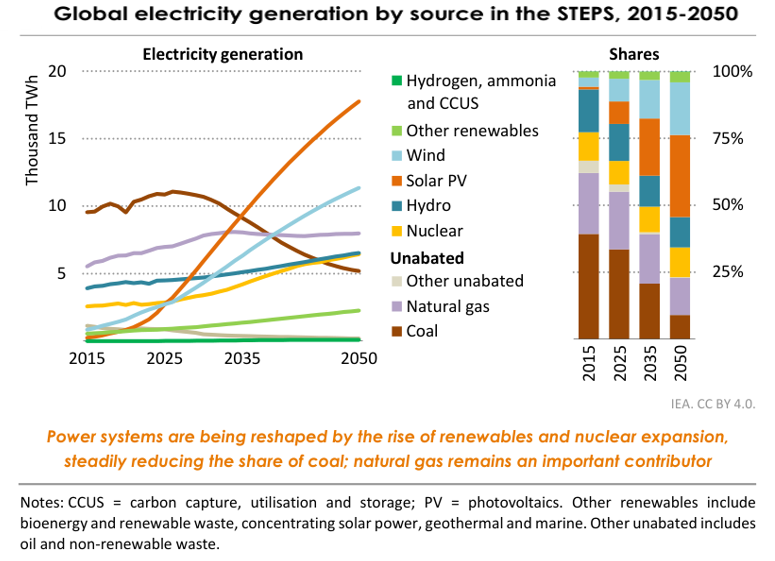
Solar power is projected to account for just over 20% of global electricity generation by 2035, followed by wind at nearly 15%, according to a report by the International Energy Agency (IEA).
IEA’s report outlines three scenarios: Current Policies (CPS), based on existing policies; Stated Policies (STEPS), factoring in proposed policies and market trends; and Net Zero Emissions by 2050 (NZE), mapping a net-zero pathway.
Under STEPS, renewables could generate two-thirds of global electricity by 2050. Solar and wind’s combined share rose from 4% in 2015 to 17% in 2025.
The IEA expects global electricity demand to grow by 3.2% annually through 2035 under STEPS, adding 10,500 TWh. India and Southeast Asia are projected to record annual growth of 6% and 5%, respectively, contributing a combined 2,100 TWh.
Rising air-conditioning and appliance use, electrification of transport and industry, and expanding data centers are expected to drive demand growth. Cooling and appliances alone are projected to account for nearly 30% of the increase, or 2,900 TWh. Electric vehicle adoption and growing electricity requirements for artificial intelligence and digital infrastructure will add further demand, alongside the shift from fossil fuels to electricity in industrial processes.
Renewable Capacity Additions
Solar accounted for more than half of the record 1,100 GW of new power generation capacity installed worldwide in 2025. Annual solar additions reached approximately 635 GW, raising installed solar capacity above 2,800 GW. China added nearly 400 GW, while the European Union, India, and the United States also contributed to installations.
Wind capacity additions increased 34% to 155 GW in 2025. Solar generation rose by 600 TWh during the year, while wind generation increased approximately 8%. Solar accounted for nearly 30% of global energy demand growth in 2025.
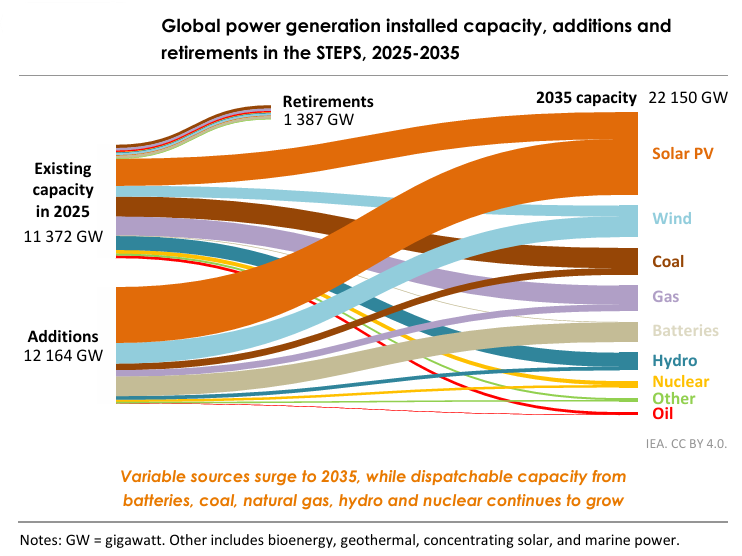
Under the CPS scenario, renewable energy is expected to account for two-thirds of global power capacity additions between 2025 and 2035. Installed global power capacity is projected to increase from 11,372 GW in 2025 to 21,131 GW by 2035, with renewables constituting the majority of installed capacity.
The Net Zero Emissions by 2050 (NZE) Scenario requires global renewable capacity to increase from 5,800 GW in 2025 to 20,500 GW by 2035. Annual solar installations would need to exceed 1,200 GW and wind installations reach 450 GW by 2035, taking cumulative capacity to approximately 13,000 GW and 5,000 GW, respectively. Renewables would supply 75% of global electricity by 2035 under this scenario.
Battery Storage Expansion
Global battery storage capacity stood at nearly 300 GW in 2025. The IEA projects capacity of approximately 1,800 GW under CPS and more than 2,100 GW under STEPS by 2035. Under NZE, the capacity would need to exceed 3,300 GW, with annual additions averaging 330 GW over the next decade.
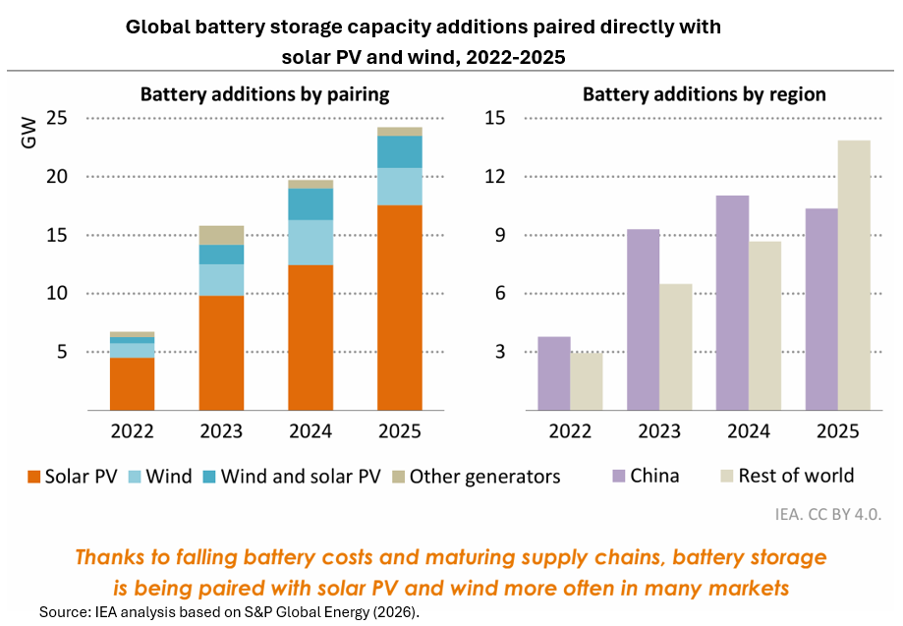
Utility-scale battery additions increased more than 55% to 93 GW in 2025. Nearly 25 GW was installed alongside renewable projects, approximately 20% more than in 2024, accounting for just over a quarter of utility-scale additions. About two-thirds of operational co-located batteries are paired with solar, 20% with wind, and 10% with hybrid solar and wind projects.
Utility-scale battery storage prices fell nearly 40% in 2025, supported by manufacturing improvements, lower mineral prices, and greater use of lithium iron phosphate batteries. This chemistry accounted for more than 90% of new stationary storage installations worldwide.
The IEA estimates that upfront battery costs have declined approximately 90% since 2010. From 2025 to 2035, battery costs are projected to fall another 30%, compared with 35% for solar and 10% for onshore wind. Combining solar, wind, and storage could provide near-continuous electricity, with hybrid systems achieving capacity factors approaching 95%.
Grid Integration and Flexibility
Increasing renewable generation will require additional grid capacity and flexibility. Global short-term power system flexibility requirements could rise to 2.2 times their 2025 level under CPS and 2.4 times under STEPS by 2035. Batteries could provide approximately 30% and 40% of these requirements, respectively, with demand response contributing another 20% under both scenarios.
In India, short-term flexibility requirements could nearly triple under CPS and increase to almost 3.5 times their 2025 level under STEPS. The IEA said battery storage can shift surplus midday solar generation to evening demand periods. In 2025, India’s average midday residual load was approximately 25% below its evening peak.
Energy-efficient, grid-interactive buildings can help manage peak power demand, improve system flexibility, and enable large-scale integration of renewable energy to address grid strain caused by rising building energy demand in India.
Global electricity networks currently extend over 85 million km.
Renewable projects awaiting grid connections have reached 3,000 GW globally, increasing 60% in one year.
Investment Outlook
Under STEPS, global power sector investment is projected to average nearly $1.7 trillion annually through 2035. Solar investment is expected to rise 30% to $345 billion annually, while wind investment increases 70% to nearly $240 billion. Battery storage investment is projected to grow more than fivefold to $110 billion, including $78 billion for utility-scale systems. Transmission and distribution investment is expected to increase 75% to $580 billion annually.
India’s investment in low-emissions power generation is projected to nearly triple to approximately $60 billion annually under STEPS, while utility-scale battery investment averages $7 billion annually. Grid and storage investment in India is expected to more than double.
Under NZE, average annual renewable energy investment would need to triple to $1.4 trillion through 2035. Annual investment in grids and storage would need to reach approximately $525 billion and $150 billion, respectively. The IEA also projects that under NZE, demand for copper and lithium would be 20% and 70% higher than under STEPS by 2035.


Parth Shukla
More articles from Parth Shukla.