Plastic Products Maker in Tamil Nadu Goes Solar, Saves ₹8 Million Annually

The 750-kW rooftop solar system generates 114,000 units of electricity per month

December 31, 2025

thumbnail

Follow Mercom India on WhatsApp for exclusive updates on clean energy news and insights


Industries with high power consumption can use their roof space to install solar. By shifting to solar, companies can not only become sustainable but also lower their electricity costs.

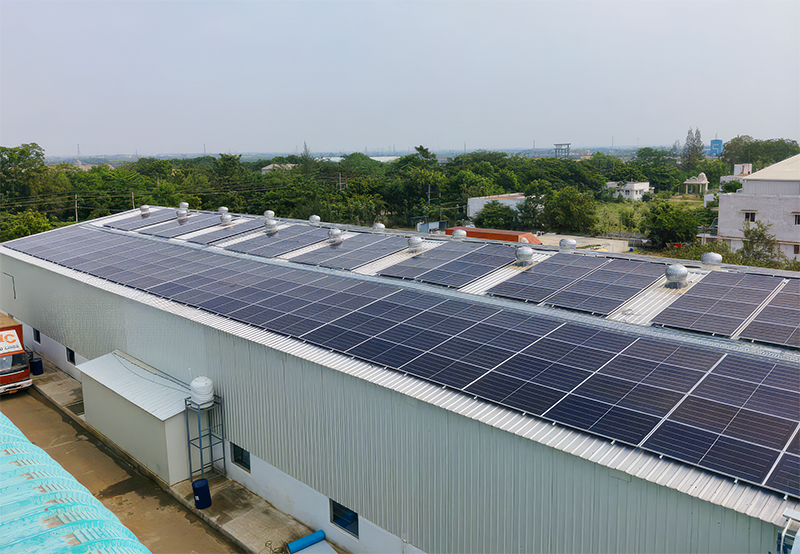
A Tamil Nadu-based plastic products manufacturer, Abhirami Pet Industries, is saving ₹8 million (~$88,979) annually through a 750 kW rooftop solar system, installed at Abhirami Pet’s manufacturing facility in Tirunelveli.

Abhirami Pet has an estimated monthly electricity expenditure of ₹3.67 million (~$40,819) and an estimated annual expenditure of ₹44.04 million (~$489,830). It’s vital that such industries explore avenues to reduce costs and remain sustainable.

Chennai-based Inforce Solar suggested that Abhirami Pet invest in a rooftop solar system.

With ample unutilized roof space, Inforce Solar installed the solar system at a cost of ₹25 million (~$278,060).

The rooftop system was set up using Navitas Solar’s 585 Wp Mono PERC modules and Solis’ 150 kW inverters. The project was set up and commissioned within 20 days.

The solar system generates around 3,800 units daily and 114,000 units per month, meeting nearly 75% of Abhirami Pet’s power consumption.

The project is expected to attain payback within 3.5 years.

While the intermittency of solar power can be addressed through battery energy storage systems (BESS), high costs and prior dependence on diesel generators prevented Abhirami Pets from investing in a solar-plus-storage solution.

Experts addressing commercial and industrial unit owners at Coimbatore in June noted that adding BESS to solar projects can save business owners about ₹10 (~$0.115)/kWh to ₹15 (~$0.172)/kWh, assuming the cost of operating diesel gensets is around ₹21 (~$0.242)/kWh.

According to Mercom India Research, India added 2.1 GW of rooftop solar capacity between July and September 2025. The industrial segment accounted for nearly 20% of the quarter’s installations, while residential installations accounted for 73%.

For residential consumers, the largest incentive has been the subsidy provided by the central government, and for the commercial and industrial (C&I) segment is the tax benefit and savings on electricity costs. Tamil Nadu-based installers say that C&I consumers can source power from rooftop solar installations at ₹4 (~$0.046)/kWh to ₹5 (~$0.057)/kWh for 25-30 years, whereas the grid tariffs are escalated year-over-year.

In Tamil Nadu, tariffs for commercial and industrial units have been increased by 3.3% and 3.4% respectively, compared to the previous financial year. These tariff hikes have improved the economics of rooftop solar, enabling businesses to hedge against rising electricity costs and strengthening the viability of projects, especially in states with robust industrial activity.

To raise awareness among businesses about the benefits of shifting to solar, the financial benefits, new approaches, and the nuances of adding battery energy storage systems, Mercom India hosts a pan-India ‘C&I Clean Energy Meet’. The next event will be held in Nashik on January 9, 2026, and in Coimbatore on February 5, 2026.

RELATED POSTS

Get the most relevant India solar and clean energy news.

RECENT POSTS