


India’s Battery Storage Additions Jump 84-Fold to 8.2 GWh in 1H 2026
Standalone battery storage accounted for 83% of cumulative installations
September 10, 2026

Follow Mercom India on WhatsApp for exclusive updates on clean energy news and insights
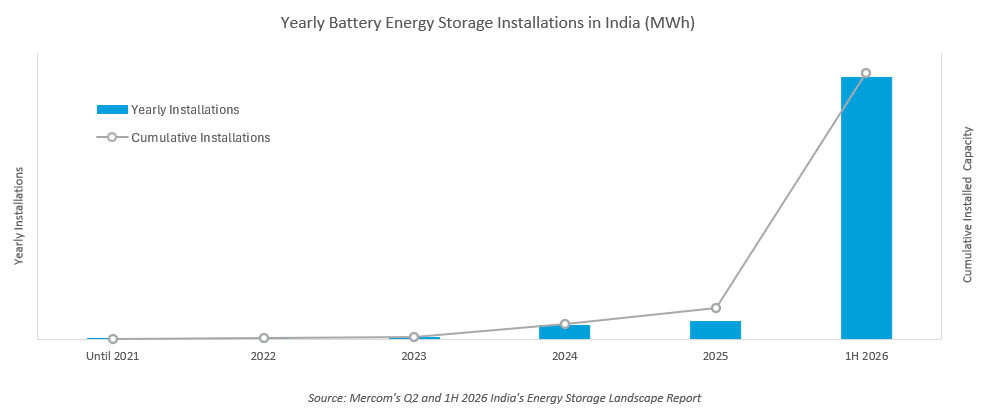
India added 8.2 GWh of battery energy storage capacity in the first half (1H) of 2026, nearly 84 times the 98.4 MWh installed during the same period last year, according to Mercom India Research’s newly released Q2 and 1H 2026 India’s Energy Storage Landscape Report.
Cumulative installed battery energy storage capacity reached 9.3 GWh at the end of June 2026, indicating a sharp acceleration in deployments as utilities increasingly turn to storage for grid balancing, peak demand management, and renewable energy integration.
However, the steep year-over-year increase must be viewed in the context of India’s still-nascent utility-scale storage market. Unlike solar, where installations have reached a scale that allows clearer quarterly trends to emerge, battery storage additions can fluctuate depending on the commissioning of a few large projects.
According to Priya Sanjay, Managing Director at Mercom India, several projects that had been pending were commissioned during the period.
With more utility-scale projects now approaching commissioning, installations are expected to rise from here. However, it is still too early to establish a consistent quarterly trend from the current numbers, she said.
Standalone Storage Leads
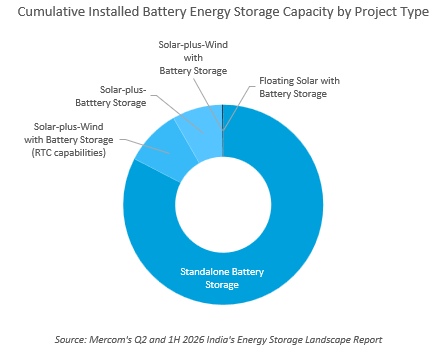
Standalone battery energy storage accounted for 83% of India’s cumulative installed capacity as of June. Solar-plus-wind projects with storage offering round-the-clock capabilities accounted for 9%, while solar-plus-storage projects represented another 8%.
The dominance of standalone storage, however, does not necessarily indicate that the market has decisively shifted toward this project configuration.
Sanjay said a few large standalone projects commissioned during the period significantly influenced the overall numbers. These installations are primarily utility-driven and are linked to auctions conducted earlier.
As utilities begin seeing storage’s ability to manage peak demand more economically, more distribution companies are expected to follow with their own tenders and projects. Standalone projects could also move relatively quickly because they do not have to wait for the development and commissioning of associated renewable generation assets.
“India’s energy storage installations spiked in 1H 2026 as large-scale standalone battery storage projects moved from tenders and policy announcement phase to installations on the ground. The need for storage is growing with rising solar additions, higher daytime generation, rising curtailment, and harder-to-meet evening demand. The outlook is strong, with a large pipeline, but growth will depend on how quickly tendered capacity moves to auctions and awards, and whether projects have bankable contracts, reliable grid infrastructure, stable supply chains, and workable project economics,” said Raj Prabhu, CEO of Mercom Capital Group.
Rajasthan led cumulative installed battery storage capacity with a 36% share, followed by Gujarat at 20% and Maharashtra at 5%. Together, the three states accounted for more than 60% of the country’s installed capacity.
States with a high share of renewables in their electricity mix are likely to see greater storage deployment as utilities seek resources to balance variable generation. Sanjay said utilities and distribution companies are expected to lead much of this deployment because they need to balance electricity at the substation and transformer levels.
This could result in larger standalone storage projects being concentrated in renewable-rich states such as Rajasthan and Gujarat before deployment expands to other markets.
Q2 Installations Decline
India added 3.6 GWh of battery storage capacity during the second quarter (Q2) of 2026, down 22% quarter-over-quarter from record installations in Q1. Standalone battery storage accounted for nearly 98% of quarterly additions, with solar-plus-storage accounting for the remainder.
As deployment scales, the industry’s challenges are also changing. Project execution and long-term performance are becoming increasingly important, with commissioning schedules, system availability, cycling performance, safety, degradation, lifecycle economics, and contract structures emerging as key considerations.
Grid connectivity remains one of the primary execution bottlenecks. Renewable energy-plus-storage projects face the additional challenge of synchronizing storage commissioning with the associated generation assets.
Supply chain dependence is another concern, particularly for standalone utility-scale storage. The industry’s reliance on imports exposes projects to equipment availability as well as battery price and currency fluctuations, Sanjay said.
Tender-Auction Gap Widens
Battery storage procurement also accelerated sharply during the first half of the year. Storage tenders totaled 28 GW during 1H 2026, while approximately 9 GW was auctioned.
The widening gap partly reflects an industry still searching for the right price for storage.
Sanjay said battery prices and discovered tariffs remain volatile. When a recent auction produces substantially lower prices, procurers may wait before conducting another auction in the expectation that prices could fall further. Conversely, rising prices can encourage buyers to move more quickly.
This uncertainty over the optimum price is contributing to the lag between issuing tenders and completing auctions, she said.
Government support will therefore remain important as the market builds scale. Interstate transmission system charge waiver extension and the expanded viability gap funding program could support further deployment.
Sanjay said such measures are particularly important during the initial phase of the storage market. VGF and ISTS charge waivers can help enable large-scale utility projects, creating the deployment volumes needed to bring costs down. As storage achieves scale and becomes commercially viable, support mechanisms could eventually be tapered, similar to the evolution of India’s solar market.
With the significant development pipeline, installations are expected to continue rising. Sanjay said that barring an unforeseen event that sharply affects prices or disrupts project execution, there is little reason for installations not to move upward.
Mercom India’s Q2 and 1H 2026 Energy Storage Landscape report provides a comprehensive analysis of India’s battery and pumped storage markets, including installations, project pipelines, tenders and auctions, state-level markets, policies, project economics, technology trends, and key growth and execution challenges.
For the complete report, visit: https://www.mercomindia.com/product/india-energy-storage-landscape-q2-2026. This report is valuable for understanding India’s energy storage market landscape, policies driving capacity additions, and the expansion trajectory.


Arjun Joshi
More articles from Arjun Joshi.