


India’s Q3 Renewable Policy Shifts: What the Industry Needs to Know
The report analyzes more than 100 policy and regulatory developments and their implications for the renewable energy industry
October 29, 2026


Follow Mercom India on WhatsApp for exclusive updates on clean energy news and insights
India’s renewable energy policies increasingly focused on improving project execution, grid stability, transmission connectivity, and reliable power delivery during the third quarter (Q3) of 2026, according to Mercom India’s Q3 2026 Renewable Energy Policy Impact Report.
The report examines more than 100 policy and regulatory developments affecting utility-scale renewable energy projects, battery energy storage systems (BESS), domestic manufacturing, open access, rooftop solar, and transmission infrastructure
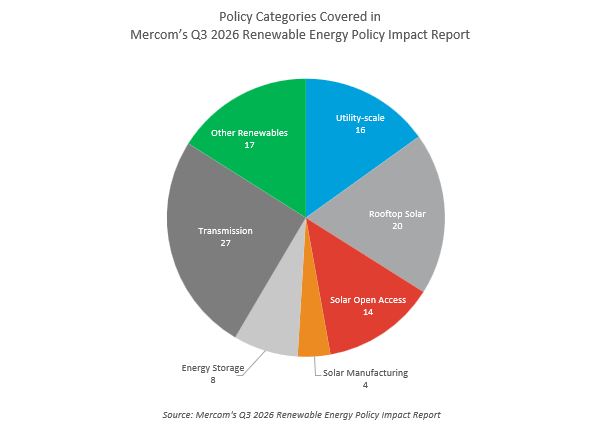
As renewable energy capacity expands, policymakers are placing greater emphasis on technical compliance, forecasting accuracy, infrastructure utilization, and storage integration.
These developments could create investment opportunities across the renewable energy value chain. However, stricter technical standards, scheduling requirements, and compliance obligations could also increase project costs and affect tariff competitiveness.
“Renewable energy growth is putting more pressure on the grid, transmission networks, and project economics. The policy changes in Q3 reflect that reality. Developers will face higher technical, scheduling, and compliance requirements, while storage, transmission, grid technologies, and domestic manufacturing are creating new opportunities. The key will be making sure policy changes improve reliability without adding unnecessary costs or slowing project development,” said Raj Prabhu, CEO of Mercom Capital Group.
Grid Stability and Project Execution Take Priority
The report identifies a growing emphasis on aligning renewable energy development with grid requirements and commercial readiness.
Changes to technical standards, deviation settlement mechanisms, and transmission connectivity regulations could improve grid reliability and infrastructure utilization. However, they may also increase engineering, procurement, construction, and operational costs.
For renewable energy developers, these developments reinforce the importance of accurate forecasting, effective scheduling, technical compliance, and contractual risk management.
Transmission infrastructure and grid modernization are also emerging as investment opportunities as policymakers seek to improve connectivity utilization and address project execution challenges.
The report indicates that developers with stronger technical capabilities, disciplined project planning, and effective cost management could be better positioned to manage the evolving regulatory requirements.
Storage and Manufacturing Present Growth Opportunities
Battery energy storage is increasingly gaining importance as a resource for grid stability, extending beyond conventional energy shifting and peak-demand management.
The growing regulatory focus on grid-support capabilities and improved infrastructure utilization could create opportunities for storage developers, equipment manufacturers, and technology providers.
Domestic solar manufacturing is also undergoing changes as the industry expands capacity and moves toward advanced technologies.
The report highlights the importance of strengthening domestic supply chains, improving manufacturing efficiency, and investing in technological upgrades.
Trade-related developments and changing international market requirements could further influence manufacturers’ investment decisions, export strategies, and long-term competitiveness.
Open Access and Rooftop Solar Economics Evolve
Changes to banking regulations, energy settlement mechanisms, and renewable power procurement requirements are influencing the economics of open access projects for commercial and industrial (C&I) consumers.
The report emphasizes the importance of aligning renewable energy procurement with electricity consumption patterns to minimize energy losses and manage costs.
Hybrid renewable energy procurement, battery storage, and energy management systems could become increasingly relevant for businesses seeking greater flexibility and reliable power supply.
Residential rooftop solar also received additional policy support during the quarter, creating opportunities for developers, engineering, procurement, and construction companies, and equipment suppliers.
However, growing requirements related to equipment compliance, digital monitoring, and installation quality could increase operational responsibilities and costs.
The report also looks at the growing importance of digital monitoring, secure data management, and grid coordination as renewable energy penetration increases.
“Companies can no longer look at policy changes in isolation. Transmission availability, storage requirements, forecasting rules, open access charges, and equipment standards can all affect the same project. Developers and investors need to understand how these changes work together before they bid, procure equipment, or commit capital,” added Prabhu.
For developers, manufacturers, utilities, and investors, the evolving policy landscape places greater emphasis on project bankability, technical capabilities, infrastructure readiness, and reliable power delivery.
The report assesses the implications of these developments for industry stakeholders, identifying emerging investment opportunities, potential regulatory risks, and factors likely to influence renewable energy project economics and competitiveness.
For the complete report, visit:https://www.mercomindia.com/product/q3-2026-renewable-energy-policy-impact


Arjun Joshi
More articles from Arjun Joshi.