



Q3 2026 RENEWABLE ENERGY POLICY IMPACT – INDIA’S RENEWABLE ENERGY POLICIES TARGET GRID STABILITY AND PROJECT ROADBLOCKS
In the third quarter (Q3) of 2026, India’s renewable energy policies placed greater emphasis on grid stability, transmission access, storage, domestic manufacturing, and tighter operating requirements for renewable energy projects. The quarter also saw important changes affecting deviation settlement, open access, and distributed solar.
As renewable energy capacity expands, policy priorities are shifting from capacity additions to reliable power delivery, efficient infrastructure use, and investment opportunities across storage, transmission, and electricity procurement.
The report reviews key policies, frameworks, and regulatory orders shaping utility-scale solar and wind, other renewables, battery energy storage, open access, residential rooftop solar, domestic manufacturing, and transmission infrastructure. It covers developments throughout India’s renewable energy value chain and looks at their implications for developers, manufacturers, EPC companies, DISCOMs, C&I companies, investors, and other industry stakeholders.
The report finds that technical standards, scheduling requirements, deviation settlement mechanisms, and connectivity regulations are playing an increasingly important role in project planning. While these developments may improve grid reliability and create investment opportunities in storage, transmission, and manufacturing, they could also increase capital expenditures, compliance costs, and project execution risks.
A significant development during the quarter was the CEA’s issuance of technical standards, which impose stringent requirements for equipment, protection, monitoring, communications, and grid support. These standards are expected to improve infrastructure reliability and grid integration, but will increase EPC and BoS costs. Revised deviation settlement rules will also expose future wind and solar projects to greater financial risks from forecasting and scheduling errors, making improved forecasting, scheduling, and risk allocation increasingly important to project economics.
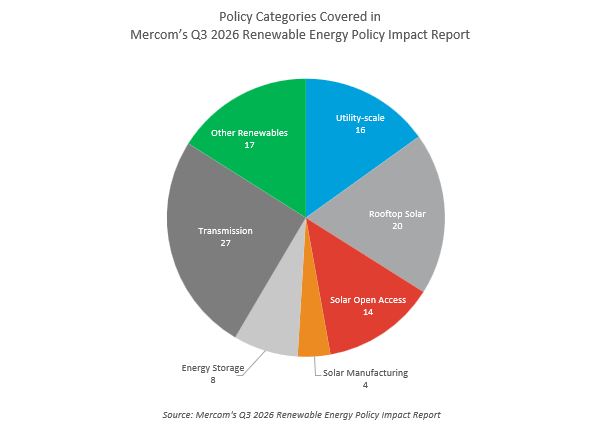
Transmission planning and grid preparedness emerged as another major policy priority. The announcement of the Green Energy Corridor Phase III program, which targets the integration of 135 GW of renewable energy and 50 GWh of storage, is expected to create opportunities across transmission lines, substations, grid modernization, and storage infrastructure. Regulators are also tightening the link between transmission connectivity and development progress, providing limited flexibility to projects making progress while seeking to release idle capacity held by projects without sufficient commercial progress.
The report also details how digital monitoring and grid coordination will evolve as renewable penetration increases. Developments in indigenous SCADA systems, secure data hosting, standardized monitoring, and improved load-dispatch coordination are expected to create opportunities for software developers, automation providers, inverter manufacturers, and grid technology companies. Overall, these developments should improve visibility into generation and grid conditions, supporting better forecasting, distribution planning, congestion management, and grid reliability.
The report also analyses the impact of continued expansion in India’s domestic solar manufacturing ecosystem. As of the report publication, ALMM-listed solar module capacity reached approximately 225.5 GW, while solar cell capacity rose to 37.8 GW, highlighting the gap between listed module and cell manufacturing capacity. The report notes that expanding upstream manufacturing and strengthening supply-chain resilience will be important to improving domestic sourcing and long-term competitiveness. Government support for pilot-scale perovskite manufacturing can also strengthen India’s research and commercialization capabilities, although commercial adoption will depend on improvements in scalability, durability, and production costs.
Battery energy storage continued to grow in importance, expanding beyond energy shifting and peak-demand management. Increased focus on grid-forming inverters, voltage and frequency support, automatic generation control, and black-start capabilities is expected to drive demand for advanced power conversion systems, monitoring infrastructure, and sophisticated storage solutions. In addition, regulatory flexibility to extend storage duration without increasing approved MW connectivity could improve the utilization of existing grid infrastructure. The expanded customs duty exemption for 85 categories of lithium-ion cell manufacturing equipment could also reduce capital costs and support investment in domestic battery manufacturing.
Hybrid renewable procurement, battery storage, and energy management systems may become increasingly attractive to businesses seeking to improve self-consumption, reduce energy losses, and manage electricity costs.
Open access regulations continued to shape renewable energy procurement for C&I consumers. Changes to banking charges, energy settlement mechanisms, and application procedures made it increasingly important to align renewable generation with actual electricity demand. Gujarat’s reduction of green energy banking charges to ₹1/kWh offers near-term relief, while Madhya Pradesh’s rolling three-month banking arrangement provides added flexibility. However, the report also reviews the ongoing effects of banking limits, in-kind charges, and unused energy lapsing. Renewable energy mandates and incentives for data centers in Gujarat and Uttar Pradesh could further boost demand for open access, captive, hybrid, and storage-backed renewable power.
Mercom India’s analysis indicates that India’s renewable energy market is entering a phase where project bankability, technical capabilities, infrastructure readiness, and reliable power delivery matter as much as capacity expansion. Developers will need to account for compliance obligations, forecasting risks, procurement lead times, and potential delays. Manufacturers, meanwhile, will need to focus on technological advancement, product reliability, and supply-chain resilience.
Mercom’s Q3 2026 Renewable Energy Policy Impact report analyses more than 100 policies and regulatory developments across India’s renewable energy sector, examining implementation timelines, market implications, emerging investment opportunities, strategic insights, power procurement, and grid infrastructure. The report offers industry participants insights to navigate India’s evolving regulatory landscape.
Call us for pricing and details: +91.80.4121.148, or email: info@mercomindia.com.
Clean EnergyResearch Reports
Mercom India Research delivers in-depth market reports, that includes Proprietary data intelligence across the clean energy sector.

Other Reports
Custom Research & Consulting
Do you need more tailored research that cannot be answered by any of Mercom’s popular reports?
Our custom research services may be the answer.
We provide data and analysis to help companies understand information specific to their particular segment so they can make sound strategic decisions relating to new market entry, product introductions, or to simply help them understand how they or their customers are positioned within the market.
Mercom’s custom research and advisory services provide clients data and analysis tailored to meet their unique needs. Call us today to learn more: research@mercomindia.com