


Hybrid, Storage and Grid Readiness Key to India’s Next Phase of Clean Energy Growth
Standalone energy storage systems still face challenges despite the large tender capacity
July 2, 2026

Follow Mercom India on WhatsApp for exclusive updates on clean energy news and insights
India’s renewable energy sector is rapidly moving beyond standalone solar and wind projects toward hybrid, storage-backed, and round-the-clock power solutions, as the country looks to build a more resilient and flexible grid.
In Q1 2026, around 7 GW of tenders were floated under solar-plus-storage and renewable dispatchable capacity structures, according to Mercom India Research.
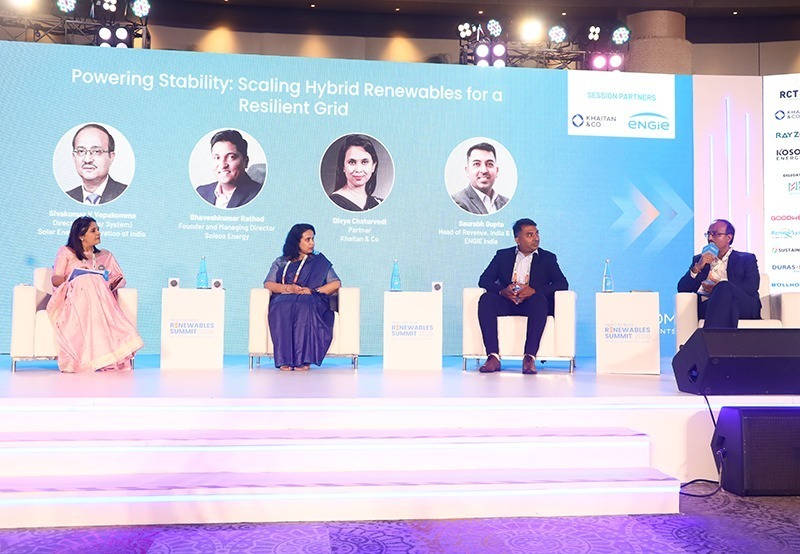
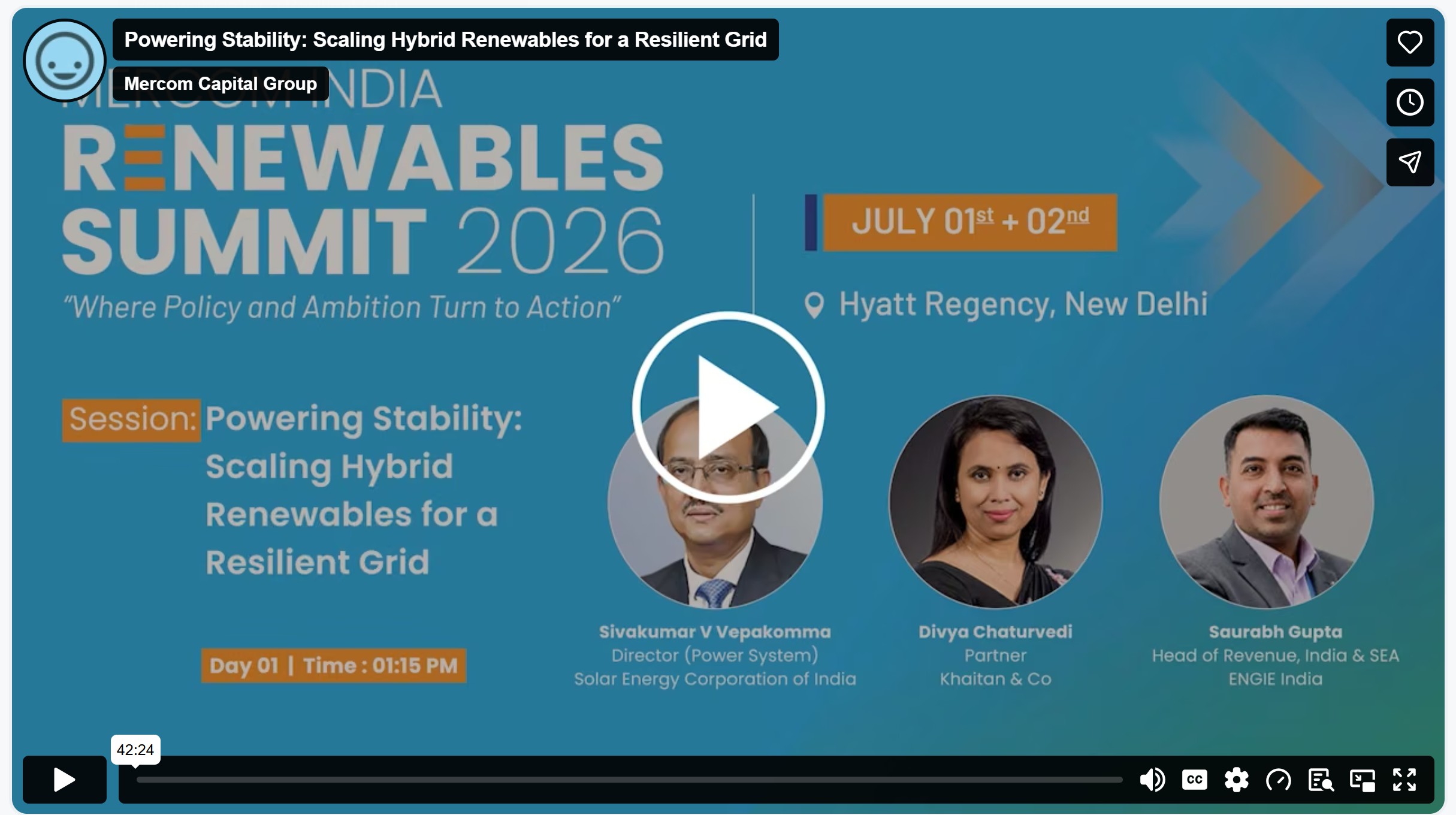
At the Mercom India Renewables Summit 2026, panelists at the session titled “Powering Stability: Scaling Hybrid Renewables for a Resilient Grid” discussed how hybrid renewables, battery energy storage systems, and evolving tender structures are reshaping India’s power procurement market.
The panel included Sivakumar Vepakomma, Director (Power Systems) at Solar Energy Corporation of India; Divya Chaturvedi, Partner at Khaitan & Co.; and Saurabh Gupta, Head of Revenue India and SEA at Engie India. The session was moderated by Priya Sanjay, Managing Director of Mercom India.
Divya Chaturvedi, a transaction advisor active across renewables, hydrogen, storage, finance, and manufacturing, said firm and dispatchable renewable energy has gained investor confidence in recent years. “We are all aware that firm and dispatchable renewable power has become tried and tested in terms of policy push, and investor confidence is definitely there.” She added that co-located solar and battery energy storage systems are attracting growing investor interest.
However, Chaturvedi said standalone battery energy storage systems still face challenges despite the large tender capacity seen in the market. “The challenge remains with the tariff which has been built. It is very low, and there are challenges which we are foreseeing. Almost two-thirds of the two-hour storage system that has been built is still below cost-reflective. In the long run, we will have to see how much economies of scale work in its favor to make it profitable.”
Investors ultimately need a reasonable return on capital, she said.
Chaturvedi also pointed to green hydrogen as a sector where policy support and investor interest exist, but activity remains limited. “There is a lot of policy push, and the framework is there. Investor interest has been reflected time and again, but we have not seen so much activity in that sector. The capital investment is slow, especially compared to the 2030 target.”
Transmission infrastructure, she said, was another key concern. “Transmission network is chronically underutilized and underbuilt as compared to the generation which has been added to the system.”
Speaking from a developer’s perspective, Saurabh Gupta said India is now entering the second phase of renewable energy development.
“We have seen phase one, where there were only plain vanilla contracts-solar and wind. Now, moving toward hybrid, there are a lot of learnings that have gone through the entire cycle,” he said.
He said developers, lenders, and other stakeholders are now more aware of the risks that can affect hybrid projects.
“The first challenge is the readiness of the grid aligned with the timelines of your project,” Gupta said. “Today, we see delays in the readiness of the grid, which results in delays. Even a bit of delay compromises the returns on the project.”
“The lenders are aware of this, and they would like to take a particular view on these projects. They believe this has to be resolved first,” he said.
Land acquisition is another major challenge for hybrid projects, he said. “When we go for hybrid systems, the land requirement is huge, so it comes as a second set of challenges,” Gupta added.
He also emphasized the importance of revenue visibility and cash flow certainty. “The revenue stack is very important for the cash flow and servicing of debt. All these aspects are well known to stakeholders, and they would like to see how we preserve them while financing such projects,” he said.
On storage optimization, Gupta said developers must carefully manage charging and dispatch strategies to achieve competitive pricing. “We should know at what point in time the battery has to be charged if it is grid-charged. If it is solar, not the entire solar can charge the battery. Unless we optimize these finer things, it is very difficult to have the optimal pricing we see in the market.”
Sivakumar Vepakomma said tender structures have evolved significantly to match the changing needs of distribution companies and consumers. The market is moving from simple renewable procurement toward more structured power supply products that meet peak and round-the-clock demand.
On module prices, he said the impact of domestic content-related requirements has not been as significant as initially expected. “Initially, we thought ALMM 2 would increase prices, but that is not the case we are witnessing. There is competition in the market.”
He said domestic manufacturing capacity and changing export market dynamics have helped keep module prices competitive. “The capacity now is about 25 GW of cell capacity, and modules are more than 130 GW.”
Vepakomma said the next major demand cycle could come from commercial and industrial consumers, especially data centers. “Google’s data center in Visakhapatnam and Tata are also coming in a big way into data centers. The next demand cycle will kick in by giving 24/7 power to data centers.”
He added that supply could eventually fall short of demand. “Supply may fall short of demand, but it will take a couple of years for this scenario to emerge.”
Vepakomma also said SECI has started engaging with emerging industrial demand. “We have already entered this fray,” he said, adding that developers who won green ammonia tenders are seeking renewable energy supply. “Recently, we concluded one such agreement with one of these developers to supply solar power. So, we are trying to create a base for this C&I domain as well.”
The panel concluded that hybrid renewables and storage-backed projects will play a central role in India’s clean energy transition. However, their success will depend on realistic tariffs, grid readiness, land availability, optimized storage operations, and stronger demand from distribution companies and C&I consumers.
As renewable penetration rises, India’s ability to scale hybrid power will be critical to ensuring grid stability, meeting peak demand, and delivering reliable clean power to emerging demand centers.


Rakesh Ranjan
More articles from Rakesh Ranjan.