

How Industrial Decarbonization Can Power the Future of Clean Energy Growth
Experts feel that replacing grid electricity with renewables is the first stage of decarbonization
July 3, 2026

Follow Mercom India on WhatsApp for exclusive updates on clean energy news and insights
India’s decentralized energy market is emerging as a major driver of clean power demand supported by open-access policies, growing commercial and industrial (C&I) demand, and new business models that make renewable energy adoption easier for consumers.
However, panelists at the Mercom India Renewables Summit 2026 said the next phase of consumer-led clean power growth will require stronger grid planning, more flexible regulations, and a shift from renewable electricity procurement to deeper industrial decarbonization.
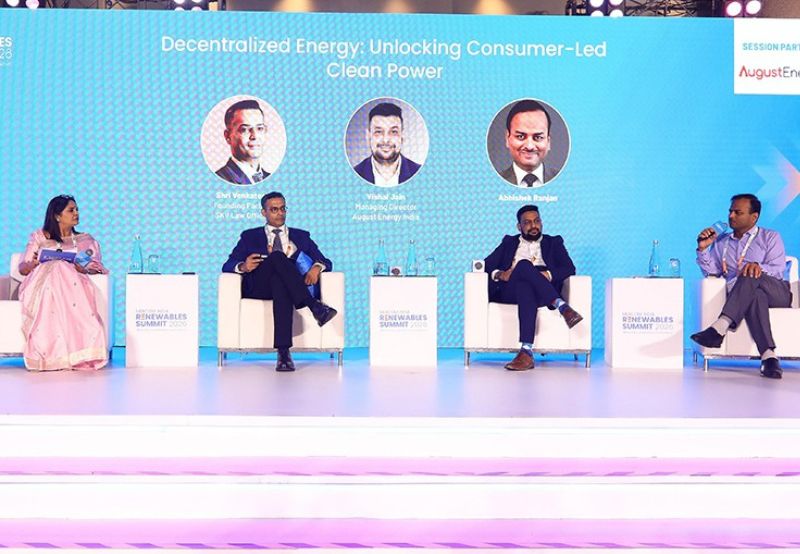
During the session ‘Decentralized Energy: Unlocking Consumer-led Clean Power,’ speakers including Abhishek Ranjan, CEO, BRPL; Shri Venkatesh, Founding Partner at SKV Law Offices; and Vishal Jain, Managing Director at August Energy discussed the evolving role of consumers, DISCOMs, developers, and regulators in India’s clean energy transition. The session was moderated by Priya Sanjay, Managing Director at Mercom India.
Speaking on the implementation of ALMM List II, Vishal Jain said, “There will always be short-term hindrances or hiccups that will come with such a paradigm policy. As part of the industry and being there in the industry, I think this is in the right direction. But I think, as I said, this is not a cost; this is an investment.”
Speaking on the evolution of battery storage, Jain said, “The open access solar market is heavily solar. There are hardly any hybrid projects. And because of the nature of solar generation, the viability of such projects depends on power banking. Now, the industry has been treating the grid as an infinite battery, which is unsustainable. In the long term, no country has survived excess daytime solar generation. This is a hard step towards the long-term sustainability of the grid.
Speaking about regulatory uncertainty, Venkatesh said projects conceptualized during policy transitions face uncertainty because developers may not know when new lists or rules will be notified or take effect. He said companies should organize documentation to demonstrate project execution status and ensure that contracts clearly address risk allocation, as boilerplate tender-based contracts often fail to adequately capture policy-change risks.
“The problem occurs when you sign a contract based on it, without considering the intraday arbitrage overhang between peak solar hours and non-solar hours. You don’t factor this in, and then you sign a power purchase contract, and later, when a dispute arises, you are all fighting over what the minimum guaranteed sale is. So, when you’re signing a contract or getting into a business, look at the surrounding context, because what is happening in the market will translate into some form of regulation in the months and years ahead,” Venkatesh added.
Sharing his views on resource adequacy guidelines, Abhishek Ranjan said that distribution companies are planning renewable energy procurement based on long-term resource adequacy studies and production cost optimization models rather than on short-term price signals.
He said the utility models demand across all 96 time blocks each day over a 10-year horizon, incorporating existing and planned generation sources to identify the most cost-effective capacity mix.
He noted that Delhi has already installed over 420 MW of rooftop solar capacity and aims to cross 700 MW within the next two years. However, given that the city’s peak demand occurs at night, battery energy storage has become critical for integrating renewables.
He added that the state regulator has approved more than 300 MWh of distributed battery storage at the 11 kV level across 10 locations, reflecting a planned approach to integrating distributed renewable energy and storage.
Vishal Jain said India has made significant progress in helping C&I consumers reduce electricity-related emissions by procuring renewable energy.
“India has done a tremendous job of replacing the Scope 2 footprint through supportive policies around open access and focus on renewables,” Jain said. “Customers have, over the longer term replaced 40% to 50% of their Scope 2 footprint.”
However, he cautioned that replacing grid electricity with renewable power is only the first stage of corporate decarbonization.
“Energy transition, just by replacing the electrons, is a short-term approach. The focus has to move from electrons to molecules (fuels and thermal energy used directly in operations), wherein Scope 1 has to come into the picture to truly achieve a net-zero status for the longer term,” said Jain.
He said industrial consumers will need to explore process heat, industrial steam, and other fuel-based applications to move closer to net-zero operations.
“Process heat, industrial steam, waste heat recovery setups, and heat pumps can help achieve that status by replacing molecules,” Jain said.
The panelists said decentralized energy is no longer limited to rooftop solar or open access procurement. It is becoming a broader market involving storage, demand-side management, industrial electrification, behind-the-meter solutions, and flexible clean power models.
Abhishek Ranjan said DISCOMs will play a central role in managing this transition as more consumers become active participants in the power system. As distributed energy resources expand, utilities will need to balance consumer choice with grid reliability, system discipline, and cost-effective planning.
He said the future role of DISCOMs will likely evolve from conventional electricity distribution towards a more dynamic network management function, requiring new regulations for distributed resources, demand flexibility, smart appliances, and peer-to-peer energy transactions.
“The need for balancing reserves should be established through detailed studies, not by forcing solutions. The responsibility for grid balance should be shared based on a ‘polluter pays’ principle,” Ranjan added.
Shri Venkatesh said regulatory uncertainty remains a critical risk for decentralized energy projects. Sudden policy shifts, including changes to open access, banking, charges, and approval processes, can alter the economics of long-term renewable energy contracts.
He said standard contracts may not be sufficient in a market where policy and regulatory frameworks continue to evolve. Developers, consumers, and investors must design agreements that clearly allocate regulatory risks, anticipate potential changes, and account for market conditions throughout the project’s life.
Venkatesh also added that large C&I consumers and data centers should not be viewed through the same lens, as data centers require significantly higher levels of energy security and redundancy.
“In our experience, when it comes to large C&I consumers or data centers, execution risk is the most important factor because, in many ways, they are insulated from regulatory risk,” Venkatesh noted.
Vishal Jain said that innovative business models, such as energy-as-a-service, are helping C&I consumers adopt clean energy without taking on the full upfront capital burden. Under such models, solution providers can finance, build, operate, and maintain clean energy systems while customers benefit from lower-carbon energy and predictable costs.
Jain said faster deployment will require better coordination across government departments and approval agencies. Delays in permits, connectivity, and interdepartmental clearances can slow project.
“The industry must move beyond treating the grid as an ‘infinite battery’ and embrace energy storage,” Jain noted.
The session also highlighted the growing importance of storage and grid-balancing solutions. As renewable energy penetration rises, the need for flexibility will increase, but storage deployment should be guided by system needs, technical studies, and cost-benefit analysis rather than one-size-fits-all mandates, the panelists said.
The panelists also noted that large consumers such as data centers will require reliable, round-the-clock clean power. This will create new opportunities for hybrid renewable energy, storage-backed power, and structured power supply contracts. At the same time, such projects will need to manage risks related to transmission availability, power evacuation, approved module sourcing, and 24×7 supply obligations.


Rakesh Ranjan
More articles from Rakesh Ranjan.