


Global Renewable Capacity to Grow by Over 4,770 GW by 2031: IEA
India forecast to be second-largest contributor to renewable capacity additions
November 11, 2026

Follow Mercom India on WhatsApp for exclusive updates on clean energy news and insights
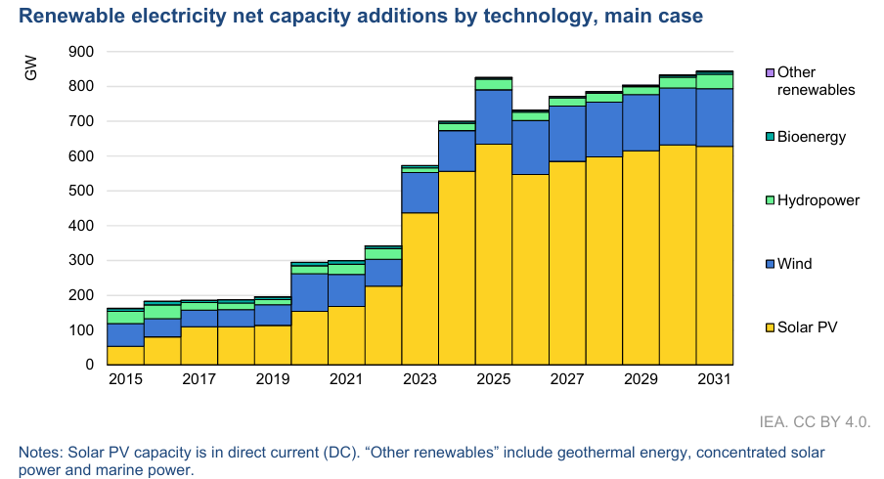
Global renewable energy capacity is expected to increase by more than 4,770 GW from 2026 to 2031, with India emerging as the second-largest contributor to such additions, according to a report by the International Energy Agency (IEA). Renewables are projected to account for more than 80% of total power capacity additions.
The expansion would represent a 57% increase over the preceding six years, averaging nearly 800 GW annually. However, annual additions are forecast to decline 11% in 2026, ending 21 consecutive years of record growth, primarily because of slower solar installations in China.
Renewable Power Capacity
Solar projects are expected to account for three quarters of renewable capacity additions between 2026 and 2031. Utility-scale solar is expected to contribute 2,075 GW and distributed solar 1,530 GW. Global onshore wind capacity is projected to reach 2,040 GW by 2031, while offshore wind will add 117 GW and pumped storage hydropower approximately 74 GW.
China is expected to add nearly 2,520 GW, accounting for 53% of global additions during the forecast period, compared with more than 60% in 2025. India’s additions are projected to increase 2.6-fold, nearly doubling its global share to 8.5%, supported by utility-scale solar, rooftop solar, and pumped storage hydropower.
Europe is projected to add over 615 GW, while Asia Pacific excluding China will add more than 840 GW, nearly half of it from India. The U.S. is expected to add approximately 314 GW, Latin America and the Caribbean 165 GW, the Middle East and North Africa 122 GW, and Sub-Saharan Africa more than 120 GW.
With the expansion, global renewable capacity is projected to reach 9,710 GW by 2030.
Grid Integration and Storage
Global behind-the-meter battery energy storage capacity is projected to exceed 670 GWh by 2031, with power capacity reaching approximately 290 GW.
Over 550 GWh of energy storage capacity and approximately 230 GW of power capacity are expected to be added between 2026 and 2031. Energy storage capacity additions will be more than five times those recorded during the preceding six years.
Commercial battery storage is forecast to account for almost half of global behind-the-meter storage additions during 2026–2031, compared with one-third during 2020–2025.
China is expected to account for approximately 60% of global commercial battery storage additions, representing over 150 GWh.
Residential battery storage deployment is also expected to accelerate, with annual additions rising from the equivalent of 13% of rooftop solar PV additions in 2025 to over 35% by 2031.
Declining battery costs, improving self-consumption economics, and growing demand for grid flexibility are expected to drive storage deployment.
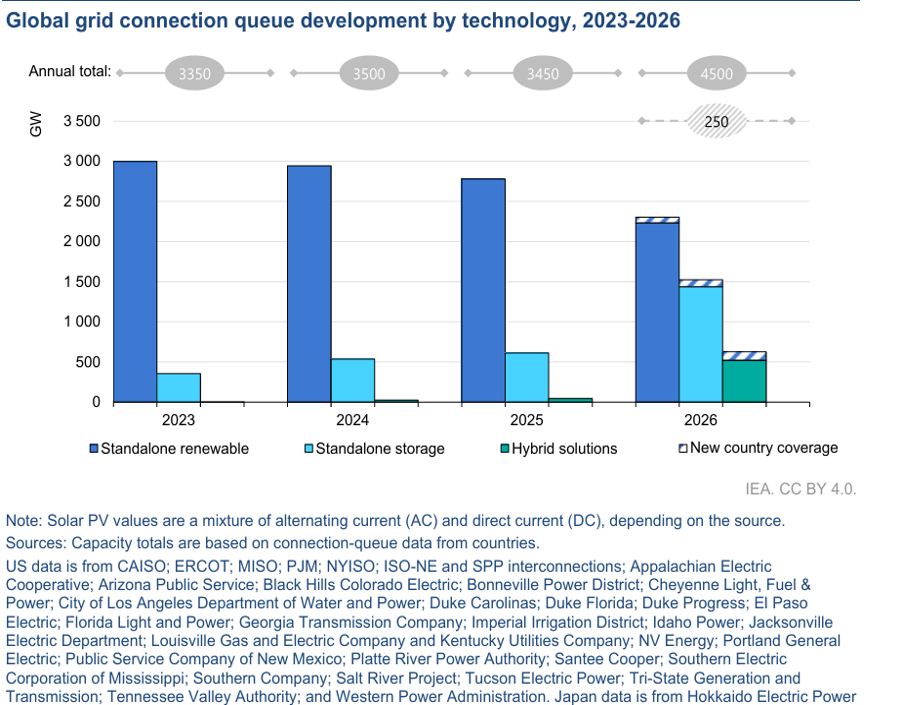
Grid connection queues total nearly 4,400 GW, including more than 1,500 GW of battery storage applications. Annual wind and solar curtailment could increase nearly fivefold by 2031. The IEA estimates that favorable weather and lower curtailment could increase renewable generation by over 1,550 TWh without additional capacity.
IEA identified transmission expansion, financing, streamlined permitting, and storage deployment as priorities for accelerating growth.
Renewables in Transport
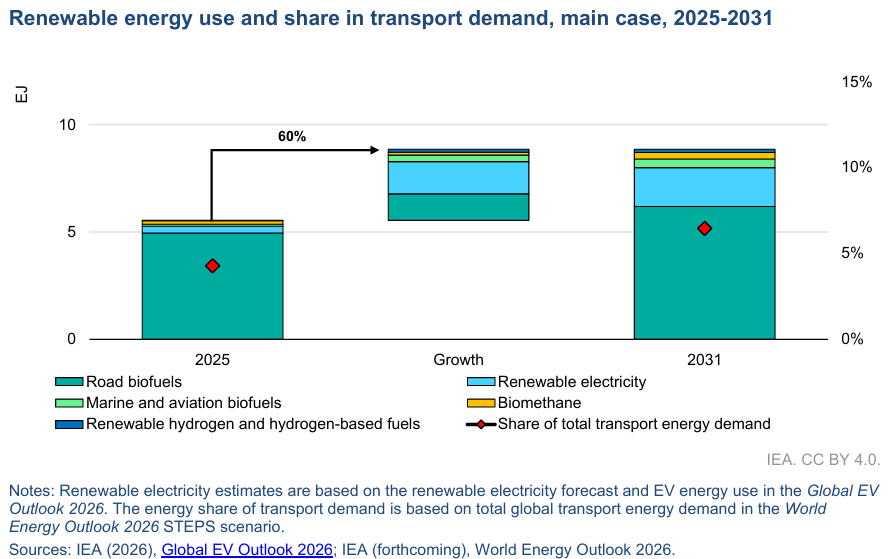
Global renewable energy consumption in the transport sector is expected to increase 60% from 5.5 exajoules (EJ) in 2025 to nearly 9 EJ by 2031.
Renewable electricity is expected to account for 45% of the growth in renewable energy consumption in transport, increasing from 0.3 EJ in 2025 to 1.8 EJ by 2031, driven by rising electric vehicle (EV) adoption and the growing share of renewables in electricity generation.
EVs accounted for one-quarter of global new car sales in 2025. China is projected to contribute 50% of the growth in renewable electricity consumption in transport, supported by the rapid adoption of electric passenger vehicles and medium- and heavy-duty trucks, along with strong domestic battery supply chains.
Europe is expected to account for another 30% of the growth, driven by the increasing availability of affordable EVs.
Liquid biofuel consumption in road transport is projected to rise from 195 billion liters to 240 billion liters. Brazil and India are expected to account for 40% and 25% of global ethanol demand growth, respectively. India achieved its 20% ethanol blending target in 2025 and is projected to maintain that level through 2031.
Sustainable aviation fuel (SAF) demand is projected to increase nearly fivefold, from just over 2 billion liters in 2025 to 10 billion liters annually by 2031, accounting for 2% of aviation fuel demand. Europe will contribute 45% of demand growth, North America 30%, and Asia Pacific 20%.
Solar Manufacturing Supply Chains
China is expected to maintain its dominance across the solar supply chain despite financial pressures and rising bankruptcies. Over 90% of major Chinese solar manufacturers reported losses in 2026, while more than 70 companies have filed for bankruptcy since 2024 due to overcapacity and declining prices.
Most emerging solar manufacturing capacity outside of China is dedicated to cells and modules, as these segments require lower upfront investment than upstream polysilicon and wafer production. Higher energy and labour costs in many markets outside China also weigh more heavily on the competitiveness of upstream production, further favouring investment in cells and modules.
New entrants can also invest directly in higher-efficiency production technologies, such as TOPCon, back-contact or HJT cells, avoiding costs related to converting existing PERC production lines. Trade barriers and industrial policies are also increasingly influencing the location of new manufacturing capacity.
India is expected to emerge as a key alternative manufacturing hub, becoming the only country besides China capable of producing all major solar components at scale by 2031.
Renewable Heating
Modern renewables’ share of global heat demand is projected to rise from 15% in 2025 to 19% in 2031. Renewable electricity will account for nearly two-thirds of the increase in modern renewable heat consumption, with electricity used for heating rising from 9.4 EJ to 14.6 EJ.
Renewable heat consumption in buildings is forecast to grow 25%, with India recording 50% growth, the fastest among major emerging economies. Global renewable industrial heat consumption is also expected to increase 25%, raising its share of industrial heat demand from 16% to 19%.
India’s renewable industrial heat consumption is projected to increase by 1 EJ, accounting for one-quarter of global growth, with bioenergy contributing two-thirds of India’s increase. India is also expected to contribute more than half of the projected global increase in industrial solar thermal consumption. Fossil fuels will still meet over 80% of industrial heat demand in 2031.
Biogas and Biomethane
Global biogas and biomethane production is expected to rise 18% from 2026 to 2031, while biomethane output is projected to nearly double. India’s compressed biogas (CBG) production could increase nearly ninefold, supported by incentives, blending mandates, and project development.
India’s ₹237.31 billion (~$2.5 billion) unified scheme for CBG, introduced in August 2026, provides incentives through financial year 2035-36. Existing CBG facilities operate at approximately 35% capacity utilization because of feedstock shortages, limited digestate markets, and transportation constraints. The IEA lowered its India 2030 biogas production forecast by 49% from its previous report.
Fossil Fuel Savings
Renewable energy expansion from 2010 to 2025 reduced global fossil fuel demand by approximately 8% in 2025, avoiding 41 EJ of consumption. Cumulative savings reached 275 EJ, with the power sector accounting for nearly 70% and heating 24%.
India recorded the largest relative reduction. Without renewable energy expansion since 2010, its fossil fuel demand would have been nearly 14% higher in 2025. Renewable heat avoided approximately 15 EJ of fossil fuel consumption globally in 2025, with India accounting for 17% of savings.
Renewable electricity use in road transport reached about 280 PJ in 2025, representing 33% of road transport electricity demand. From 2010 to 2025, renewable electricity in transport avoided approximately 1.9 EJ of coal and 0.8 EJ of natural gas consumption, while biofuels displaced nearly 19 EJ of oil products.
Renewable Ammonia
Renewable ammonia could reduce dependence on imported natural gas and fertilizers, although capital expenditure, financing, and technology costs remain barriers. The IEA assessed projects in Brazil, China, Egypt, India, and Indonesia using a 13% weighted average cost of capital (WACC).
China had the lowest estimated production cost at approximately $1,400/tonne, nearly twice prevailing ammonia prices. Lowering WACC to 8%, alongside declining electrolyzer and renewable energy costs could improve competitiveness by 2030. China and India are expected to have the lowest costs among the projects assessed.
In a 2026 report, the IEA reported that global electricity consumption would grow at an average annual rate of 3.6% from 2026 to 2030.


Parth Shukla
More articles from Parth Shukla.