


Global Market Value of Clean Energy Technologies Reaches $1.2 Trillion in 2025: IEA
Electric vehicles dominated the clean energy technology market
April 9, 2026

Follow Mercom India on WhatsApp for exclusive updates on clean energy news and insights
The combined global market value of clean energy technologies has grown by 20% per year on average over the past decade, reaching nearly $1.2 trillion in 2025, according to a new report by the International Energy Agency (IEA).
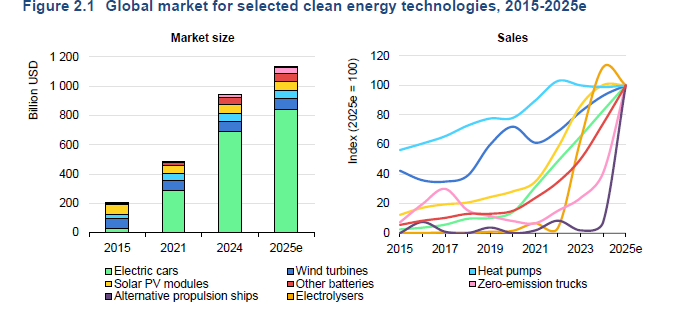
China has remained the largest market for clean energy technologies for a decade, with its market share increasing to 45% in 2025.
In 2025, the electric car market in China is expected to have reached $390 billion, accounting for more than 80% of the total clean energy technology market in the country.
Europe has the second-largest clean energy technology market today, with market growth averaging more than 20% per year from 2015 to 2025.
The growth in Europe’s clean energy technology market was driven by electric vehicle (EV) sales, which accounted for 85% of the growth.
The global market for electric cars grew by more than 40% per year on average between 2015 and 2024, accounting for around 90% of total clean energy technology market growth.
Electric cars are expected to dominate the clean energy technology market in 2035, accounting for around three-quarters of the total market value in all scenarios.
Solar and Wind Market
The market value for solar PV and wind turbines has grown much more slowly, as plunging costs have offset much of the growth in demand.
Solar capacity additions grew tenfold between 2015 and 2024, yet the overall market value rose by only 4%, or less than 1% per year, due to an 85% drop in the cost of modules.
Similarly, while wind turbine costs fell by around 55% over the same period, the market growth remained modest.
Despite a 75% increase in capacity additions since 2015, the market value in 2024 remained broadly unchanged, reflecting the impact of significantly lower prices.
Around 80% of global solar PV and wind generation now occurs at lower levelized costs than for coal or gas, supporting a surge in global capacity additions.
Battery Market
Battery prices have fallen by 75% over the past decade, boosting electric car sales and enabling a larger share of variable renewable energy in electricity supply.
The decline in battery prices led to 30% decline in average EV prices, boosting sales in 2025.
In some emerging markets, battery electric cars are becoming cheaper to buy than comparable internal combustion engine cars.
Low-Emission Fuels
The market for low-emission fuels grew by an average of 7% annually in the past decade, reaching around $215 billion in 2025.
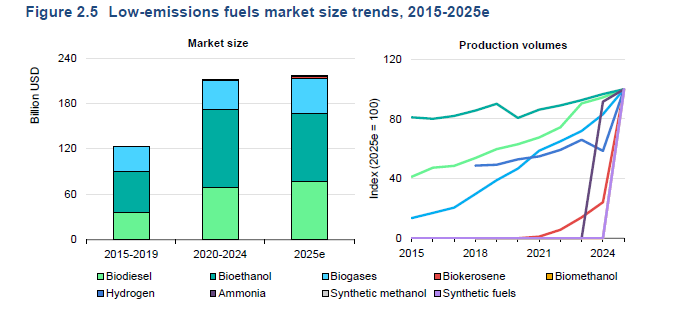
However, the medium-term growth prospects for the low-emission fuel market are projected to reach about $390 billion in 2035 under both the Current Policies Scenario (CPS) and the Stated Policies Scenario (STEPS), equivalent to about 20% of the combined market for diesel and gasoline used in transport sector.
The report highlighted that increased use of more costly fuels with low market penetration, such as sustainable aviation fuels and other hydrogen-based fuels, would require stronger policy support.
Investments
Investment in production assets for clean energy technologies, near-zero-emissions materials, and low-emissions fuels is estimated to reach around $245 billion in 2025, about three times the level five years earlier.
Global investment in manufacturing has grown substantially in recent years and is projected to reach around $7.5 trillion annually by 2025.
Global manufacturing investment in key clean energy technologies fell slightly to just under $200 billion in 2024, down from a high of $220 billion in 2023, and is expected to continue to decline gently through to year-end 2025.
Manufacturing investment for most technologies does not return to the levels reached over the past 2 years under the STEPS and CPS through to 2035.
The decline in investments was largely driven by a surplus of existing manufacturing capacity relative to the current demand for solar PV and batteries.
Investment in developing supporting infrastructure for renewable energy growth, primarily electricity grids, is estimated to approach $430 billion in 2025, about 40% higher than in 2020.
Global investment in low-emissions hydrogen production climbed to nearly $8 billion in 2025, a year-on-year growth of 80%.
Investments in electrolyzer deployment are also expected to grow through 2030, similar to the expansion seen as solar PV ramped up.
For Carbon Capture, Utilization and Storage, average annual investment grew more than 15-fold since 2020 to over $5 billion in 2025, with several landmark projects reaching final investment decisions, though almost 90% of announced projects have not yet reached that milestone.
Average annual investment in production assets for clean energy technologies, materials, and fuels combined falls by 60% under STEPS from 2031-35, compared to 2025 levels.
Growth of Early-Stage Technologies
Startups developing technologies such as nuclear fusion, solid-state cooling, iron ore electrolysis, production of conventional cement without limestone, or direct electrochemical ammonia production are now attracting increased investments.
But such technologies are still at early stages of technology readiness and face substantial technical and cost barriers. The report said it is unlikely they will achieve a significant market share within a decade.
Impact of Higher Tariff
Of all global gross imports of clean energy technologies in 2025, only about 15% was accounted for by countries that now impose substantially higher tariffs.
While tariff and duty increases are expected to put upward pressure on average production and import costs, the impact in 2025 was partly offset by falling commodity prices, the substitution of imports with domestically produced goods supported by financial assistance, and other changes in trade patterns.
In the STEPS, the global value of net trade in these technologies more than doubles from $290 billion in 2025 to reach $620 billion by 2035.
According to the report, China will remain the largest exporter by a wide margin, with the value of its net exports growing to $ 375 billion in 2035.
Emerging Economies
The total clean energy technology market in emerging economies, excluding China, is estimated to have reached $75 billion in 2025.
Emerging economies accounted for less than 5% of China’s EV exports in 2020; they now represent nearly 40%.
In Central and South American countries, Chinese EVs are projected to account for around half of total EV sales on average by 2035 under the STEPS.
India
In India, the market for clean energy technologies is estimated to grow by around 40% in 2025 compared with 2024. However, this is a recent trend: growth in the Indian market has averaged only 10% per year since 2015, to reach an estimated $18 billion in 2025.
Under STEPS, India increases its share in global production to more than 10% from 3% in 2024.
Global Outlook
Clean energy represents 18% of the global energy mix in 2025, up from less than 15% in 2015.
This share is projected to continue growing across all outlooks discussed in this report, reaching 27% in 2035 under the STEPS, 25% under the CPS, and 52% under the Net Zero Emissions by 2050 Scenario.
In the STEPS, the market for clean energy technologies grows almost two-and-a-half times to reach $3 trillion (in real 2024 dollars) by 2035, while it almost doubles to reach around $2 trillion in the CPS.
Clean energy demand increases by more than 60% from now to 2035 in the STEPS, reaching around 195 EJ, a level similar to today’s oil demand.
Electric cars remain by far the largest clean-energy technology market in 2035 across all scenarios.
The use of solar PV grows particularly strongly, almost quadrupling over the next decade in the STEPS, while the use of wind energy grows by 150%.
Costs for solar and onshore wind are projected to decline further through to 2035, by about 40% for solar PV, and about 10% for onshore wind.
As a result, the use of unabated fossil fuels declines by 7% by 2035 in the STEPS (mostly at the expense of coal), even as total energy demand increases.
From 2025 to 2035, the demand for liquid biofuels grows by about 30% in both the STEPS and CPS, but their share of total energy demand increases only slightly, reaching around 1% in 2035.
The global market for low-emissions fuels is expected to roughly double in size by 2035 in both the STEPS and the CPS, expanding to around $390 billion, or about 15-20% the current size of the diesel and gasoline markets in transport.
Under the STEPS, installed solar PV capacity more than triples over the period; its market size in 2035 is about 25% lower than in 2025, reflecting declining technology costs.
Average annual investment in production assets for clean energy technologies, materials, and fuels combined falls by 60% in the STEPS from 2031-35 relative to 2025 levels, driven by lower manufacturing costs.
Average annual investment in electricity grids between 2031-35 under the STEPS is about 60% higher than in 2025.
Installation costs are projected to decline further through to 2035, by about 40% for solar PV, and about 10% for onshore wind.
According to an IEA report, installed renewable energy worldwide is expected to increase by 4,600 GW by 2030. The growth is being driven primarily by solar installations, which will account for nearly 80% of the increase in renewable capacity over the next five years.


Melvin Mathew
More articles from Melvin Mathew.