


Drop in Module Shipments Pushes Jinko Solar’s Q1 Revenue Down 11.5% YoY
The company’s net loss contracted by 65% YoY
May 4, 2026


Follow Mercom India on WhatsApp for exclusive updates on clean energy news and insights
China-based solar cell and module manufacturer JinkoSolar posted a revenue of RMB12.25 billion (~$1.78 billion) in the first quarter (Q1) of 2026, down 11.5% year-over-year (YoY) from RMB13.84 billion (~$2 billion).
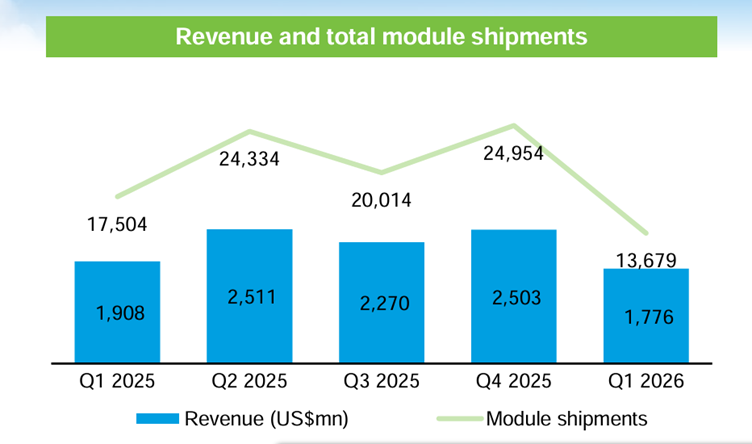
The company attributed the decrease in revenue to a drop in the volume of solar module shipments.
Its net loss contracted by 65% YoY to RMB463.5 million (~$67.2 million) from RMB1.32 billion (~$193 million).
The earnings per share (EPS) came in at a loss of RMB2.21(~$0.32) from an EPS loss of RMB6.4 (~$0.93) last year.
Business Highlights
In Q1 2026, Jinko’s total module shipments were approximately 13.7 GW, with overseas markets accounting for over 80% and shipments to the U.S. accounting for approximately 4%. By the end of Q1, the company delivered more than 400 GW of solar modules cumulatively.
Cumulative shipments of its Tiger Neo module series reached approximately 240 GW. The average power output of its Tiger Neo 3.0 series reached 655-660 W by the end of the quarter.
Shipments of the company’s high-efficiency modules with power output above 640 W increased sequentially, accounting for nearly 25% of its total shipments in the first quarter of 2026.
The company said that the production capacity for these high-efficiency products with power output above 650 W will exceed 40 GW by the end of 2026.
It added that as production capacity for high-efficiency products gradually ramps up, it expects the cost structure to continue improving as greater economies of scale are realized.
The company also highlighted progress in mass production of silver-coated copper technology, which is expected to shield Jinko from commodity market fluctuations.
In Q1 2026, Jinko’s subsidy income stood at RMB331.9 million (~$48.1 million), compared with RMB536 million (~$78.39 million) in Q1 2025.
The company recorded an income tax benefit of RMB379.3 million (~$55 million), compared with RMB699.5 million (~$102.3 million) last year.
Energy Storage Market
In Q1 2026, shipments of energy storage systems rose by more than 350% YoY to 1.42 GWh, and its signed and high-potential orders exceeded 10 GWh. Energy storage system manufacturing capacity stood at 17 GWh of packs and 5 GWh of battery cells at the end of 2025.
Jinko secured 266 MWh across multiple energy storage projects in Australia, 280 MWh in the UK, and 165 MWh in the Middle East.
It also launched a solar-plus-energy-storage solution tailored for the AI data center market.
Module Prices Rebounded
Xiande Li, JinkoSolar’s Chairman and Chief Executive Officer, said that module prices rebounded sequentially during the quarter, driven by an improved supply-demand balance, especially in overseas markets. He added that it helped Jinko narrow its net loss.
Li highlighted that while recent geopolitical disruptions have impacted key logistics lines and are temporarily putting pressure on our shipping costs and delivery schedules, they also underscored the critical importance of global energy security.
Jinko expects module prices to remain relatively stable as sales of its high-efficiency products continue to ramp up and industry competition is projected to gradually normalize, supported by ongoing policy initiatives to promote more disciplined competition.
The company said it is also expanding its footprint in the distributed solar market and entering diverse niche application scenarios that align with rising global power demand and shifts toward cleaner, more distributed energy systems.
Jinko said it is seeing growing demand from industrial, commercial, residential, and utility customers for solar and storage solutions, and is further optimizing its production pipeline and geographic mix in response to evolving market dynamics.
The company expects demand from the Chinese market to drop by roughly 20% compared to last year. However, non-China demand is projected to increase roughly 10% year-over-year.
Jinko said that demand for solar modules is expected to slow in Q2 due to a rush to complete projects before the China VAT policy change witnessed in Q1.
However, Jinko believes that the demand is expected to remain stable throughout the year due to energy security concerns stemming from the Middle East conflict and the growth of AI data centers. The company also expects strong demand from the C&I or distributed solar market.
Guidance
In 2026, module shipments are expected to be within the range of 75 and 85 GW and 14-16 GW in Q2 2026. Over 60% of the shipments are expected to have modules exceeding 640 W.
In 2026, the company’s integrated production capacity is expected to reach 100 GW, including 14 GW overseas.
Shipments of energy storage systems are expected to more than double in 2026.
Production capacity for its Tiger Neo 3.0 modules is expected to reach over 40 GW.
In Q4 of 2025, JinkoSolar posted revenue of RMB17.51 billion (~$2.56 billion), down 15.2% YoY from RMB20.65 billion (~$3.03 billion), mainly due to a decrease in the average selling price of solar modules.
In Q3, its revenue dipped 34.1% year-over-year (YoY) to RMB16.16 billion (~$2.27 billion), primarily due to a decline in the average selling price of solar modules.


Melvin Mathew
More articles from Melvin Mathew.