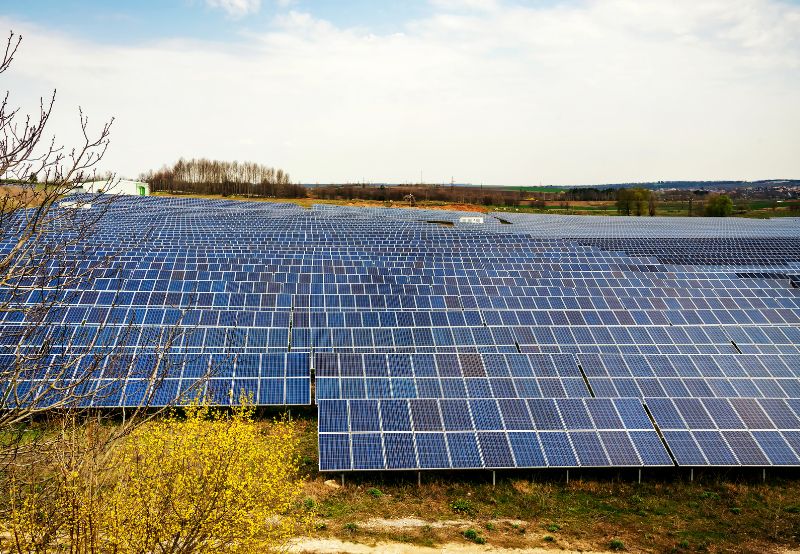
CERC Adopts Usage Charges of ₹2.45/kWh for NCL India’s 510 MW Solar Project
NLC India can provisionally recover change-in-law compensation related to the GST increase
January 5, 2026
Follow Mercom India on WhatsApp for exclusive updates on clean energy news and insights
The Central Electricity Regulatory Commission (CERC) has adopted a usage charge of ₹2.45 (~$0.0272)/kWh for the 510 MW solar power project developed by NLC India.
The Commission held that this usage charge qualifies for adoption under Section 63 of the Electricity Act, 2003, as it corresponds to the ceiling usage charge that was in effect at the time of the competitive bidding.
Background
NLC India filed the petition seeking adoption of usage charges for its 510 MW solar project selected under Tranche III of the Central Public Sector Undertaking (CPSU) Program Phase II (Tranche III).
The bidding process was conducted by the Indian Renewable Energy Development Agency (IREDA) acting as the bid process coordinator on behalf of the Ministry of New and Renewable Energy.
Under the CPSU program, viability gap funding (VGF) per megawatt was the sole bid parameter, while usage charges were subject to a pre-specified ceiling. At the time of the tender and e-reverse auction, the ceiling usage charge was set at ₹2.45 (~$0.0272)/kWh, and the maximum permissible VGF was capped at ₹5.5 million (~$60,931)/MW.
Under the CPSU program, usage charges are not competitively discovered power tariffs but government-capped charges intended to recover project costs after VGF, payable on a per-unit basis for use of the generating asset.
NLC India emerged as one of the successful bidders and was issued a letter of award for an allocated capacity of 510 MW. Following the allocation, the petitioner approached various state distribution companies to sell power on a long-term basis.
Power usage agreements were subsequently executed with Rajasthan Urja Vikas Nigam for 300 MW at a usage charge of ₹2.52 (~$0.0279)/kWh and with Telangana distribution companies for 200 MW at a usage charge of ₹2.57 (~$0.0285)/kWh.
These agreements were approved in principle by the respective state electricity regulatory commissions, subject to the CERC’s adoption of the tariff.
The petitioner submitted that the increase in usage charges above ₹2.45 (~$0.0272)/kWh was necessitated by a change in the goods and services tax (GST) rate applicable to renewable energy equipment.
The Ministry of Finance revised the applicable tax rate from 5% to 12%, which the Ministry of New and Renewable Energy later acknowledged as a change in law.
Consequently, the ceiling usage charge under the CPSU program was revised upward to ₹2.57 (~$)/kWh.
NLC India argued that the usage charges reflected in the power usage agreements were within the revised ceiling and should therefore be adopted by the Commission.
IREDA supported the petitioner’s case by confirming that the bidding process had been conducted in strict compliance with the CPSU program guidelines and Section 63 of the Electricity Act. It submitted conformity certificates and audit approvals to establish that the e-procurement process was transparent, competitive, and compliant with government standards.
Commission’s Analysis
The Commission noted that under Phase II of the CPSU program, the competitive element of the bidding process lay exclusively in the VGF quoted by bidders and not in the usage charge itself. Usage charges were subject only to a government-determined ceiling.
The Commission observed that at the time of bidding and issuance of the letter of award, the ceiling usage charge notified to all bidders was ₹2.45 (~$0.0272)/kWh. The maximum permissible VGF was ₹5.5 million (~$60,931)/MW was directly linked to this ceiling. Any post-bid alteration to the usage charge ceiling, even if permitted under the program, could not retrospectively modify the tariff eligible for adoption under Section 63.
Relying on its earlier decisions in similar cases, the Commission reiterated that mutual agreements between generators and procurers on usage charges cannot be equated with tariff discovery through competitive bidding when such charges were not themselves bid parameters.
The Commission emphasized that allowing the adoption of post-bid revised usage charges would erode the integrity of the competitive bidding process and create uncertainty for future tenders.
At the same time, the Commission recognized that the increase in GST constituted a change in law event under the terms of the power usage agreements.
While such a change in law impacts cannot be absorbed into the adopted tariff under Section 63, affected parties are entitled to seek separate compensation to restore them to the same economic position they would have been in had the change not occurred.
Balancing these considerations, the Commission adopted the usage charge of ₹2.45 (~$0.0272)/kWh for the entire 510 MW project as the tariff under Section 63.
Simultaneously, it allowed NLC India to provisionally recover change-in-law compensation related to the GST increase, subject to final determination in a separate petition to be filed by the petitioner within the stipulated timeframe.
In September last year, the Commission allowed NHPC to adopt usage charges of ₹2.45 (~$0.029)/kWh under the competitive bidding process to procure 1,000 MW of solar power under the CPSU Phase II (Tranche III).
Subscribe to Mercom’s real-time Regulatory Updates to ensure you don’t miss any critical updates from the renewable industry.