



CERC Notifies Phased Move to Schedule-Based Deviation for Wind, Solar Under DSM
The blended deviation formula and tighter tolerance bands will take effect from April 1, 2026
April 1, 2026


Follow Mercom India on WhatsApp for exclusive updates on clean energy news and insights
The Central Electricity Regulatory Commission (CERC) has determined the value of “X” for computing deviation by wind and solar sellers under the Deviation Settlement Mechanism (DSM) Regulations, 2024.
The revised framework will come into force from April 1, 2026.
The implementation of the order, however, is subject to the outcome of writ petitions pending before the Delhi High Court challenging provisions of the DSM Regulations, 2024. The Commission has clarified that no coercive action will be taken during the continuance of the interim relief granted by the Court.
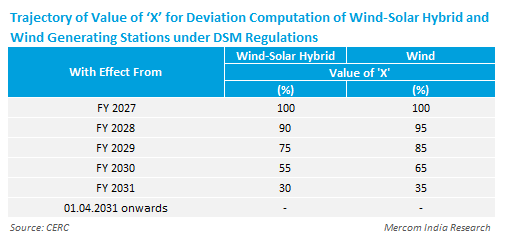
Under the DSM Regulations, deviation for wind and solar (WS) sellers will no longer be calculated solely against available capacity. Instead, it will be computed using a blended denominator that combines available capacity and scheduled generation.
The weighting parameter, “X,” will progressively decline over time, shifting the basis of deviation calculation toward scheduled generation.
CERC has adopted a phased trajectory for this transition, with differentiated pathways for solar and wind technologies reflecting differences in forecasting predictability.
The Commission has also tightened the revenue-neutral tolerance bands. For solar and hybrid projects, the permissible deviation band will narrow from ±10% to ±5%, while for wind projects it will reduce from ±15% to ±10%, effective April 1, 2026. This change reduces the deviation volume limits within which generators operate without additional commercial exposure.
While the structural shift toward a blended denominator begins from FY 2026–27, the Commission has retained X at 100% for the first year of implementation. As a result, deviation will continue to be effectively computed based on available capacity during FY 2026–27, with the transition toward scheduled generation commencing thereafter.
The Commission said the calibrated reduction in X is intended to strengthen scheduling discipline as renewable energy penetration increases. With a growing share of wind and solar in the generation mix, even moderate forecasting errors can translate into large absolute deviations, affecting system frequency, reserve deployment, and ancillary service requirements.
The phased approach is designed to progressively align deviation assessment with scheduled generation while balancing grid security considerations and stakeholder concerns.
The order also formalizes differentiated treatment between wind and solar technologies, noting that solar generation is relatively more predictable, while wind projects are more sensitive to changes in the deviation calculation framework.
In addition, CERC has directed the National Load Despatch Centre, in consultation with Regional Power Committees, to develop a procedure for computing the deviation percentage beyond March 31, 2031, for time blocks with very small scheduled generation.
The framework applies to wind and solar sellers, including generating stations aggregated at pooling stations through qualified coordinating agencies.
The Commission recently extended the applicability of the existing mechanism for sharing deficits in the Deviation and Ancillary Service Pool Account under the DSM Regulations, 2024.
Subscribe to Mercom’s real-time Regulatory Updates to ensure you don’t miss any critical updates from the renewable industry.


Arjun Joshi
More articles from Arjun Joshi.