Bridging the Solar Skills Gap as Academia Races to Catch Up
Hands-on training and industry tie-ups are key to workforce readiness
May 22, 2026
Follow Mercom India on WhatsApp for exclusive updates on clean energy news and insights
India’s push to expand solar manufacturing is exposing a persistent gap between academic training and industry requirements, contributing to a growing shortage of skilled workforce, according to industry leaders.
The widening skills gap has increasingly affected project costs, execution timelines, and overall productivity across the sector.
The challenge extends beyond curriculum design to include infrastructure limitations, insufficient faculty exposure, and limited industry integration. As India scales its solar manufacturing ecosystem, academic institutions are reassessing how engineers are trained for manufacturing-focused roles.
Theory-Heavy Learning
One of the most widely acknowledged challenges in solar education is the imbalance between theoretical knowledge and practical skill development.
Most academic programs continue to fall short in preparing students for real-world industry roles.
“Courses are largely technical in nature and cover technologies and some aspects of manufacturing,” said Nikhil Tambe, Chief Executive Officer, The Energy Consortium at the Indian Institute of Technology (IIT) Madras. “But they stop there. They do not necessarily cover what somebody on the ground needs, like installation skills or practical deployment.”
This lack of hands-on exposure is particularly critical in solar manufacturing, where operational efficiency and precision on the factory floor play a decisive role.
Training in installation, equipment handling, and system troubleshooting, essential for workforce readiness, is still not systematically embedded in most academic programs.
Acknowledging the gap, institutions have begun offering new courses specifically focused on skills development for working professionals and students entering the solar installation and manufacturing segment.
Curriculum Revamp
According to Balachander Krishnan, Chief Operating Officer at Indosol Solar, addressing the skills gap must begin with a fundamental overhaul of how solar manufacturing is taught.
“Curriculum revamp is not optional. It has to be co-designed with industry,” he said. “We need to move beyond legacy content and introduce specializations in next-generation technologies like TOPCon, HJT, and even emerging areas like perovskites.”
Beyond theoretical updates, he highlighted the role of digital tools in accelerating learning. Technologies such as virtual and augmented reality can simulate real manufacturing environments, enabling students to train on complex processes safely and efficiently before entering the factory floor.
Industry Collaborations
To bridge the disconnect between academia and industry, many institutions are increasingly relying on industry partnerships to make learning more relevant and application-oriented. Industry-funded research projects, consultancy assignments, and collaborative programs are exposing students to real-world challenges early in their academic journey.
At IIT Madras, for instance, industry-funded projects now constitute a significant portion of academic work. Students involved in these projects gain valuable insights into industry operations, including project timelines, deliverables, and problem-solving in live environments.
“When students work on industry projects, they understand how to plan for 12 to 24 months, unlike pure research, they get tuned to industry needs,” Tambe explained.
Short-term technical consultancy has also seen a rise, with industries approaching academic institutions to address specific operational challenges. Although shorter in duration, these assignments provide highly focused and practical learning opportunities.
A standout initiative is the Industrial Energy Assessment Cell at IIT Madras. Under the program, student teams visit industrial units, especially MSMEs, to measure energy consumption, identify inefficiencies, and recommend improvements.
Over time, the initiative has evolved into a hub-and-spoke model involving around 10 IITs, supported by approximately 50 full-time members and several student participants.
At the doctoral level, industry integration has become even more prominent. Industry-funded PhD programs and research consortia allow students to work on long-term, forward-looking challenges defined by companies.
Infrastructure a Key Differentiator
While industry collaborations remain important, access to real-world infrastructure is emerging as a decisive factor in addressing the skills gap. While many institutions continue to rely on partnerships, Pandit Deendayal Energy University (PDEU) has adopted a more infrastructure-driven approach to solving the skills gap.
The Department of Solar Energy at PDEU offers a comprehensive curriculum covering the entire solar value chain, from semiconductor physics and cell design to module manufacturing, power electronics, and policy frameworks. This curriculum is continuously updated through active research and industry feedback.
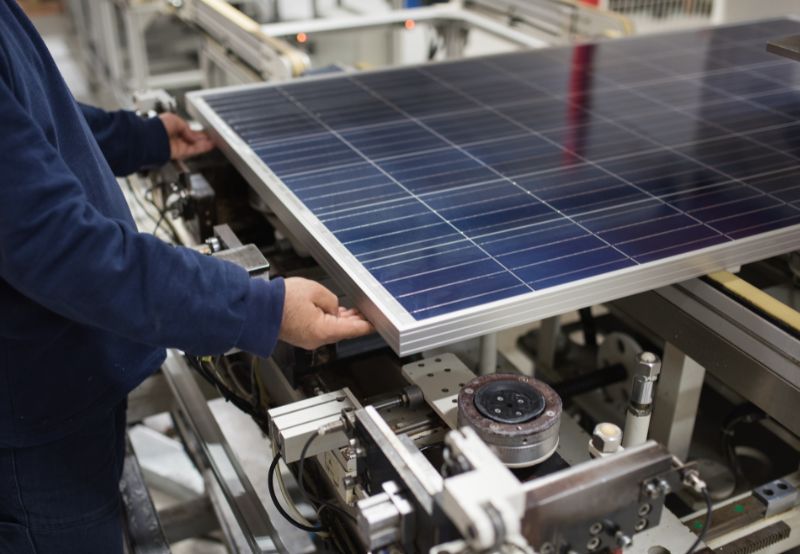
The university operates a 1 MW multi-technology, grid-connected solar park that has been active since 2011, providing students with exposure to real-time solar performance. It also commissioned a 45 MW solar module manufacturing line in 2024 that replicates an industrial production environment and offers hands-on training on equipment such as stringer machines, lamination presses, and electroluminescence testers.
Pankaj Yadav, Associate Professor at the Department of Solar Energy, explains, “Students here don’t just learn about solar manufacturing, they work directly on production-grade systems.”
Echoing this view, Abhijit Ray, Professor in the Department of Solar Energy, said such infrastructure ensures students are exposed simultaneously to both systems-level and manufacturing-level challenges, a combination rarely available in academic settings.
Krishnan also emphasized the need for embedded infrastructure. “We need ‘labs-on-campus’ where industry brings in actual manufacturing equipment. Training cannot happen in abstraction. It has to mirror real production environments,” he added.
Faculty Gaps
Another challenge is the shortage of faculty with direct industry experience. Even leading institutions continue to face significant staffing gaps. “There is a large shortage of faculty, even at IIT Madras. We would like to have significantly more,” Tambe said.
To address this, new roles such as “Professor of Practice” have been introduced, enabling industry professionals to teach for short durations and bring practical insights into academic programs. The relatively short tenures are designed to ensure a continuous influx of industry expertise into classrooms.
At PDEU, faculty recruitment places strong emphasis on international research exposure and applied industry expertise.
Joint R&D and Innovation Ecosystems
Looking ahead, deeper collaboration in research and innovation could play a transformative role in strengthening India’s solar manufacturing ecosystem.
“Joint research and development (R&D) projects between academia and industry are critical,” said Krishnan. “Students should work on real manufacturing challenges, including improving yield, reducing material consumption, and minimizing defects in crystal growth.”
Such collaborations not only enhance practical learning but also contribute directly to industry competitiveness and manufacturing efficiency.
Standardization and Certification
Another gap is the absence of standardized skill benchmarks across the solar sector.
“India needs national-level certification frameworks for solar technicians. This ensures consistency in quality across the sector,” Krishnan noted.
He also recommended aligning academic programs with national skill frameworks and working closely with the Skills Council for Green Jobs to ensure that training programs meet industry-defined qualification standards.
No Feedback Mechanism
Evaluating whether graduates are truly industry-ready remains a complex challenge. Most institutions rely on placement statistics as the primary indicator of success. “There is no systemic feedback mechanism from industry after students graduate,” Tambe admitted.
However, PDEU adopts a broader and more outcome-oriented approach. Beyond placements, the university evaluates success through entrepreneurship, innovation, and research output.
The department notes that more than 15 companies have been founded by alumni, while over 200 startups have been incubated through the university ecosystem. Placement rates exceed 85%, with graduates joining companies such as Adani Solar, Waaree Energies, and Tata Power Solar.
“The most credible proof is not placement, it is company formation,” according to the university.
During a panel discussion at the Mercom Renewables Summit 2025, Raj Prabhu, CEO and Co-Founder of Mercom Capital Group, highlighted the growing talent gap as one of the biggest challenges facing India’s clean energy sector.
“India’s solar industry is scaling rapidly, but the talent pipeline has not kept pace with the market’s evolution. We regularly interview candidates across the industry, and many are still being taught technologies and business models that became irrelevant years ago. Companies are spending significant time and resources retraining graduates because the education system has not evolved alongside industry. Many students have told me they learned more about the market from reading Mercom India publications than from their college curriculum,” Prabhu said.
Sudeep Jain, Additional Secretary at the Ministry of New and Renewable Energy (MNRE), also acknowledged the need to modernize training programs. “Traditional approaches aren’t enough. We need to introduce renewable energy modules in engineering colleges, industrial training institutes, and vocational schools. Industry involvement is key to building effective curricula,” he said.
As India works towards its ambitious target of 500 GW of renewable energy capacity by 2030, demand for a skilled workforce in solar manufacturing is expected to surge. Engineering colleges must quickly align their curricula with the evolving requirements of the solar manufacturing ecosystem, particularly as the government increases its focus on domestic manufacturing across the value chain, from ingots and wafers to cells and modules.