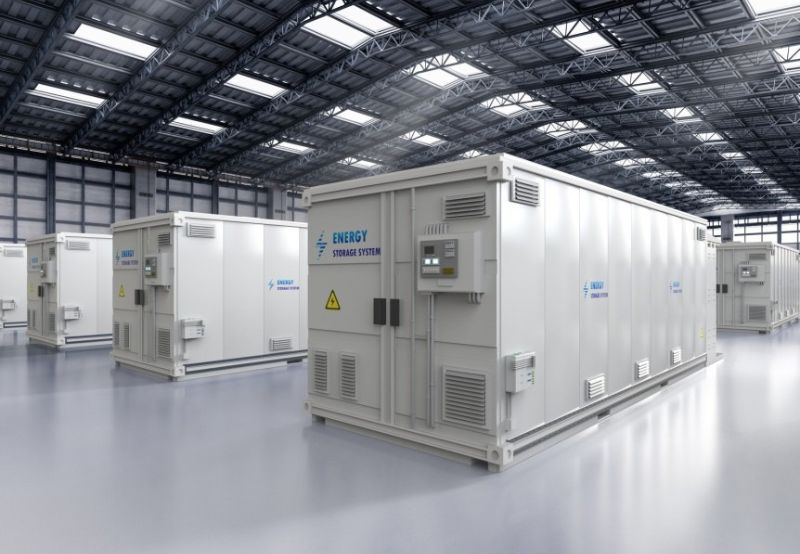
Uttarakhand Invites Bids for 250 MWh Standalone BESS Projects
The last date to submit bids is March 10, 2026
February 16, 2026
Follow Mercom India on WhatsApp for exclusive updates on clean energy news and insights
Uttarakhand Power Corporation (UPCL) has floated tenders to set up standalone battery energy storage systems (BESS) with a cumulative capacity of 100 MW/250 MWh.
The last date to submit bids is March 10, 2026. Bids will be opened on March 11.
The tenders were floated for three clusters.
Cluster A comprises 36 MW/90 MWh in Rudrapur, Kashipur, Haldwani, and Pithoragarh; Cluster B comprises 23 MW/57.5 MWh in Dehradun (Urban) and Dehradun (Rural); and Cluster C comprises 41 MW/102.5 MWh in Tehri, Haridwar, and Roorkee.
Bidders must submit an earnest money deposit of ₹36.1 million (~$398,598) for Cluster A, ₹23.1 million (~$255,059) for Cluster B, and ₹41.3 million (~$456,181) for Cluster C.
They must also submit a performance guarantee of ₹113.4 million (~$1.25 million) for Cluster A, ₹72.5 million (~$800,509) for Cluster B, and ₹129.2 million (~$1.43 million) for Cluster C.
Bidders must submit a tender fee of ₹29,500 (~$325.72) for each cluster. Projects can avail of up to ₹1.8 million (~$19,874.7)/MWh per project.
They must also submit a document processing fee of ₹845,000 (~$9,333) for Cluster A, ₹540,000 (~$5,963) for Cluster B, and ₹963,000 (~$10,636) for Cluster C.
The projects are estimated at ₹1.8 billion (~$19.87 million) for Cluster A, ₹1.16 billion (~$12.81 million) for Cluster B, and ₹2.06 billion (~$22.75 million) for Cluster C.
Successful bidders must sign a battery energy storage purchase agreement (BESPA) with UPCL for 12 years after the commercial operation date. They must also complete the projects within 12 months from signing BESPA or handing over the projects.
The scope of work covers site survey, design, engineering, financing, supply, installation, testing, commissioning, operation, and maintenance of grid-connected battery energy storage system (BESS) projects.
The BESS must be designed for UPCL to charge and discharge on an on-demand basis as per the dispatch instructions issued by the state load dispatch center/system operations wing of UPCL.
The projects must discharge for a minimum of 2.5 hours per cycle and for two cycles per day.
They must be interconnected at UPCL’s 33 kV distribution network.
The projects can be technology agnostic. Successful bidders can also use lithium-ion battery storage technology.
UPCL will provide land with its 33/11 kV substation for the installation of BESS under a right-of-use agreement.
Successful bidders must bear all costs related to transmission and evacuation infrastructure from the BESS up to the point of inclusion.
The BESS must provide real-time visibility, through SCADA integration, on state of charge, readiness for remote operation, cumulative energy imported/exported, and other operational and health parameters to UPCL’s control systems.
Successful bidders must deploy a battery management system and an energy management system (EMS) along with the BESS projects. The EMS must be developed in India.
UPCL is planning the BESS for arbitrage and to provide ramping support for the grid.
The BESS must be available for at least 95% of the time and guarantee an AC-to-AC round-trip efficiency of 85%.
Bidders must have developed a single standalone BESS of 63 MWh or two projects of 36 MWh, or three projects of 11 MW in the last seven years. The projects must have been commissioned before March 31, 2025.
Alternatively, they may have completed a single solar plus BESS project totalling 25 MW, or two solar plus storage projects totalling 14 MW, or three projects totalling 11 MW in the last seven years. The projects must have been completed before March 31, 2025.
Bidders must have designed, engineered, and constructed substations from 400 kV to 33 kV voltage level with a single project of at least ₹1.26 billion (~$13.91 million), or two projects of ₹720 million (~$7.95 million) each, or three projects of ₹540 million (~$5.96 million) each in the last seven years. The projects must have been operational for at least two years.
They may be an engineering, procurement, and construction contractor/developer of renewable energy projects, having commissioned a single project totalling 25 MW over the last seven years. Each project must be at least 8 MW and operational for at least 2 years. The projects must have been connected up to at least the 33 kV level.
Bidders may be an original equipment manufacturer of containerized battery energy storage systems or an entity holding an Indian manufacturing license agreement with a BESS manufacturer. The BESS manufacturer must have supplied a cumulative BESS capacity of at least 100 MWh, with each project having a capacity of at least 15 MWh.
Bidders must have a positive net worth in the last three financial years and a minimum annual turnover of at least ₹541.5 million (~$5.97 million) in the best three years of the last five financial years.
They must also have liquid assets and/or evidence of access to or availability of fund-based credit facilities of at least ₹361 million (~$3.98 million),
Recently, UJVNL floated a tender to set up a 16 MW/40 MWh BESS at the Pathri substation and hydroelectric project in Uttarakhand’s Haridwar district.
It also floated two tenders to set up 15 MW/37.5 MWh standalone BESS each in the Udham Singh Nagar and Dehradun districts of Uttarakhand.