


US Solar Module Imports Plunge 78% as Domestic Manufacturing Expands: Crux
New import origins emerged aside from the Southeast Asian countries impacted by customs duties
October 5, 2026

Follow Mercom India on WhatsApp for exclusive updates on clean energy news and insights
The value of crystalline silicon (c-Si) solar module imports into the U.S. fell 78% between the first half (1H) of 2024 and 1H 2026, as trade enforcement measures and domestic manufacturing incentives reshaped the country’s solar supply chain, according to a white paper by Crux.
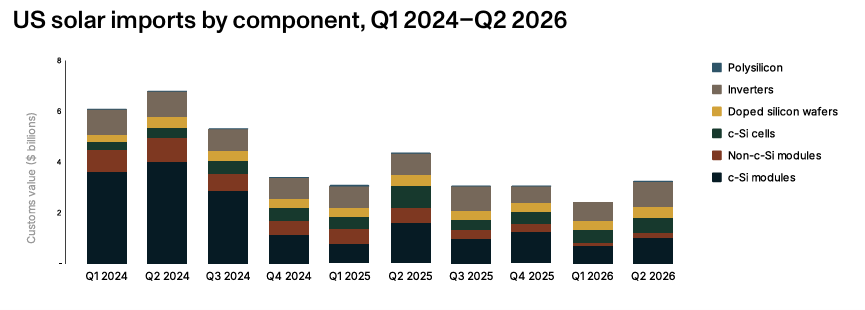
Module import value fell from $7.6 billion in 1H 2024 to $1.7 billion in 1H1 2026. Southeast Asian countries covered by U.S. trade measures accounted for 86% of c-Si module import customs value in 1H 2024, but their share dropped to less than 2% two years later.
Imports from India, Indonesia, and Laos fell to 19% by H1 2026, according to later petitions filed in July 2025.
The Philippines (35%), Ethiopia (17%), and Nigeria, Kenya, and Djibouti (19%) emerged as alternative module import countries.
The shift followed several years of trade enforcement and industrial policies aimed at encouraging domestic manufacturing.
U.S. solar module manufacturing capacity increased roughly eightfold to 75.3 GW as of September 2026 since the 45X tax credit took effect under the Inflation Reduction Act (IRA). However, the C-Si technology dominates most of the capacity.
Between the first quarter (Q1) of 2022 and Q2 2026, investments in solar, batteries, and critical minerals received investment amounting to roughly $185 billion in announced investments against about $17.5 billion in canceled investments.
Solar Upstream Supply Chain
The Crux whitepaper observed that China continues to dominate global silicon production; however, Brazil, Canada, and Norway led as silicon import origins between 2021 and 2024.
The U.S. still depends heavily on China for solar wafers; China accounts for about 95% of global manufacturing capacity.
The value of cell imports increased 50% between 1H 2024 and 1H 2026, even as module import value declined sharply.
Domestic manufacturers identified solar glass as one of the most significant remaining components without domestic supply at scale or a dedicated manufacturing incentive.
Energy Storage
Domestic lithium iron phosphate (LFP) module and storage system manufacturing capacity of approximately 75 GWh annually is sufficient to meet current demand. However, cathode active material (CAM) and anode active material (AAM) remain major bottlenecks.
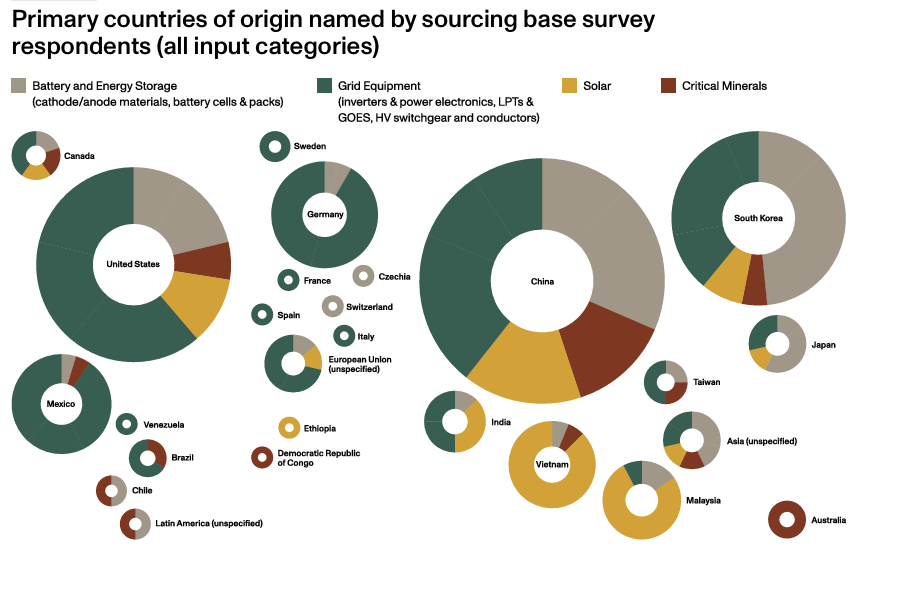
China accounted for 98% of global LFP cathode material manufactured in 2025, compared with 67% for nickel-based cathode material.
Battery imports have also shifted away from China, though not entirely onshore. China accounted for 72% of lithium-ion battery import customs value in 1H 2024, falling to 40% in 1H 2026.
Over the same period, Japan, South Korea, and Malaysia’s combined share increased from 14% to 40%.
Chinese graphite import customs value fell by 90%, taking China from 67% of the category total to 6%, while Indonesia rose from no recorded shipments to 53% of the category in 1H 2026.
Grid Equipment
U.S. manufacturers supplied approximately 30% of domestic large power transformer (LPT) demand as of 2023.
Mexico, South Korea, and Canada accounted for between 54% and 55% of grid equipment import customs value in both 1H 2024 and 1H 2026. Total import value rose from $4.6 billion to $7 billion in 1H 2026.
Import dependence is particularly high for critical inputs and larger equipment. The U.S. relies on imports for nearly 90% of high-grade grain-oriented electrical steel used in transformers, while approximately 80% of finished LPTs with power-handling capacity exceeding 100 MVA are imported.
Deployment of transmission infrastructure was also constrained by permitting and construction timelines. Transmission infrastructure can take more than five years to permit, site, and construct, while electricity demand from data centers can come online within months.
Critical Minerals
Half of the surveyed companies sourcing critical minerals reported less than 25% domestic content.
U.S. Geological Survey data shows net import reliance of 100% for natural graphite, 79% for cobalt, and 67% for rare earth metals and compounds. China was either the leading or a major supplier for 14 of the 31 critical minerals for which U.S. net import reliance exceeded 50% in 2025.
Refined copper cathodes accounted for nearly all of the customs value growth over the two-and-a-half-year period, as the total rose from $4.4 billion to $12.9 billion. Chile accounted for 52% of total critical mineral import customs value in 1H 2024 and 44% in 1H 2026.
The average period between mineral discovery and production increased to about 17.9 years during 2020-2023, up from 12.7 years during 2005-2009.
Meanwhile, 89% of the surveyed companies said at least some of their most tariff-exposed inputs lacked a domestic substitute available at a competitive price. Forty-seven percent said the absence of a domestic producer, or insufficient domestic manufacturing scale, was the biggest barrier to securing their most constrained inputs.
Manufacturing Incentives
Industry respondents favored combining trade measures with incentives rather than relying on tariffs alone.
The findings also highlighted the importance of sequencing trade restrictions with domestic manufacturing incentives, as restricting foreign supplies before domestic or allied alternatives reach sufficient scale could increase costs and affect project financing.
The U.S. announced a 15% additional tariff on certain polysilicon products and set minimum import prices (MIP) for polysilicon, wafers, and solar cells and modules, effective December 4, 2026, regardless of the country of origin. The MIP and tariffs aim to increase domestic polysilicon production.
Despite strong growth in the domestic solar sector, the U.S. clean energy sector lost 36,949 jobs in 2025, reversing four consecutive years of employment growth, according to E2’s Clean Jobs America 2026 analysis.


Melvin Mathew
More articles from Melvin Mathew.