


Solar to Become World’s Largest Power Source by 2032: Report
Energy transition investment must more than double by 2030 to align with the net-zero pathway
May 29, 2026

Follow Mercom India on WhatsApp for exclusive updates on clean energy news and insights
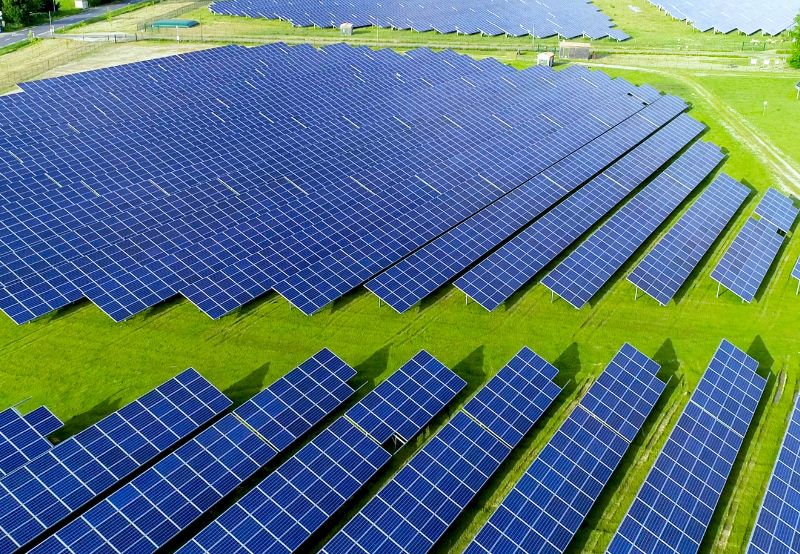
Annual solar installations rose nearly ninefold from 75 GW in 2016 to 655 GW in 2025, with solar expected to become the largest zero-carbon power source by the end of this decade before overtaking all other generation sources by 2032. The findings are part of BloombergNEF’s New Energy Outlook 2026.
BloombergNEF’s Economic Transition Scenario assumes no major new climate policy and models evolve as technologies compete on cost. Its Net Zero Scenario outlines a pathway well below 2 °C aligned with the Paris Agreement.
The report says the shift to solar, batteries, electric vehicles, heat pumps, and other clean technologies can improve energy security by reducing exposure to fossil-fuel price shocks and reliance on imports.
Asian economies with high energy import exposure, including Vietnam, Japan, Indonesia, and India, are expected to benefit significantly. Energy imports accounted for 3% to 6% of gross domestic product in these markets in 2025, and the report says this exposure can decline sharply by 2035 and further by 2050.
Electricity demand to rise 69% by 2050
Electricity is expected to become the largest source of final energy by 2047 under the Economic Transition Scenario and by 2037 under the Net Zero Scenario.
Electricity accounted for 21% of final energy in 2025, second to oil products at 38%. BloombergNEF expects global electricity demand to rise 29% by 2035 and 69% by 2050 under the Economic Transition Scenario.
Electric vehicles, data centers, buildings, industry, air conditioning, and heat pumps will drive the increase.
Data centers are emerging as a major source of new load. Their electricity use is expected to more than triple by 2035, reaching 5.4% of global power demand. BloombergNEF estimates data centers could account for 23% of demand in the U.S. PJM market, 18% in Malaysia, and 15% in the U.K. by 2035.
The report says data center demand could require about 1,000 GW of utility-scale solar, 400 GW of battery storage, 370 GW of gas, and 110 GW of coal capacity by 2050. However, 51% of incremental generation to serve data centers by 2050 may still come from new and existing fossil-fuel generators, raising power-sector emissions risk.
Batteries to grow 17-fold
BloombergNEF has raised its outlook for battery storage deployment. Storage capacity is projected to rise from 223 GW in 2025 to 3.8 TW by 2050 under the Economic Transition Scenario.
The report says lithium-iron phosphate battery products are becoming increasingly commoditized, driving prices down faster than previously expected. China’s top 10 lithium-iron phosphate battery suppliers hold a combined 47% share of the domestic market, suggesting a fragmented supply base.
Batteries are expected to help shift midday solar generation to evening hours. However, the report cautions that battery economics weaken as renewable penetration rises and storage assets are no longer fully cycled daily.
Long-duration storage technologies are attracting investment and moving toward cost competitiveness. Still, the report says they have not yet reached sufficient scale to affect BloombergNEF’s grid modeling over the next 10 to 25 years.
Power systems will also need more demand-side flexibility. By 2035, about 11% of generated megawatt-hours are expected to be shifted, up from 3% today, using batteries, pumped hydro, and flexible demand measures such as smart electric-vehicle charging.
Oil and gas diverge
The report says oil and gas will move in different directions under the Economic Transition Scenario.
Global oil demand is expected to peak around 2029 and decline by 2050 to levels last seen in the early 2000s, mainly due to the electrification of road transport. Electric vehicles are already reducing gasoline demand in markets such as China and are expected to have a growing impact across Southeast Asia and Latin America.
Gas demand, however, is expected to grow under the Economic Transition Scenario, supported by power generation, data centers, industry, and transport. BloombergNEF expects gas to surpass oil as the largest share of primary energy by the middle of the 2040s.
Under the Net Zero Scenario, both oil and gas decline. Gas peaks in the early 2030s before entering structural decline through 2050.
Coal is expected to continue losing ground in power generation. Its share of global power generation peaked at 41% in 2011 and is projected to fall to around 8% by 2050 under the Economic Transition Scenario.
The report says coal will remain in the energy system because of existing assets, round-the-clock power needs, and its role in industrial and non-energy applications. Under the Net Zero Scenario, unabated coal without carbon capture and storage is phased out of the power system.
China to lead emissions cuts
China remains the world’s largest emitter, with annual carbon dioxide emissions roughly twice those of any other country. BloombergNEF estimates China’s energy-related emissions peaked in 2023-2024 at over 11 GtCO2.
Under the Economic Transition Scenario, China’s emissions fall to 9 GtCO2 by 2030, 17% below their peak. By 2050, they will have declined nearly 50% from the peak.
Europe and the U.S. also continue reducing emissions after peaking in 2006 and 2007, respectively. However, the report says these reductions are insufficient to address climate change adequately.
Global emissions fall 21% between now and 2050 under the Economic Transition Scenario and are about 40% below a no-transition pathway by 2050. This trajectory is linked to a 2.4 °C warming outcome by 2100.
The Net Zero Scenario is consistent with a peak temperature rise of 1.81 °C by 2049 and 1.73 °C by 2100. BloombergNEF says the window for limiting warming to 1.5 °C using currently available, credible technologies has effectively closed.
Investment gap remains large
Energy transition investment reached a record $2.3 trillion in 2025, broadly in line with the Economic Transition Scenario.
Under that scenario, annual investment must average $3.1 trillion during 2026 to 2030 and $3.7 trillion during 2031 to 2035.
The Net Zero Scenario requires a much larger increase. Annual low-carbon investment must average $4.8 trillion during 2026 to 2030, more than double the 2025 level, and rise to $7.7 trillion during 2031 to 2035.
The largest absolute investment gap is in electrified transport. Carbon capture and storage records the fastest relative growth from a low base.
BloombergNEF says clean power provides the largest emissions reduction under the Economic Transition Scenario, accounting for 60% of abatement by 2050 compared with a no-transition pathway. Electrification accounts for 27%, energy efficiency for 9%, and hydrogen and bioenergy for around 2% each.
Current technologies remain insufficient
The report identifies electric vehicles, wind, solar, and batteries as the strongest drivers of clean technology. It expects heat pumps to grow slightly faster than previously projected and is somewhat more positive on nuclear power because of lower assumed closure rates for existing plants.
However, this does not reflect major confidence in small modular reactors or large new nuclear projects outside the Asia Pacific.
The report lowers its outlook for low-emissions hydrogen because costs have risen in key markets and policy support has weakened.
In the Net Zero Scenario, carbon capture and storage plays a smaller cumulative role than in the previous outlook, down by around one-third. It remains critical for hard-to-abate sectors and aims to reach around 7 GtCO2 of annual capture by 2050.
Hydrogen demand reaches around 290 million metric tons by 2050 in the Net Zero Scenario, around one-third lower than previously expected, reflecting weaker economics and a more targeted role in hard-to-abate sectors.
BloombergNEF says the next major low-cost clean energy technology has not yet emerged despite climate-tech firms raising over $500 billion since 2021, including $225 billion in venture capital and private equity for early-stage innovation.
India installed 15.3 GW of solar capacity in Q1 2026, its highest-ever quarterly total, according to Mercom India’s Q1 2026 India Solar Market Update Report. Additions rose more than 143% year-over-year from 6.3 GW in Q1 2025, and nearly 49% quarter-over-quarter from about 10.3 GW in Q4 2025.


Arjun Joshi
More articles from Arjun Joshi.