


Solar Module Manufacturers May Face Cell Supply Shortage for 6-7 Months: Interview
As India's solar manufacturing becomes more localized, its competitiveness in international markets will continue to improve
July 23, 2026

Follow Mercom India on WhatsApp for exclusive updates on clean energy news and insights
The rush to comply with the Approved List of Models and Manufacturers (ALMM) guidelines for solar modules and cells has sparked concerns among industry stakeholders about a potential mismatch between demand and supply and delayed project timelines.
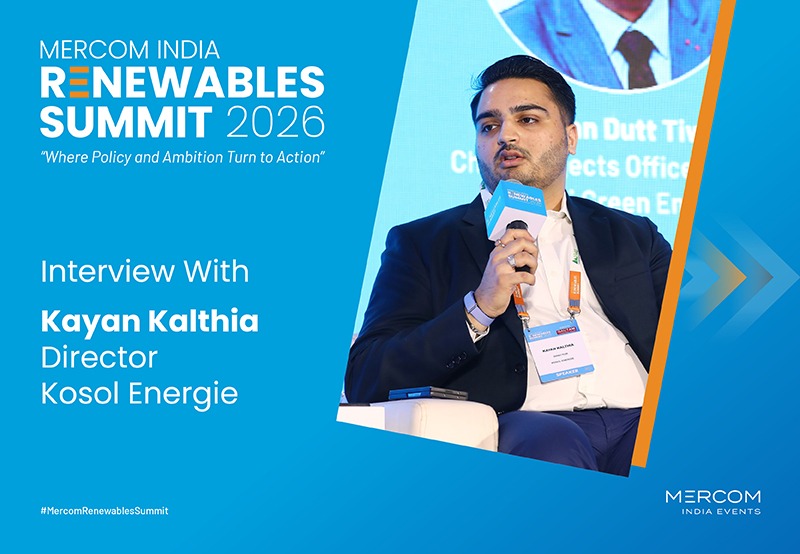
While module manufacturers are gearing up to increase production and meet demand, Kayan Kalthia, Director at Kosol Energie, feels the sector might face cell supply constraints for another six to seven months before new domestic capacity stabilizes the market.
In an interview on the sidelines of the Mercom India Renewables Summit 2026, held in New Delhi on July 1 and 2, Kalthia talks about India’s solar manufacturing ecosystem, export opportunities, timelines for the Approved List of Models and Manufacturers (ALMM), battery energy storage, and Kosol’s plans to foray into battery cell manufacturing.
The following are edited excerpts from the interview.
Given the wide gap between ALMM-listed module capacity and cell capacity, how much domestic cell capacity is currently available to independent module manufacturers?
Cell manufacturers are making every effort to increase supplies, but the number of module manufacturers far exceeds the available domestic cell capacity. Currently, only about 20% to 25% of India’s domestic cell production is available to independent module manufacturers, well below what the market requires.
The industry had anticipated this shortage and is prepared to deal with it. I expect the next six to seven months to remain challenging, but additional cell manufacturing capacity should come online and stabilize the market after that period.
Kosol has been in the industry since 2012, and our long-standing relationships with cell manufacturers have helped us secure supplies.
With more than 250 GW of module manufacturing capacity announced or under construction, where can this additional capacity be sold?
Selling that additional capacity will be difficult, regardless of the market. Europe continues to be largely dominated by Chinese manufacturers. In markets where non-Chinese sourcing requirements are emerging, there are more economical Southeast Asian suppliers than Indian manufacturers.
The industry needs to take a hard look at where it is allocating capital. It also needs to consider new ways of deploying this power. Data center capacity is expanding rapidly, and if grid connectivity becomes a constraint for these facilities, off-grid power systems could create another avenue for deploying additional module manufacturing capacity.
The U.S. was previously a significant market for Indian exporters. Do you see any other export markets emerging for Indian modules?
Even when India exported significant volumes to the U.S., exports were concentrated among a relatively small number of manufacturers. Most of those select exporters now have their own cell manufacturing capacity.
Alternative markets exist, but Indian manufacturers will continue to face strong competition from Chinese suppliers. The more indigenized Indian manufacturing becomes, the more competitive it can be internationally.
However, selling modules compliant with domestic content requirements in India is currently more viable than exporting them. Kosol continues to export because of its technological capabilities and advances in module technology, which help us maintain a competitive edge. I am unsure about how many recently established module manufacturers have approached the market with the same focus.
The industry faced bottlenecks when the ALMM lists I and II were introduced, and there is now a timeline for ingot and wafer manufacturing. Should the government reconsider these timelines?
I do not think the timelines should be reconsidered. By maintaining the deadlines, the government has demonstrated that it will not continue moving the goalposts. That provides investors with greater confidence and makes it easier to raise capital for further vertical integration.
Many cell manufacturing projects have been announced, and India may have to face an overcapacity phase. However, I believe that it could be beneficial for the sector because it may open export markets for Indian manufacturers.
An ingot and wafer manufacturing facility takes around two years to establish. Since the government is maintaining the implementation timeline, investors are more confident and willing to commit capital to these projects.
Which segments are most likely to drive energy storage demand: commercial and industrial (C&I), residential, or public utility projects?
Public utility projects will see the largest growth because their business case and project parameters are easier to define and evaluate.
However, the C&I segment could offer higher internal rates of return. India is moving toward time-of-day tariffs, with different tariffs during solar and non-solar hours. The wider that difference becomes, the more viable battery energy storage systems will be for commercial, industrial, and residential consumers.
In some developed markets, the tariff difference can be as high as six times. At that level, battery storage becomes highly attractive and almost mandatory.
India still depends heavily on China for battery cells. How do you see the battery value chain becoming more indigenous? What are the main bottlenecks?
I expect domestic battery cell manufacturing to develop quickly. The solar manufacturing experience has demonstrated that the Indian government supports indigenous manufacturing.
Kosol is actively moving toward battery cell manufacturing because we expect the government to continue supporting domestic production. Based on our experience in solar manufacturing, we also expect to have excess capacity that can serve other battery assembly companies entering the market.


Arjun Joshi
More articles from Arjun Joshi.