SJVN Green Expands Operational Capacity of Bikaner Solar Project to 830 MW
The company recently commissioned a capacity of 100.56 MW at the project
December 16, 2025
Follow Mercom India on WhatsApp for exclusive updates on clean energy news and insights
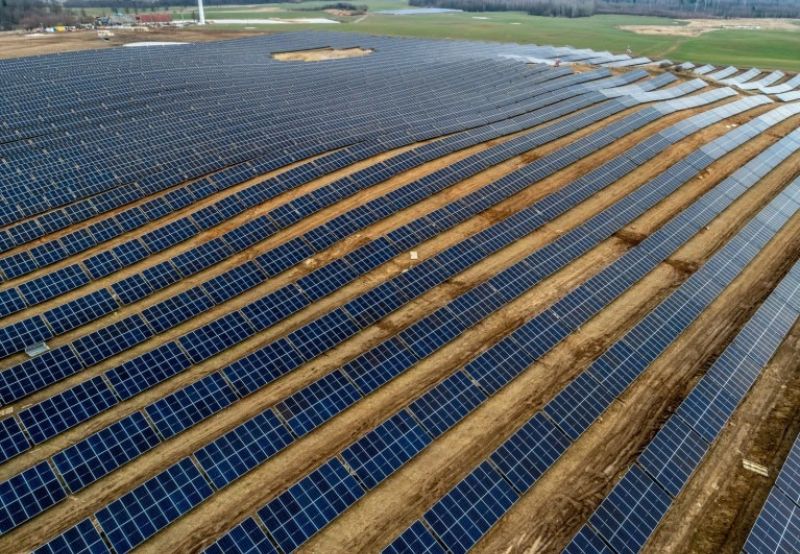
SJVN Green Energy has commissioned 100.56 MW of its 1 GW Bikaner solar project in Rajasthan, bringing its total operational capacity to 830.7 MW.
In October, SJVN commissioned a capacity of 128.88 MW.
During the second quarter (Q2) of the financial year (FY) 2026, SJVN also commenced the construction of a 200 MW solar project, part of the Omkareshwar Solar Project Phase 17 in the Khavda Solar Park, Gujarat. This project is expected to generate approximately 505 million units in its first year.
In August, SJVN Green invited bids for the engineering, procurement, and construction of 500 MW solar projects near the 220 kV Bikaner-IV substation at Ambaran, in Rajasthan.
The company’s Q2 revenues from the wind and solar business rose 104.2% to ₹1.08 billion (~$12.26 million) from ₹532 million (~$6 million) in Q2 FY 2025.
According to the Q3 2025 India Solar Market Update Report by Mercom India Research, the country added 26.6 GW of solar capacity in the first nine months (9M) of the calendar year 2025, an increase of 53.7% year-over-year from 17.3 GW.
Large-scale solar accounted for 81.5% of the capacity commissioned in 9M 2025, with solar open access projects accounting for 28.3%. Rajasthan was the top state in cumulative large-scale solar installations, accounting for over 29.5%.
Despite the state seeing many large-scale solar projects, inadequate grid infrastructure led to significant wind and solar curtailments in 2025, resulting in substantial financial losses for developers.
According to the state’s load dispatch center, Rajasthan Rajya Vidyut Prasaran Nigam, Rajasthan has an estimated spare transmission capacity of up to 13 GW in the financial year 2026 for future renewable energy projects, Rajasthan will have up to 1.4 GW of spare transmission capacity in FY 2027 and up to 3.9 GW of capacity in FY 2028. The available transmission capacity will drop to 1.9 GW by FY 2029.