

Renewable Manufacturing Needs a New Generation of Skilled Engineers: Interview
The skills gap must be closed in five years to prevent it from constraining the industry’s growth
August 10, 2026

Follow Mercom India on WhatsApp for exclusive updates on clean energy news and insights
India’s renewable energy ambitions are creating demand for a new generation of engineers, researchers, and manufacturing professionals with specialized skills. However, the workforce pipeline has struggled to keep pace with rapid growth in solar manufacturing, energy storage, green hydrogen, and other emerging clean energy technologies.
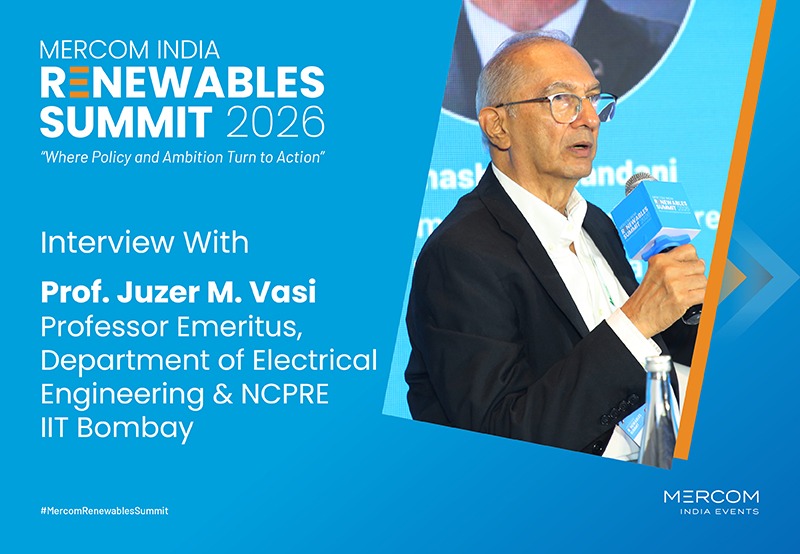
In an interview on the sidelines of the Mercom India Renewables Summit 2026, Juzer M. Vasi, Professor Emeritus, Department of Electrical Engineering, and associated with the National Centre for Photovoltaic Research and Education (NCPRE) at IIT Bombay, discussed the shortage of skilled professionals in the renewable energy sector, the need to align academic training more closely with industry requirements, and the importance of introducing more specialized courses tailored to the sector.
Vasi emphasized that the workforce skills gap must be addressed within the next five years to prevent it from becoming a constraint on industry growth.
Edited excerpts from the interview:
As renewable energy expands and India scales up solar, wind, and energy storage, do you think the existing workforce pipeline is growing fast enough to meet the demand?
India is deploying renewable energy at a rapid pace, and we obviously need competent and skilled people to support that growth.
At the same time, manufacturing is expanding significantly. India now has almost 200 GW of module manufacturing capacity, while cell manufacturing capacity is ramping up.
This manufacturing expansion will require an entirely different set of professionals from those involved in project deployment. These professionals must also have a strong understanding of solar cell manufacturing processes and hands-on experience in fabrication laboratories.
Where do you see the most serious skill gaps: manufacturing, project implementation, or R&D? Which area needs the most attention?
There is certainly a gap on the deployment side, but I believe it can be filled relatively quickly. If someone joins a company, they can probably become quite competent within a few months.
Manufacturing is comparatively more difficult because it requires more specialized skills, particularly in cell manufacturing, where highly skilled engineers are needed.
Research and Development (R&D) is even more demanding because professionals need to understand the process in considerable detail. They must not only operate existing processes but also develop new ones. Solar technology is changing very rapidly, and unless companies continuously upgrade and adapt, they will no longer remain globally competitive.
R&D therefore requires significantly more effort and professionals trained in research laboratories for several years before they can become competent R&D engineers.
What are the primary reasons for the shortage of skilled workers in the renewable energy sector, and how can the gap between academia and industry be bridged?
Solar has grown very rapidly over the past seven or eight years. On the other hand, it is not easy for educational institutions to change their programs and curricula at the same pace. That has created a significant gap.
However, if industry and academia work together, there are several ways to address this problem. The gap may not disappear completely, but stronger collaboration can narrow it substantially.
Does India have enough specialized university and college courses to train the workforce required by the solar and renewable energy sectors?
I do not think we have enough courses at present, partly because academia is only now beginning to fully recognize the importance of solar and the number of jobs the sector is likely to create.
I should mention one program we ran through the National Center for Photovoltaic Research and Education at IIT Bombay. When we launched the center many years ago, we saw a significant shortage of people capable of contributing effectively to the National Solar Mission.
We realized that, one institution alone could not train the large workforce India required. We therefore launched a 40-hour intensive program called “Teach a Thousand Teachers.” It was conducted online and distributed nationwide, with about 1,050 teachers participating.
We also sent lab kits to around 40-50 remote centers so that teachers could learn to use them and later incorporate them into training for their own students.
Eventually, we distributed around 200 lab kits to colleges across the country. Something similar is now needed again because the sector has moved to a different level, and the training requirements have also evolved considerably.
What kind of government support is required to address the renewable energy sector’s skills gap?
Regarding training and education, the “Teach a Thousand Teachers” program was fully funded by the Ministry of New and Renewable Energy (MNRE). Even the 200 lab kits were funded by the Ministry rather than by the engineering colleges that received them.
Government funding is essential. One may ask whether such funding should come from the Ministry of Education, since this is fundamentally an educational initiative.
However, the Ministry of Education looks after a very broad range of areas. MNRE should support such initiatives because the workforce requirements are being driven directly by renewable energy growth.
The funding required is not necessarily large, and there are several innovative ways to structure such initiatives.
I can give another example from the nanoelectronics sector rather than solar energy.
We had a program called the Indian Nanoelectronics Users Program. At the time, Ministry of Electronics and Information Technology, which oversees nanoelectronics, funded students, including PhD and other research students, from across the country to come to IIT Bombay and IISc, which were partners in the program.
Students could spend one week, two weeks, one month, or, in some cases, an entire semester in our laboratories. They were able to fabricate their own devices and gain real, hands-on experience with advanced equipment and instrumentation.
Around 700 papers were published by program participants, and more than 800 people used the facilities. Importantly, the intellectual property generated through the program belonged to the students and researchers themselves.
The patents, research publications, and PhD theses arising from the program belonged to the participants, while we provided the facilities and mentorship.
This had a significant impact on the semiconductor ecosystem. As India subsequently launched the India Semiconductor Mission, many of these people were well positioned to contribute effectively to it.
A similar program could play an important role in supporting the scale-up of India’s solar and renewable energy workforce.
Can India address the renewable energy skills gap within the next five to 10 years, and what steps are needed?
The skills gap at any level cannot be fully addressed in a couple of years. Some parts of it can be addressed quickly, but not all.
We must try to close this gap within about five years. Otherwise, the mismatch between industry requirements and the availability of skilled manpower could become large enough to constrain the sector’s growth.
Training and educational institutions therefore need to ramp up their capabilities quickly over the next five years.
We cannot wait 10 or 20 years. That would be far too long.
Are academic curricula adapting quickly enough to rapid technological changes in the solar sector?
Curricula are adapting. For example, we have a course on photovoltaic technology, and the content keeps changing as new technologies emerge.
What is more difficult is for entire academic programs to adapt. There are very few programs in India offering specialization at the bachelor’s or even master’s level in solar or renewable energy engineering. There are some, of course, but such structural changes happen more slowly.
We need more such programs. However, we must also remember that a bachelor’s, or even a master’s, program cannot be overly narrow in focus, because students ultimately need the flexibility to choose the areas in which they want to work.
Degree programs should therefore remain broad enough to give students flexibility while offering deeper specialization in emerging renewable energy technologies.


Melvin Mathew
More articles from Melvin Mathew.