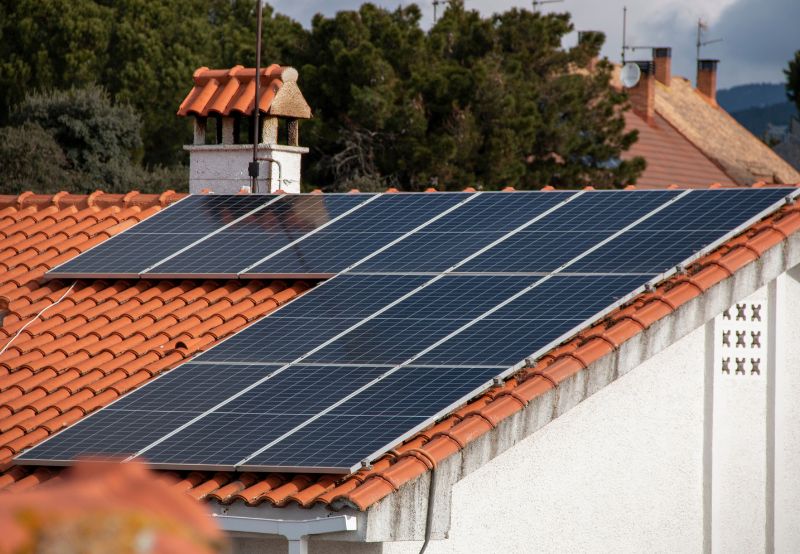
MNRE Amends PM Surya Ghar Service Charge Rules
The amendment introduces a phased disbursement mechanism for the service charges
December 31, 2025
Follow Mercom India on WhatsApp for exclusive updates on clean energy news and insights
The Ministry of New and Renewable Energy (MNRE) has amended guidelines for disbursing service charges under the PM Surya Ghar program, introducing operational clarifications for state and model solar village implementation agencies, while retaining the program’s overall financial framework.
The PM Surya Ghar program aims to enable 10 million residential rooftop solar installations across India during its implementation period up to the financial year (FY) 2026-27, with a total outlay of ₹750.21 billion (~$9.04 billion).
Of this, ₹6.57 billion (~$79.2 million) has been earmarked as service charges, equivalent to 1% of the central financial assistance (CFA) component provided to residential consumers, to support administrative, technical, and monitoring functions at national and state levels.
Clarified role of SIAs on the portal
Under the amended provisions, distribution companies (DISCOMs) remain designated as state implementation agencies (SIA) in their respective jurisdictions, with an explicit requirement that they be onboarded to the PM Surya Ghar Portal.
Expanded eligibility for additional SIAs
State governments are now specifically permitted to nominate a state renewable energy development agency as an additional SIA, replacing the earlier, broader provision that allowed nomination of a “different SIA.”
Execution focus shifted to DISCOM field units
The amendment also specifies that SIAs deploy dedicated resources to DISCOM field-level units, rather than to unspecified national and regional field units, to strengthen ground-level implementation capacity.
Service charge allocation
The base service charge allocation for SIAs remains unchanged at ₹2 billion (~$24.1 million) out of the total service charge pool of ₹6.57 billion (~$79.2 million). This amount is to be distributed among SIAs in proportion to the number of domestic consumers in the respective state or union territory, based on the latest ‘Central Electricity Authority General Report on the Power Sector’, subject to a minimum allocation of ₹5 million (~$60,200)/SIA.
The wording has been updated from SIAs “liable to receive” the service charge to “eligible to receive”, reinforcing that disbursement is contingent on compliance with program conditions.
The amendment clarifies that the domestic consumer base is to be counted at the state and union territory (UT) level, addressing potential ambiguity in interpretation. Disbursements continue to be structured as three equal annual instalments, released at the beginning of each financial year.
Reallocation rules strengthened
The revised guidelines also modify the framework for reallocating service charges when multiple agencies within a state or UT undertake PM Surya Ghar-related work. While state or UT Energy or Power Departments retain the authority to issue reallocation orders from the overall service charge accruing to SIAs, such reallocations must now conform to modalities determined by the Mission Director, adding a layer of supervision.
Model solar villages disbursement mechanism
For model solar villages, the definition of the model solar village implementation agencies remains unchanged, with the role usually assigned to the state renewable energy development agency or another agency designated by the state government.
The service charge remains at ₹500,000 (~$6,020) per model solar village for general states and ₹750,000 (~$9,040) for special category states and UTs, including Uttarakhand, Himachal Pradesh, Jammu and Kashmir, Ladakh, the Northeastern states, including Sikkim, and island territories such as the Andaman and Nicobar Islands and Lakshadweep.
However, instead of releasing the service charge only after completion, the amendment introduces a phased disbursement mechanism, i.e., 50% of the service charge is released upon the district-level committee’s selection of the village for preliminary activities, such as detailed project report preparation. The remaining 50% is released upon completion, along with the final CFA instalment.
In October this year, MNRE said 1% of the CFA component will be imposed as a service charge on rooftop solar installations under the PM Surya Ghar to provide financial support to implementing agencies.
In June this year, MNRE issued operational guidelines for implementing the PM Surya Ghar’s component for CFA to residential consumers.