Manufacturing, Storage Draw Capital as Clean Energy Financing Matures
Investors said clean energy companies need real offtake, governance, and execution history to attract capital
July 3, 2026
Follow Mercom India on WhatsApp for exclusive updates on clean energy news and insights
India’s clean energy financing landscape has expanded significantly over the past decade, but investors are becoming more selective as the market matures, with capital shifting toward manufacturing, grid infrastructure, battery storage, and differentiated business models, panelists said at Mercom India Renewables Summit 2026.
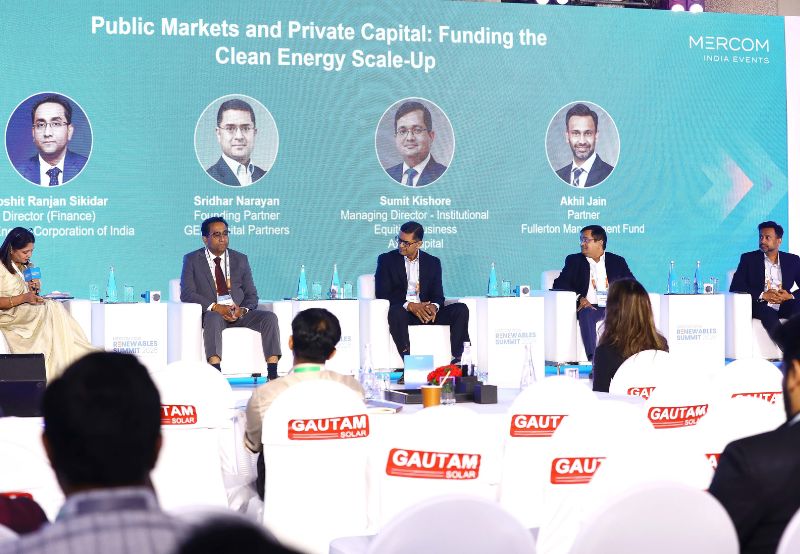
The session, titled “Public Markets and Private Capital: Funding the Clean Energy Scale-Up,” was moderated by Priya Sanjay, Managing Director at Mercom India. It featured Joshit Ranjan Sikidar, Director (Finance) at the Solar Energy Corporation of India; Sridhar Narayan, Founding Partner at GEF Capital Partners; Sumit Kishore, Managing Director, Institutional Equities Business at Axis Capital; and Akhil Jain, Partner at Fullerton Management Fund.
Opening the session, Sanjay said corporate funding in India’s solar sector has exceeded $24 billion since 2010, with investment increasingly shifting from downstream project development toward domestic manufacturing.
She said storage funding, though smaller than solar funding, has begun to rise as battery demand and grid flexibility needs increase.
Sanjay said clean energy public market activity has gained momentum, with the number of initial public offerings reaching a high in 2025. IPO activity has expanded across the value chain, including developers, engineering, procurement and construction companies, original equipment manufacturers, inverter companies, software providers, financing companies, and bioenergy businesses.
Sikidar said the availability of renewable energy financing has improved substantially over the past 10 to 15 years. Domestic banks, financial institutions, non-banking financial companies, infrastructure investment funds, and capital markets have expanded their lending, while sovereign wealth funds, foreign banks, and multilateral institutions have increased their participation.
He said instruments such as payment instruments and insurance bonds have helped bidders and developers participate in tenders by easing working capital pressure.
Sikidar said financing itself is no longer the primary constraint. Developers instead face challenges during loan disbursement because lenders often require extensive land documentation before releasing funds. Developers are finding it difficult to submit land documents before first disbursement because possession for execution may be available before formal documentation is complete.
He pointed to high prepayment penalties that discourage refinancing after projects are commissioned. In multi-bank funding structures, developers also face delays when decisions such as vendor replacement or project cancellation require approvals from all lenders.
Narayan said GEF Capital Partners typically invests $50 million to $100 million in equity and targets mid-stage growth companies with proven business models, profitability at scale, and clear expansion potential.
He said GEF previously invested in independent power producers when private equity returns were available in renewable projects. As the sector matured and returns compressed, the independent power producer segment became more suited to infrastructure funds and yield-based capital.
Narayan said GEF has shifted toward manufacturing businesses where private equity can generate stronger growth returns. The firm’s investments span power electronics, smart metering, solar module manufacturing, cables, conductors, and other grid infrastructure products.
He said renewable energy will face the same system-level issues as conventional power, including grid safety, reliability, and integrity. Battery energy storage and grid infrastructure products are expected to become a large part of the firm’s investment program over the next five years.
Kishore said investor appetite for clean energy companies remains strong, but public market investors have become more selective as more renewable energy companies seek listings.
He said companies that consistently execute their growth plans, maintain profitability, and demonstrate attractive project returns under existing tariff structures are more likely to attract investors. As more companies enter similar segments, investors increasingly compare new listings with listed peers, making differentiation more important.
Kishore said companies entering crowded listed segments such as solar photovoltaic manufacturing will be benchmarked against incumbents. Companies that lack scale or clear differentiation may have to accept valuations at a discount to established listed players.
Jain said growth equity occupies a relatively narrow space between venture capital and infrastructure investing. Fullerton typically invests earlier than larger private equity funds, taking minority stakes in companies with contracted revenues, proven business models, disciplined execution, and capital-efficient operations.
Fullerton looks for contracted revenues from real paying customers, rather than memorandums of understanding or early-stage announcements. In climate investments, he said customers must be willing to pay a price comparable to conventional alternatives, or lower, because that is what makes the business sustainable.
The discussion also examined financing challenges for hybrid and firm renewable energy projects.
Sikidar said the industry’s focus has shifted from adding renewable energy capacity to improving reliability, dispatchability, grid stability, and assured power delivery through firm and dispatchable renewable energy and round-the-clock projects.
He said these projects combine multiple technologies, increasing technical complexity for lenders. Many financial institutions still lack the in-house expertise to evaluate integrated renewable energy projects, while consultants often raise issues that do not fully reflect on-ground execution realities.
Revenue projections are also more complicated because hybrid projects include performance obligations and penalties that must be evaluated alongside construction risks and financing schedules, Sikidar said.
For Narayan, execution capability remains the single most important factor when evaluating investments. He said financial, tax, and legal diligence can often be completed within a few months, but investors spend considerably more time assessing management quality, decision-making, governance, and the ability to scale businesses successfully.
“The one thing that stands out among the companies that have done well is their ability to execute and scale,” Narayan said.
Kishore said similar considerations influence public market investors. Companies preparing for an IPO must demonstrate a credible operating history, strong management, disciplined project execution, and the ability to manage regulatory risks, transmission constraints, curtailment, and project cost overruns.
He said India’s long-term power demand growth continues to support the sector. Listed independent power producers, hybrid renewable energy companies, and pure-play renewable utilities have outperformed the Nifty year-to-date by about 10% to 25%, while some companies have outperformed by more than 50%.
Looking ahead, panelists identified several investment themes expected to attract increasing capital.
Kishore said battery storage, firm and dispatchable renewable energy projects, domestic battery manufacturing, transmission equipment, transformers, and wind energy all present long-term opportunities. Companies capable of delivering integrated renewable energy solutions combining solar, wind, and storage are likely to attract strong investor interest.
He said wind should not be overlooked because India is more self-reliant in wind manufacturing than in solar, with a large share of wind turbine components already produced domestically.
Kishore said transformer manufacturing could become another major investment opportunity as transmission infrastructure expands and global demand increases. Companies with export competitiveness in capital goods could benefit as other countries also face equipment shortages.
Jain said green hydrogen, ammonia, and other green molecules remain promising investment themes, provided projects secure real industrial customers and achieve cost parity with conventional alternatives.
He said many green hydrogen and ammonia announcements have not moved forward because they lack offtake. He also identified demand-side flexibility as an emerging opportunity. As smart metering expands and time-of-day tariffs become more common, companies providing demand management and energy flexibility services could benefit from the next phase of power sector development.
On project bankability, Sikidar said tender design plays a central role in attracting financing. Investors and lenders seek certainty around offtake, revenue mechanisms, and risk allocation. SECI develops new tender structures through consultations with developers, lenders, financial institutions, and government agencies to improve bankability.
He said SECI is piloting contract-for-difference tenders designed to deepen electricity markets while reducing commercial risks for project developers. If the pilot succeeds, more such tenders could follow.
The panel also discussed diversification strategies for renewable energy companies.
Narayan said companies should diversify only into businesses that build on existing capabilities, customer relationships, and supply chains.
Jain said investors distinguish durable businesses from companies benefiting from market sentiment by looking at whether they can survive without subsidies or thematic investor enthusiasm. He said durable companies typically have pricing power, proprietary processes, governance standards, operating history, and real customer traction.
He said red flags include weak governance, reliance on memorandums of understanding, dependence on short-term order books, and limited operating history.
Panelists concluded that capital remains available across India’s clean energy sector, but investors are placing greater emphasis on execution, differentiated business models, governance, bankable contracts, real offtake, and technologies that support the next phase of renewable energy deployment.