


Lithium Prices in China Drop Over 20% in September as Demand Weakens
China’s battery manufacturing capacity has expanded rapidly relative to demand
October 5, 2026

Follow Mercom India on WhatsApp for exclusive updates on clean energy news and insights
Lithium carbonate futures on Chinese markets plunged more than 20% in September 2026 amid weakening demand and concerns over excess battery cell production capacity.
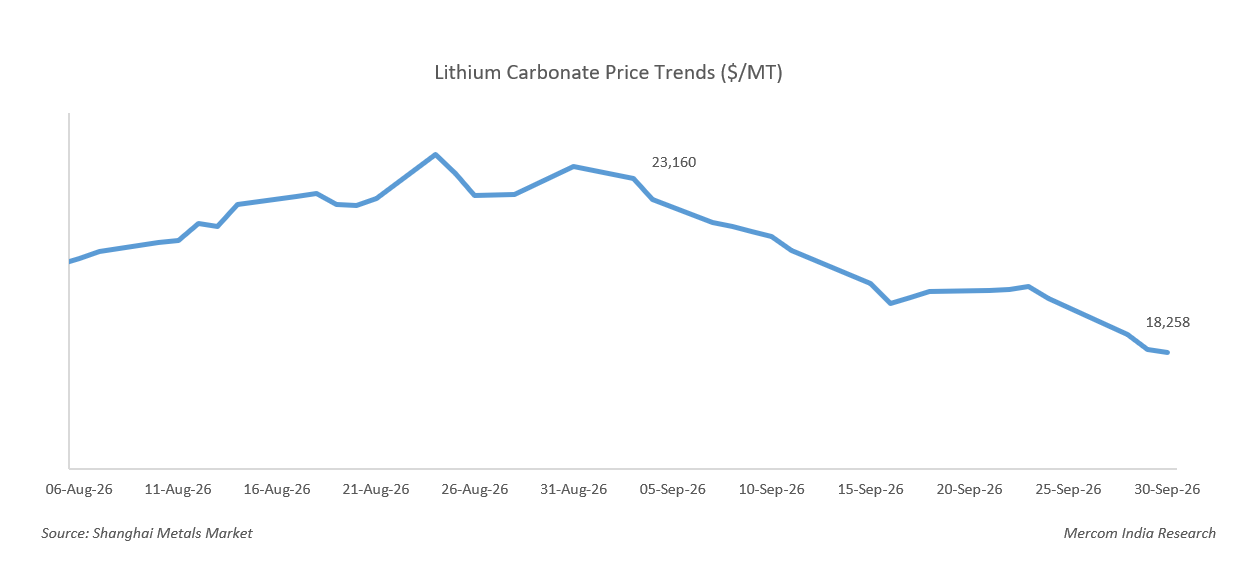
Lithium carbonate prices fell 21.2% to $18,258.32/metric ton (MT) on September 30 from $23,160.86/MT at the beginning of the month, according to Shanghai Metals Market price movements tracked by Mercom India.
Prices in August ranged between $20,677/MT to $22,710/MT.
The decline was sharper on the Guangzhou Futures Exchange, where lithium carbonate futures dropped about 25% to $16,850/MT from $22,470/MT at the start of September.
The market has remained highly volatile this year amid expectations of stronger global supply of the key battery material. A similar price decline was witnessed in July despite expectations of growing lithium carbonate demand from electric vehicle (EV) batteries and grid-scale energy storage systems.
Analysts at that time had predicted supply to increase further following the likely resumption of production at CATL’s Jianxiawo mine in China, and in Australia which could add an estimated 25,000 tons of lithium supply in the second half of the year. The additional production could ease supply constraints through 2027 and into 2028.
Lithium carbonate prices had bottomed out in 2025 before recovering earlier this year as mine supply constraints, strong exports, and growing demand from utility-scale battery energy storage systems tightened the market.
However, sentiment has weakened since mid-2026 amid concerns over whether demand can absorb the continued expansion in battery cell production through the end of the year.
China’s battery manufacturing capacity has expanded rapidly relative to demand, raising concerns about oversupply across the supply chain. Reports in September indicated that Chinese authorities had suspended approvals for new battery factories as part of efforts to curb excessive capacity expansion.
Policy changes have also weighed on demand expectations. Chinese authorities announced in July that batteries would be subject to consumption taxes beginning in September as part of measures aimed at curbing unrestrained industry growth.
The phased reduction of incentives that had helped lower EV purchase costs for buyers has also affected expectations for battery demand, adding pressure on the lithium carbonate market.
Despite the recent price decline, market watchers expect the lithium supply-demand balance to remain relatively tight through the end of 2026. Periodic inventory drawdowns could provide some support to prices when short-term supply deficits emerge.


B.S. Nagaraj
More articles from B.S. Nagaraj.