


Led by Utility-Scale Segment, US Storage Market Hits 18.9 GWh in Q2 2026
Average storage duration rose to 3.5 hours during the quarter
September 24, 2026

Follow Mercom India on WhatsApp for exclusive updates on clean energy news and insights
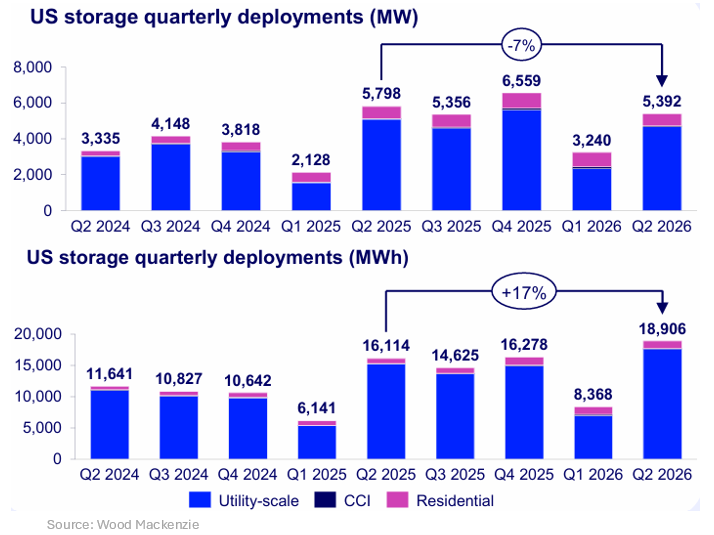
The U.S. energy storage market installed a record 18.9 GWh in the second quarter (Q2) of 2026, even as installed power capacity fell 7% year-over-year (YoY), according to a report by Wood Mackenzie.
The growth was driven by longer-duration utility-scale and residential systems.
Storage Market Trends
Average storage duration increased from 2.8 hours to 3.5 hours in Q2 2026, while energy capacity (MWh) grew 17% YoY.
The utility-scale segment added 4.7 GW/17.6 GWh, down 8% YoY. However, installations in the first half of 2026 rose 5% YoY. Project durations increased, supported by long-duration storage in California and utility-contracted projects in Texas.
Commercial and industrial installations totaled 48 MW, returning to typical levels after a record first quarter.
Residential installations reached 676 MW, up 3% YoY but down 15% quarter-over-quarter. The national storage attachment rate rose to 46% from 41% a year earlier. California, Texas, Puerto Rico, Arizona, and Illinois accounted for 88% of Q2 residential installations.
Storage Market Outlook
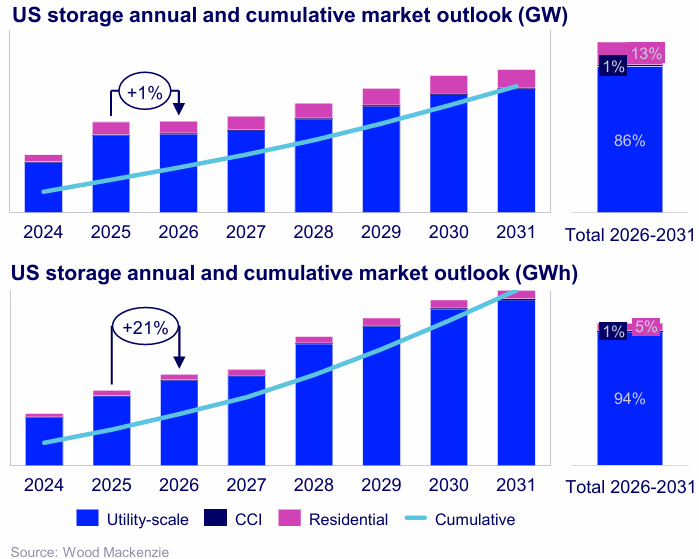
The U.S. energy storage market is projected to reach 207 GW/715 GWh of installed capacity by 2031, supported by rising electricity demand and growing renewable energy penetration.
More than 130 GW/534 GWh of utility-scale storage is expected to be deployed between 2026 and 2031. Installations are forecast to stagnate in 2026 and 2027 amid changing supply chain dynamics before recovering in 2028 and growing at an 11% average annual rate through 2031 as domestic cell manufacturing expands.
Commercial and industrial storage installations are projected to grow 29% annually from 2026 to 2031. California is expected to remain the largest market, while New York, Massachusetts, Illinois, Maryland, and Texas are likely to support the broader growth.
Residential storage installations are forecast to decline 4% in 2026. Excluding Texas, installations could fall 13% across the country, reflecting third-party ownership transition challenges, tight tax equity availability, and weak permitting activity.
According to a report by Wood Mackenzie and the Solar Energy Industries Association, solar and storage accounted for 91% of all new electricity-generating capacity additions in the U.S. during Q1 2026, with solar contributing 60%.
The U.S. installed a record 18.9 GW/51 GWh of energy storage in 2025, increasing 52% YoY.


Parth Shukla
More articles from Parth Shukla.