


India’s Solar Irradiation Below Normal in 2025, Global Anomalies Reach 20%
According to Solargis, the most significant irradiation drops during 2025 reached below 14% of the LTA


Follow Mercom India on WhatsApp for exclusive updates on clean energy news and insights
Global solar irradiation swung to both positive and negative extremes in 2025, with the highest positive anomalies reaching up to 20% over long-term averages (LTA), according to the maps released by Slovakia-based global solar data assessor and forecaster Solargis.
The greatest drops in global horizontal irradiation (GHI) during the year reached below 14% of the LTA.
Solargis’ maps show the extent of divergence of regional weather conditions from the LTA. The data helps project developers, asset managers, and investors understand how atmospheric variability may have influenced photovoltaic performance worldwide.
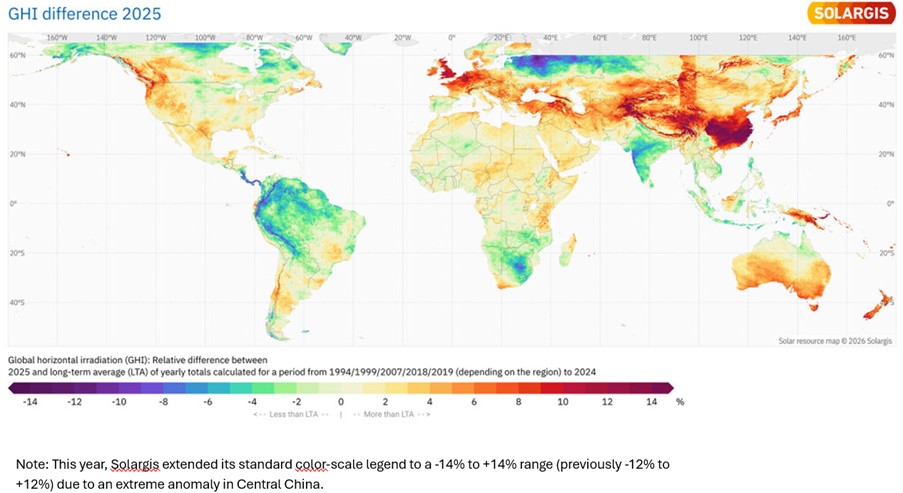
Solar Irradiation in India Below Normal
Most of India recorded below-normal solar irradiation in 2025, with levels ranging from below 1% to less than 8% of the norm. The strongest anomalies were recorded along the country’s southwest coast, reaching below 10%.
Solargis said that an unusually long and intense monsoon season contributed to the comparatively limited solar resource. Monsoon has undergone noticeable behavioral shifts compared to previous decades. In the third quarter of 2025, solar generation in Rajasthan and Gujarat fell by 9.7% and 18.5%, respectively, quarter-over-quarter due to prolonged monsoons.
India experienced up to 7% below-average variability in solar radiation between 2018 and 2022 and between 3% and 10% in 2024.
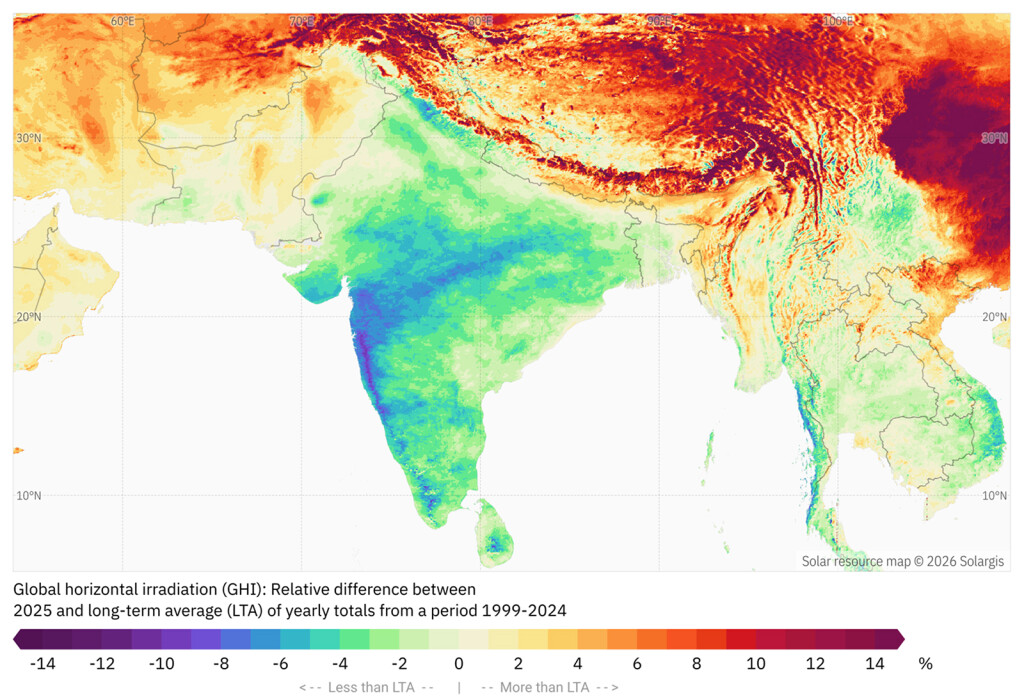
East Asia
Solar irradiation in Central East China was over 15% above the long-term average. Parts of the Sichuan Basin recorded irradiation levels exceeding 20% of the norm.
Solargis stated that this increase in irradiation continues a multi-year trend, with the last four of five years all recording above-average levels.
Japan and the eastern coastal regions of South Korea recorded widespread irradiation anomalies of 4% to 10%. Notably, Japan experienced a record-breaking heatwave during the summer of 2025.
According to Solargis, the available solar resources in Japan was 13% to 22% above the long-term summer average. Some local regions even exceeded 25%. Air temperatures were also exceptionally high in the country during this period. Japan set a new record for average July temperatures, finishing 2.89°C above the 1991–2020 climatological average.
Southeast Asia also witnessed localized irradiation dips of less than 5% to below 8% of the average in areas including central Vietnam, northwest Malaysia, central Java, and the surrounding islands.
The region between Moscow and St. Petersburg witnessed irradiation anomalies of less than 12%.
UK and Benelux
Europe also recorded higher-than-average irradiation anomalies in 2025.
The UK experienced its sunniest year on record. Numerous areas in the UK and in Belgium, the Netherlands, and Luxembourg (Benelux) recorded irradiation levels more than 10% above the LTA.
Considerable areas in western, central, and southeastern Europe recorded levels above 4% and as high as 10% above the norm.
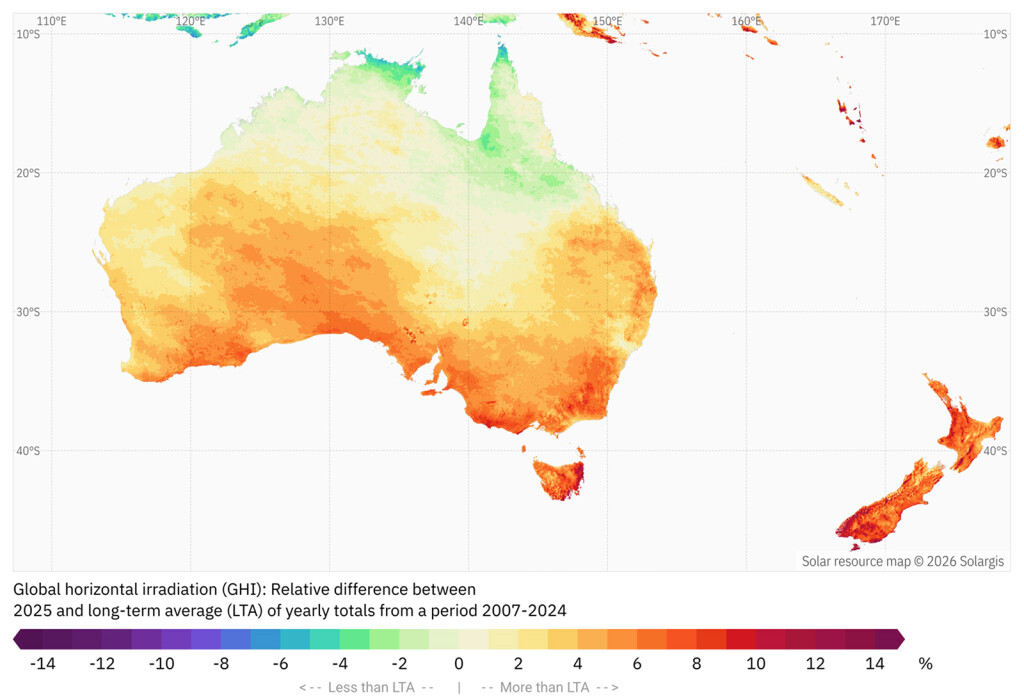
Southeast Australia and New Zealand
Irradiation values in Southeast Australia and New Zealand typically ranged from over 3% to above 10% in 2025.
Notably, New Britain and New Ireland islands in Papua New Guinea witnessed irradiation spikes often exceeding 15% above the LTA.
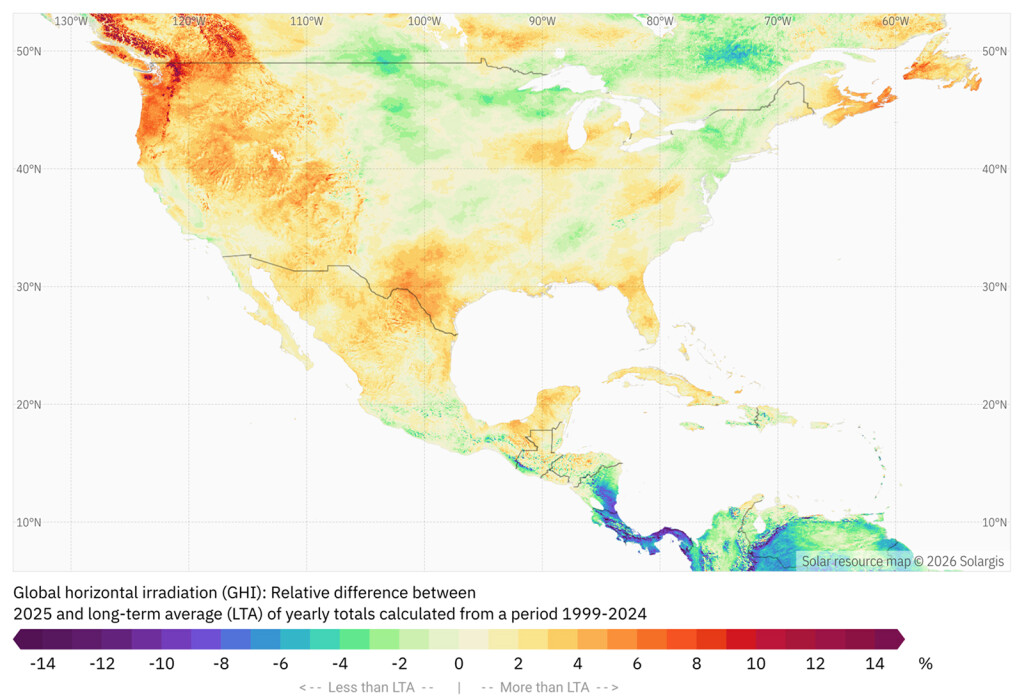
Stable Irradiation in US
The U.S., Canada, and Mexico witnessed stable solar irradiation.
However, Central America, most notably Panama, Costa Rica, and Nicaragua, reported a considerable drop in irradiation. This dip was largely due to a stronger-than-average hurricane season in the second half of 2025, with heavy rainfall cutting the available solar resource.
This region recorded GHI levels ranging from below 7% to less than 12% of the LTA.
Solar irradiation anomalies in the Johannesburg–Pretoria region of South Africa reached below 8% of the norm.


Parth Shukla
More articles from Parth Shukla.