


India’s Downstream Battery Storage Manufacturing Capacity Reaches 86 GWh
Only 21.6% of India's battery manufacturing capacity is operational
October 22, 2026

Follow Mercom India on WhatsApp for exclusive updates on clean energy news and insights
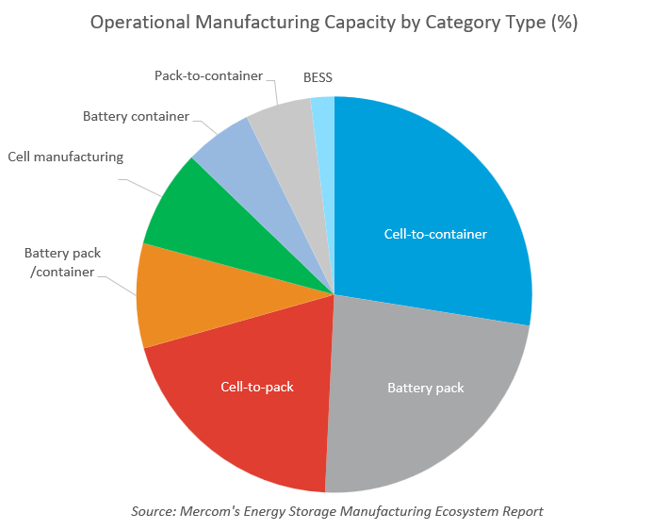
India’s operational battery energy storage manufacturing capacity is heavily concentrated in downstream manufacturing, which accounts for 92% of the total, while cell manufacturing represents just 8%, according to Mercom India’s recently released Energy Storage Manufacturing Ecosystem Report.
India’s downstream battery storage manufacturing capacity, including battery packs, containers, and integrated energy storage systems, stands at approximately 86 GWh. The gap between cell and downstream manufacturing capacity highlights the country’s dependence on imported battery cells, materials, and specialized equipment.
Only 21.6% of India’s combined operational and planned battery storage manufacturing capacity is operational. The remaining capacity comprises projects under construction or announced.
Most identified cell manufacturing capacity has yet to become operational.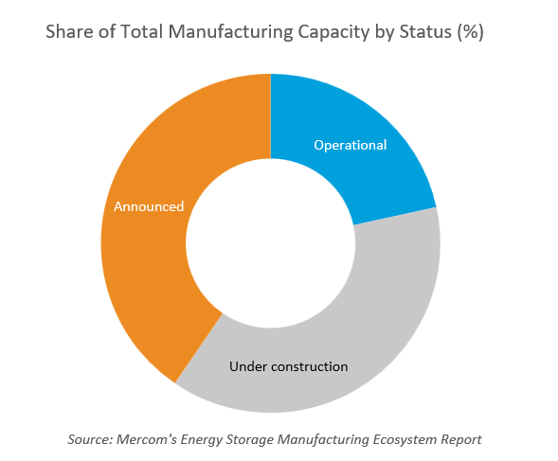
“India’s battery manufacturing industry is expanding rapidly, but domestic cell production is still at an early stage. While downstream manufacturing has grown much faster, enabling companies to assemble battery systems domestically, the industry continues to rely on imported cells and materials. A large amount of cell capacity is under construction or announced, but the real challenge will be converting that capacity into stable commercial production,” commented Raj Prabhu, CEO at Mercom Capital Group.
Manufacturing Capacity and Pipeline
India’s existing cell and downstream manufacturers accounted for 47% of identified capacity across operational and planned facilities, while new entrants accounted for 53%.
Lithium-based chemistries dominated manufacturing capacity across both cell and downstream manufacturing segments.
Converting planned capacity into commercial production remains a challenge, particularly for cell manufacturing.
Geographic Distribution
Gujarat accounted for 51% of India’s battery storage manufacturing capacity under construction, followed by Maharashtra.
Together, Gujarat and Maharashtra accounted for 71% of battery storage manufacturing capacity under construction.
Competitive domestic manufacturing will require consistent production quality, competitive costs, and sufficient capacity utilization.
“Manufacturers will need to achieve competitive costs, consistent quality, strong yields, and sufficient utilization, and that will be much easier with a clear demand trajectory and better visibility on how quickly storage deployment will scale. India has a significant opportunity to build a competitive battery manufacturing ecosystem, but demand and supply need to develop in parallel,” Prabhu said.
Battery Costs and Import Dependence
Battery systems accounted for more than half of utility-scale energy storage project capital expenditure in the second quarter of 2026, with cells representing a substantial share of battery system costs.
Cell pricing and sourcing remain important to project economics and domestic manufacturers’ competitiveness.
Despite the expansion of downstream manufacturing, India continues to depend on imported cells, materials, and specialized equipment.
The gap between operational cell and downstream capacity highlights the need for an integrated domestic battery supply chain.
Government Support
Government programs support the development of domestic battery cell manufacturing capacity.
The production-linked incentive program for advanced chemistry cell manufacturing has allocated ₹181 billion (~$1.91 billion) to support 50 GWh of manufacturing capacity, plus an additional 5 GWh for niche technologies.
Among projects receiving active support under the program, 6.4 GWh of manufacturing capacity is operational, while another 28.6 GWh is under construction.
The government’s viability gap funding program also mandates a 20% local-content requirement for supported projects.
Eligible downstream components and services can satisfy this requirement without the use of domestically manufactured battery cells, limiting its direct effect on demand for domestic cell production.
Manufacturing Outlook
Further expansion will depend on storage deployment and the conversion of planned manufacturing capacity into commercial production.
Manufacturers need visibility into project awards, storage deployment, and equipment demand to support long-term investment in cell manufacturing.
Competitive costs, consistent quality, higher manufacturing yields, and adequate capacity utilization will remain important as new facilities begin operating.
“For domestic manufacturing to continue expanding, manufacturers need clear long-term visibility on storage deployment, project awards, and equipment demand before committing large amounts of capital to new cell plants. That visibility is critical to supporting capacity expansion, maintain utilization, and improve cost competitiveness. Domestic manufacturers will ultimately need to compete on cost, quality, reliability, and supply availability as more capacity comes online,” said Prabhu.
Mercom India’s Energy Storage Manufacturing Ecosystem Report assesses India’s stationary battery storage manufacturing sector, from materials and cells to packs, containers, power electronics, and integrated battery energy storage systems.
The report covers operational and planned capacity, technology trends, supply-chain dependencies, demand, government policies, localization opportunities, and manufacturing challenges. It also provides an outlook through 2030.
For the complete report, visit: Energy Storage Manufacturing Ecosystem Report.


Parth Shukla
More articles from Parth Shukla.