India Eyes 137,500 ckm Grid Expansion to Support 900 GW Renewables by FY 2036
The expansion of transmission infrastructure will cost ₹7.93 trillion
March 27, 2026
Follow Mercom India on WhatsApp for exclusive updates on clean energy news and insights
India has targeted expanding its power transmission network by 137,500 circuit km (ckm) of lines and 827,600 MVA of substation capacity, at an estimated cost of ₹7.93 trillion (~$84.33 billion), to support 900 GW of non-fossil fuel capacity by the financial year 2035-36, according to the Central Electricity Authority (CEA).
Transmission Integration Planning
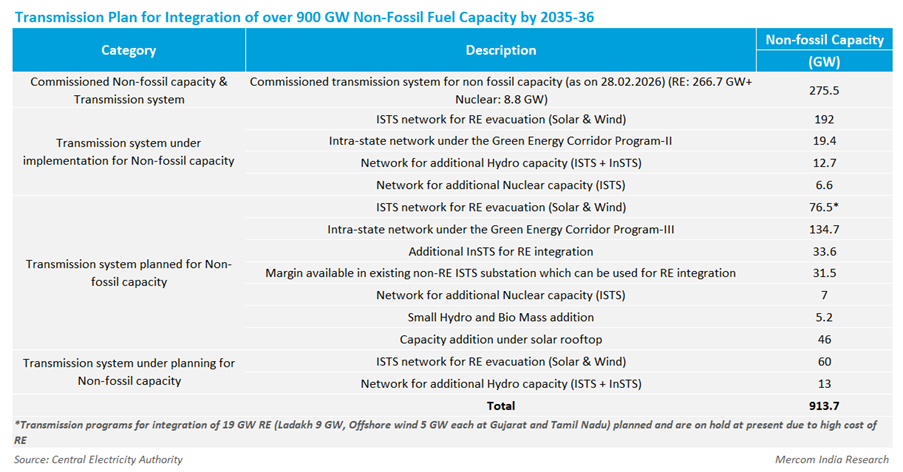
In its Transmission Plan for Integration of Over 900 GW Non-Fossil Fuel Capacity by 2035-36, the CEA said the government has planned to integrate approximately 20 GW of renewable energy capacity into the intrastate transmission system (InSTS) under the Green Energy Corridor (GEC)-II program.
The recently proposed GEC-III program is expected to further enhance InSTS evacuation of an additional 134.7 GW of power from solar, wind, and hydroelectricity projects and 25.2 GW from pumped hydro storage projects (PSP), with grid augmentation in 24 renewable energy-rich states.
Under this program, the transmission infrastructure will be increased by 51,126 ckm, and substations of an aggregate capacity of 228,903 MVA will be established. The proposed program will support the development of 44.8 GWh of battery energy storage capacity.
Approximately 33.3 GW of solar and wind capacity will also be integrated with the InSTS network in Rajasthan, Gujarat, and Karnataka. The expected capacity to be evacuated in each of these states is 10 GW, 15 GW, and 8.3 GW, respectively.
The CEA states that India’s installed hydroelectricity capacity is 51,165 MW. Transmission systems for such projects have been planned to help evacuate 12.7 GW of generated power, and a transmission system to evacuate 13 GW is under planning.
Approximately 31.5 GW of transmission capacity margins are also available at existing non-renewable energy ISTS substations. The CEA said these margins can be used to integrate renewable energy.
With the current installed nuclear capacity at 8.78 GW, the government plans to expand the transmission system to evacuate an additional 7 GW of power from such projects.
Ultra-High Voltage Transmission Corridors
India is planning to install 1,1150 kV of ultra-high-voltage transmission corridors to evacuate large power capacities from renewable-rich areas and support green hydrogen hubs and industries. This includes 16 GW of renewable energy in Rajasthan and 23.1 GW of industrial demand in Odisha. The planning also covers the evacuation of 7 GW of new thermal capacity in Chhattisgarh and 4 GW in Odisha. These transmission corridors will also integrate key renewable energy regions.
Projected Electricity Demand
India’s peak demand is projected to rise to 459 GW by 2035-36, with the country’s yearly electricity requirement expected to increase from 1,929 billion units (BU) to 3,365 BU over the same period.
The Ministry of New and Renewable Energy (MNRE), in consultation with the states, has declared a total of 608.1 GW renewable energy power generation potential in multiple states rich in these sources by 2035-36 for transmission planning under the interstate transmission system (ISTS).
Rajasthan led the northern states in renewable energy potential, with 259.8 GW. Gujarat, Maharashtra, and Madhya Pradesh led the western states in generation potential, at 136.1 GW, 21 GW, and 49.5 GW, respectively. Andhra Pradesh led the southern states with 88 GW, followed by Karnataka with 32.7 GW, Tamil Nadu with 8 GW, and Telangana with 13 GW.
MNRE also undertook transmission planning to evacuate renewable energy from Ladakh and Assam, with both projected to reach capacities of 9 GW and 1 GW, respectively, by 2035-36.
The Central Electricity Regulatory Commission (Third Amendment) Regulations, 2025, introduced solar and non-solar hour access, directing solar projects to operate during solar hours. The Commission also directed wind and storage energy projects to supply power around the clock.
The CEA said this framework will help improve the efficient use of transmission capacity. It also supports wind-solar and battery storage hybrid projects to ensure a reliable power supply. A margin of roughly 176 GW is available during non-solar hours, with connectivity applications already submitted for approximately 105 GW.
According to the CEA, long-duration energy storage of around six hours will be required to integrate higher levels of renewable energy beyond 2030. It notes PSPs as a cost-effective solution that also supports grid stability through frequency and voltage control.
This January, the CEA published the Roadmap for Achieving 100 GW of Hydro Pumped Storage Projects by 2034–35, outlining the development pathway for India’s PSP capacity. It also presented the transmission planning framework for effective PSP and grid integration.