

India Can Build a Domestic Long-Duration Energy Storage Industry: Interview
IIT Madras expects vanadium redox flow batteries to reach large-scale deployment within two to four years, complementing lithium-ion systems for grid-scale, long-duration energy storage
August 6, 2026

Follow Mercom India on WhatsApp for exclusive updates on clean energy news and insights
Lithium-ion batteries dominate India’s energy storage market today, but researchers and industry are also exploring alternative technologies for long-duration energy storage that could improve domestic manufacturing and reduce dependence on imported materials.
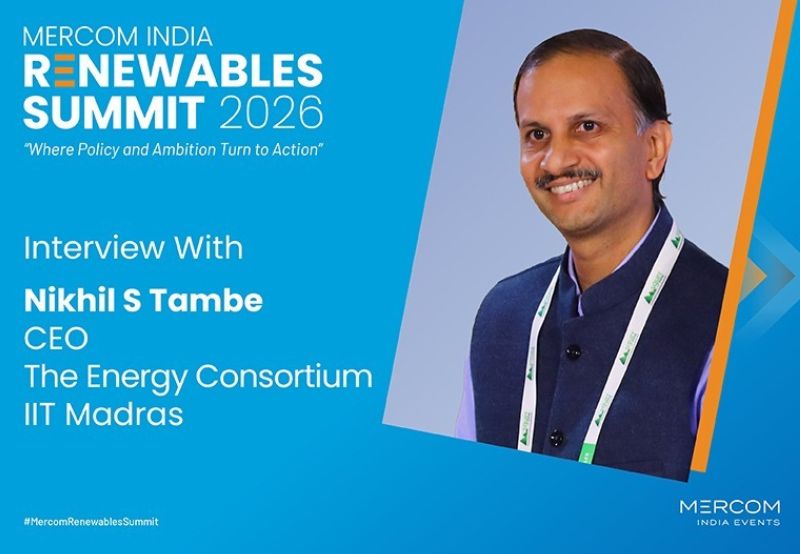
At the Mercom India Renewables Summit 2026, Nikhil Tambe, Chief Executive Officer, The Energy Consortium at the Indian Institute of Technology (IIT) Madras, discussed his team’s collaboration with High Energy Batteries, which received the Research-to-Innovation Award for developing a vanadium redox flow battery system for long-duration energy storage.
The following are edited excerpts from the interview.
Could you tell us about the project that received the Mercom research-to-innovation award?
I represent the IIT Madras Energy Consortium, and we have worked on this project with High Energy Batteries, based in Tiruchirappalli.
The project involves vanadium redox flow battery technology for long-duration energy storage. The work began at IIT Madras and was subsequently developed with our industry partner into a large pilot system that is currently operational in Tiruchirappalli.
This technology is particularly relevant because it can potentially be indigenized and manufactured at scale in India. Vanadium redox flow batteries are not yet as widely known as lithium-based systems, but we believe they can create a distinct category within the energy storage market.
Why did IIT Madras choose to focus on vanadium redox flow batteries?
Our focus is on long-duration energy storage, which means storing electricity at grid scale for six, eight hours, or even longer.
This requirement has become more important as India has rapidly expanded solar, wind, and other renewable energy capacities. The challenge is no longer limited to generating renewable electricity. It is increasingly about making that electricity available when consumers and the grid need it.
Energy storage is a key part of solving that problem.
Lithium-based chemistries have gained commercial acceptance because they are widely available and can be deployed at scale. However, we also understand their limitations, particularly for longer-duration applications.
What advantages do vanadium flow batteries offer over lithium-ion batteries?
Vanadium redox flow batteries become attractive when large quantities of energy need to be stored for six to eight hours. If several hundred megawatt-hours of electricity must be stored for that duration, lithium-based systems can become prohibitively expensive. Vanadium flow batteries are better suited to such long-duration applications.
Cost is one of the main advantages. Another is the potential for domestic manufacturing. If India has to import large quantities of lithium and associated materials, the overall cost and supply chain exposure can be significant. Many of the materials required for vanadium flow batteries, including vanadium itself, are available in India.
This reduces dependence on international supply chains and improves the possibility of developing an indigenous long-duration storage ecosystem.
What other energy storage technologies is IIT Madras working on?
We are also working on zinc-air batteries. Zinc-air is a different category of technology and could be suitable for storing energy over much longer periods, potentially for several months rather than a few hours. Our group is also working on pumped water storage. These technologies serve different use cases, and no single storage technology can address every duration, application, and operating requirement.
Is this research limited to IIT Madras, or are other institutions also involved?
Research is underway at several institutions, but IIT Madras has adopted a consortium-based approach. Our model brings together industry, academia, and the government. This collaboration strengthens technical capabilities and helps move research from the laboratory toward commercial deployment.
The government is involved, while a significant share of the project funding comes from industry. Our partnership with High Energy Batteries is an example of how industry participation can help translate laboratory research into deployable, commercially relevant technology.
How soon could vanadium redox flow batteries be deployed commercially at scale?
We already have a pilot system operating in Tiruchirappalli. The objective was to understand how the technology performs when connected to a real-world application.
For mass deployment, we are looking at a timeframe of two to four years.
The principal constraint will be India’s ability to manufacture these batteries at scale. However, recent energy storage tenders have begun to include vanadium redox flow technology alongside lithium-based systems.
We are also seeing vanadium-based systems participate successfully in commercial bids and secure projects. This gives us confidence in the technology’s commercial prospects.
How important is industry support in taking such technologies to market?
Industry support is essential. Research institutions can develop and validate technologies, but commercialization requires manufacturing capability, capital, supply chains, and deployment experience.
Industry collaboration enables us to test technologies under practical conditions and move them beyond the laboratory stage.
The renewable energy sector frequently cites a shortage of skilled workers. How serious is this gap?
The skill gap is real. One reason is the simultaneous emergence of new energy technologies. Solar may be considered a relatively mature technology, but it continues to undergo innovation, particularly in large-scale manufacturing and advanced cell technologies.
At the same time, the industry is expanding into energy storage, green hydrogen, green ammonia, and several other emerging segments.
All these industries require a large pool of specialized workforce. Without sufficient workforce development, different clean energy segments will compete for the same limited talent.
We have always said that today’s students will become tomorrow’s leaders in the renewable energy sector. They must be trained with that perspective.
Our consortium provides students with industry-relevant exposure and practical experience before they graduate.
Does IIT Madras offer dedicated programs for renewable energy professionals?
IIT Madras offers a master’s degree in energy systems and sustainable energy systems. In addition, we conduct several certification programs. We have also partnered with global institutions to establish a green energy academy that will provide technical training and certification courses.
These programs are not limited to students. Working professionals can also participate.
The certification courses range from two weeks to six months, while the degree program runs for approximately 18 months. Participants completing the certification programs receive credentials issued by IIT Madras.
How do you assess India’s progress in renewable energy compared with other countries?
India has been proactive in setting targets and supporting them through fiscal measures and implementation policies. Several countries consider themselves leaders in renewable energy, but they continue to face delays in emerging areas such as green hydrogen.
India, by comparison, has made allocations, established targets, and continued refining those targets based on market developments.
There is a consistent effort to bring costs down and scale deployment. Despite the challenges, India’s renewable energy deployment has broadly kept pace with expectations.
What is the outlook for biofuels in India?
Biofuels are already moving into the implementation stage. India has achieved the 20% blending target, and the government has now indicated greater ambitions. The next challenge is large-scale deployment and wider commercial adoption. The country has demonstrated that it can produce biofuels at scale, and the focus must now shift toward expanding their use across sectors.
Will coal continue to coexist with renewable energy in the near future?
Coal will remain relevant in the near term, but its use may evolve. One area of research is converting coal into useful fuels or chemicals instead of burning it directly. This could allow the country to use its coal resources without producing emissions through conventional combustion.
Another opportunity involves repurposing closed or inactive coal mines. These sites offer substantial land and infrastructure that could support new energy technologies and other innovative applications.
IIT Madras is working with the Ministry of Coal and has established a Center for Sustainable Energy with support from Coal India. Similar initiatives are also being pursued at other IITs.
India must examine how its existing natural resources and industrial assets can support the energy transition, rather than treating it as a simple replacement of one energy source with another.


Rakesh Ranjan
More articles from Rakesh Ranjan.