


India Adds Record 27 GW of Solar Capacity in First Half of 2026
Solar installations rose 49% YoY, while the large-scale solar project pipeline reached 208 GW
August 13, 2026

Follow Mercom India on WhatsApp for exclusive updates on clean energy news and insights
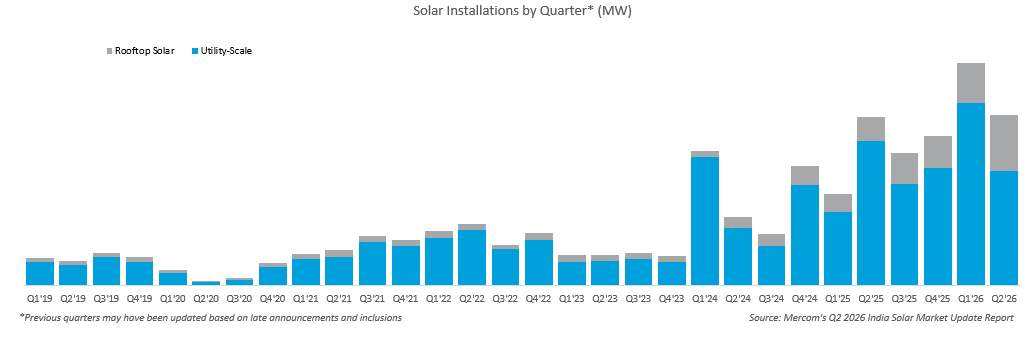
India added a record 27 GW of solar capacity in the first half (1H) of the calendar year (CY) 2026, up 49% year-over-year (YoY) from 18 GW, according to Mercom India Research’s newly released Q2 and 1H 2026 India Solar Market Update.
India installed nearly 12 GW of solar capacity in the second quarter (Q2) of 2026, making it the second-highest quarterly addition on record. Installations declined 24% from 15 GW in the first quarter but remained broadly flat YoY.
Solar project commissioning remained strong during the first half, supported by rising clean energy demand and developers accelerating project completion around the financial year-end and ahead of regulatory and transmission-related deadlines.
“India added record solar capacity in the first half of 2026, supported by strong demand and projects moving ahead of key policy changes. The concern now is whether this pace can continue. Utility-scale project commissioning is being slowed mainly by limited transmission availability and domestic cell shortages, along with other project-level challenges. Several projects are nearing completion but cannot connect to the grid because evacuation infrastructure is not yet ready. ALMM List-II has added pressure on domestic cell supply, especially TOPCon, affecting timely procurement and project planning. India’s large project pipeline will not translate into commissioned capacity at current forecasted levels unless these major bottlenecks are addressed,” said Raj Prabhu, CEO of Mercom Capital Group.
According to the report, the limited availability and higher prices of ALMM-compliant domestic cells also contributed to the decline in installations from the previous quarter. Many projects that had already secured equipment and transmission readiness were commissioned earlier, while some developers faced higher procurement costs after the ALMM List-II requirement took effect.
Priya Sanjay, Managing Director at Mercom India, said, “A significant portion of large-scale solar installations came from the open access segment, indicating strong demand from commercial and industrial (C&I) consumers. Another factor was the ALMM mandate for solar cells, which came into effect on June 1. Developers rushed to commission projects before the restriction became applicable.”
“The other major factor was the phasing out of ISTS charges waiver. Developers commissioning later would have had to pay higher transmission charges, which may not have been factored into the tariffs at which they originally bid,” Sanjay added.
Large-scale solar installations totaled 8 GW during Q2, down 37% quarter-over-quarter (QoQ) from 13 GW and 23% YoY from 10 GW. The segment accounted for 68% of total solar capacity additions during the quarter. Rooftop solar additions reached 4 GW, accounting for 33% of quarterly additions.
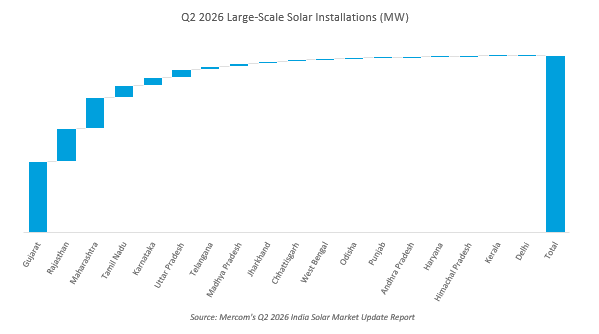
Capacity additions remained highly concentrated geographically. Gujarat accounted for 40% of large-scale solar capacity additions during the quarter, followed by Rajasthan at 19% and Maharashtra at 17%.
As of June 2026, India’s cumulative installed solar capacity reached 165 GW. Large-scale solar projects accounted for 83% of the total, while rooftop solar represented 17%.
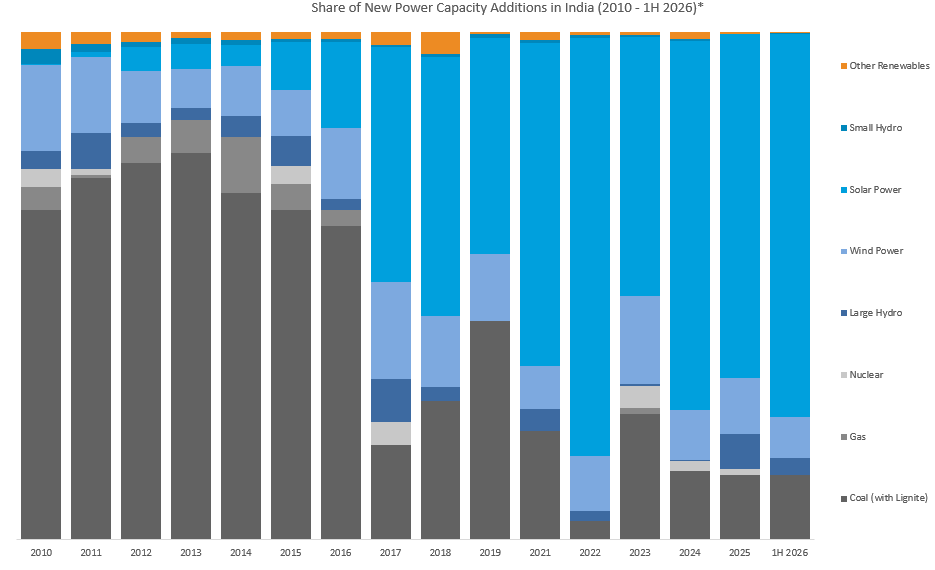
Solar photovoltaic capacity accounted for 30% of India’s total installed power capacity and 57% of renewable energy capacity at the end of Q2.
Rajasthan led the country in cumulative installed large-scale solar capacity, with a 31% share, followed by Gujarat at 22% and Karnataka at 11%.
The top 10 states accounted for 98% of large-scale solar installations during Q2.
India’s large-scale solar project pipeline stood at 208 GW as of June 2026. An additional 151 GW of projects had also been tendered and were awaiting auction.
Tender, Auction Activity Declines
Large-scale solar tender activity slowed sharply during the first half of 2026. Tenders totaling 11 GW were announced during the period, down 54% from 24 GW in 1H 2025.
Utility-scale solar projects totaling 5 GW were auctioned, down 59% YoY from 13 GW.
“Two things currently take the longest time: land acquisition and transmission connectivity. Earlier, equipment supply was less of a constraint. Today, even procuring transformers can involve an eight-month waiting period. There is also a substantial backlog of projects for which power purchase agreements (PPAs) and power sale agreements (PSAs) have not been signed. If those projects have not progressed, issuing more tenders does not necessarily solve the problem,” Sanjay said.
“Instead of creating a very long gestation period with uncertainty at every stage, it is better to clear the existing backlog and then proceed with new bidding. Once the backlog is cleared, subsequent activity can move faster. PSAs can be signed more quickly, PPAs can follow, and other project requirements can fall into place,” she added.
During Q2, tenders for 5 GW of utility-scale solar capacity were issued, down 22% YoY from 7 GW and 6% quarter-over-quarter from 6 GW.
Auctions totaled 2 GW during the quarter, declining 56% from 4 GW in the preceding quarter and 40% from 3 GW YoY.
Mercom’s Q2 and 1H 2026 India Solar Market Update report covers all facets of India’s solar market. For the complete report, visit: https://www.mercomindia.com/product/q2-2026-india-solar-market-update


Rakesh Ranjan
More articles from Rakesh Ranjan.