Gujarat Issues Guidelines to Streamline Renewable Energy Project Development
The guidelines will be in force until December 31, 2030
May 7, 2026
Follow Mercom India on WhatsApp for exclusive updates on clean energy news and insights
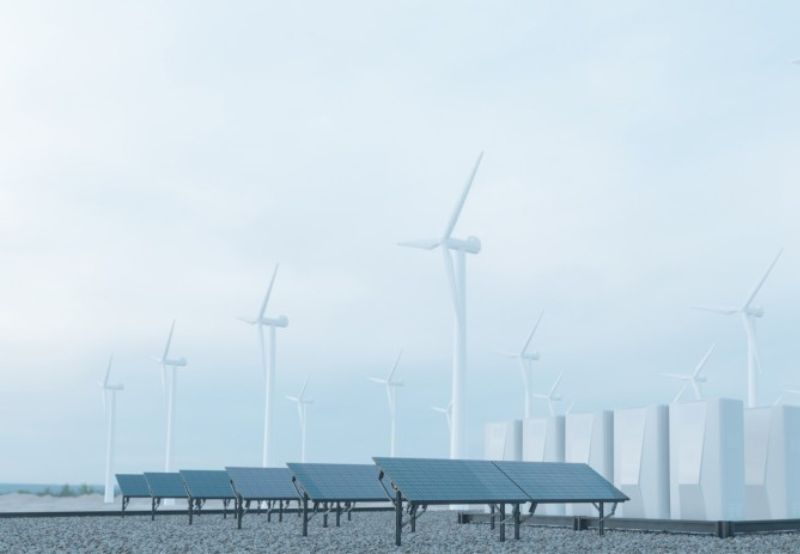
The Gujarat Energy Development Agency (GEDA) has issued the guidelines for the development of solar, wind, and wind-solar projects with or without battery storage systems, as well as standalone battery storage systems.
The guidelines, which align with the Gujarat Integrated Renewable Energy Policy 2025, will not apply to renewable energy projects established to supply power to units that produce green hydrogen and ammonia, or to pumped-storage projects.
The guidelines will be in force until December 31, 2030.
Applications and Registration
All applications and registrations for renewable energy projects will be processed through the renewable energy portal.
Renewable energy developers can access the portal after making a one-time payment of ₹10,000 (~$105) for projects under 1 MW and ₹25,000 (~$263)/MW for projects above 1 MW.
Rooftop solar, small-scale rooftop wind turbine generators, and rooftop wind-solar hybrid projects in the non-residential category must pay an application fee of ₹10,000 (~$105).
Grid Connectivity
Renewable energy project developers seeking grid connectivity must apply through the Akshyaya Urja Setu Portal after registering with GEDA.
Applicants must submit a security bank guarantee and a separate bank guarantee for the associated transmission system of up to ₹2 million (~$21,013)/MW for projects involving transmission system strengthening or augmentation.
Applicants unable to submit land ownership documents must furnish a land bank guarantee of up to ₹1 million (~$10,507)/MW.
They must select an evacuation substation from Gujarat Energy Transmission Corporation (GETCO)’s published list of existing substations.
The connectivity agreement must be signed within 65 days of the grant of connectivity. At least 10% of the project capacity must be commissioned within one month of evacuation line charging.
Wind Projects
Wind projects can be developed on government or private land with or without storage solutions. Wheeling of power from these projects will be permitted for captive and third-party use.
Developers must establish wind projects at GEDA-verified locations. After securing provisional and final connectivity from GETCO or the Central Transmission Utility of India (CTUIL) or obtaining a technical feasibility report from the concerned distribution company and securing land access, developers can apply for development permission through the renewable energy portal.
The development permission will remain valid until the scheduled commercial operation date specified in the power purchase agreement or until the validity period of the granted grid connectivity.
Only new plant and machinery will be eligible for installation under the Gujarat Integrated Renewable Energy Policy, 2025. Developers must use wind turbine generators listed in the Approved List of Models and Manufacturers (ALMM).
Only wind turbines with a rated capacity below 2 MW will qualify for repowering under the guidelines.
The guidelines mandate that annual energy generation from repowered or refurbished wind projects must be at least 1.5 times the average actual generation recorded during the three years preceding repowering or refurbishment.
Wind project developers must submit quarterly work progress reports and weekly electricity generation statements to GEDA.
Rooftop Wind Turbine Generators
Consumers can install mini-scale and micro-scale wind turbines with capacities below 50 kW on rooftops or premises under net metering or gross metering arrangements. These projects may also be set up under virtual or group net metering mechanisms.
Distribution companies will conduct pre-commissioning inspections and install bidirectional meters. After final approval, the distribution company will seal the bidirectional meter and deem the project commissioned.
Consumers can also install small-scale vertical-axis and horizontal-axis wind turbines.
Solar Projects
Ground-mounted solar projects, with or without storage systems, can be installed in solar parks or on government or private land outside them.
The guidelines exempt agrivoltaic and floating solar projects from agricultural land conversion requirements.
After securing provisional and final connectivity from GETCO or the CTUIL, or obtaining a technical feasibility report from the concerned distribution company and securing land access, developers can apply for development permission through the renewable energy portal.
The development permission will remain valid until the scheduled commercial operation date specified in the power purchase agreement or until the validity period of the granted grid connectivity.
Solar project developers must ensure that solar modules and associated electrical installations, with or without battery storage systems, are inspected by the Chief Electrical Inspector, Government of Gujarat, or the Central Electricity Authority.
The inspection certificate and permission to charge the installation must be submitted to GEDA.
The commissioning certificate will be issued within 15 days of the solar project’s commissioning.
Rooftop Solar
Rooftop solar systems, with or without battery storage, must not exceed the contract demand limits applicable to the different consumer categories.
The guidelines permit rooftop solar systems under multiple metering arrangements.
Applications must be submitted through the renewable energy portal. After final approval, the distribution company will seal the bidirectional meter and deem the project commissioned.
Residential consumers are exempt from application processing fees.
Wind-Solar Hybrid Projects
Existing or under-construction wind, solar, or battery storage projects can be converted into hybrid projects. Project registration for such projects will be based on the existing GEDA registration certificate or evacuation permission granted by Gujarat Energy Transmission Corporation or the state transmission utility before the issuance of the Gujarat Integrated Renewable Energy Policy, 2025.
The combined power injection from hybrid projects must not exceed the sanctioned transmission capacity. In cases requiring system augmentation, developers must bear the cost up to the receiving-end substation.
Developers must provide a metering arrangement at the interconnection point and submit quarterly updates and weekly electricity generation statements to GEDA.
The guidelines also allow the hybridization of existing small-scale rooftop wind-solar projects and the establishment of new ones.
After securing provisional and final connectivity from GETCO or the CTUIL, or obtaining a technical feasibility report from the concerned distribution company and securing land access, developers can apply for development permission through the renewable energy portal.
The development permission will remain valid until the scheduled commercial operation date specified in the power purchase agreement or until the validity period of the granted grid connectivity.
The project must use wind turbines listed in the ALMM for wind, and solar modules listed in the ALMM List-I.
Standalone Battery Storage Projects
Battery storage projects must ensure that annual degradation does not exceed 2%.
The projects must guarantee 90% output at the end of 5 years, 80% at the end of 10 years, and 70% at the end of 15 years. The battery storage projects must include operational cycles that correspond to the expected project life.
The energy storage projects must provide a minimum depth of discharge of 80% and a power conversion system efficiency of at least 95% with an isolation transformer.
The projects must also maintain system availability of at least 95% and round-trip efficiency of at least 70%.
Battery storage project developers must get the project inspected by the Chief Electrical Inspector, Government of Gujarat, or the Central Electricity Authority. The inspection certificate and permission to charge the installation must be submitted to GEDA.
Battery storage projects will be commissioned upon submission of the bulk power transmission agreement or wheeling agreement, the meter-sealing report, the inspection certificate, and the commissioning requisition from the project owner.
Renewable Energy Parks
The guidelines specify that renewable energy park developers must not function as distribution licensees within the park or supply power directly to renewable energy developers.
The developers must not establish internal distribution systems for project areas, and auxiliary power arrangements may only be used to power common infrastructure. Each renewable energy park must have a minimum capacity of 50 MW.
Renewable energy park developers may include state or central government agencies, joint ventures of both, or private developers.
The state will facilitate the development of solar parks and ultra-mega renewable energy power parks in accordance with the Ministry of New and Renewable Energy guidelines.
Projects within renewable energy parks in the state must be registered with GEDA.
Off-Grid Projects
Off-grid renewable energy projects must obtain certification from the concerned distribution company or Gujarat Energy Transmission Corporation confirming that the project location cannot be connected to the grid.
The certification must also specify the ownership of captive off-grid renewable energy projects.
Distribution companies will obtain an undertaking from applicants confirming that the off-grid project will not be connected to the grid under any circumstances.
Applicants must also obtain permission before changing the project status from captive use to third-party use.
Developers must apply to GEDA for development permission. Distribution companies will seal the energy generation meters after final approvals are secured.
Monthly generation data from off-grid renewable energy projects must be certified by the Chief Electrical Inspector.
In January 2026, the Gujarat Electricity Regulatory Commission revised the commissioning timelines for renewable energy projects to 1.5-3.5 years, depending on project capacity.
Subscribe to Mercom’s real-time Regulatory Updates to ensure you don’t miss any critical updates from the renewable industry.