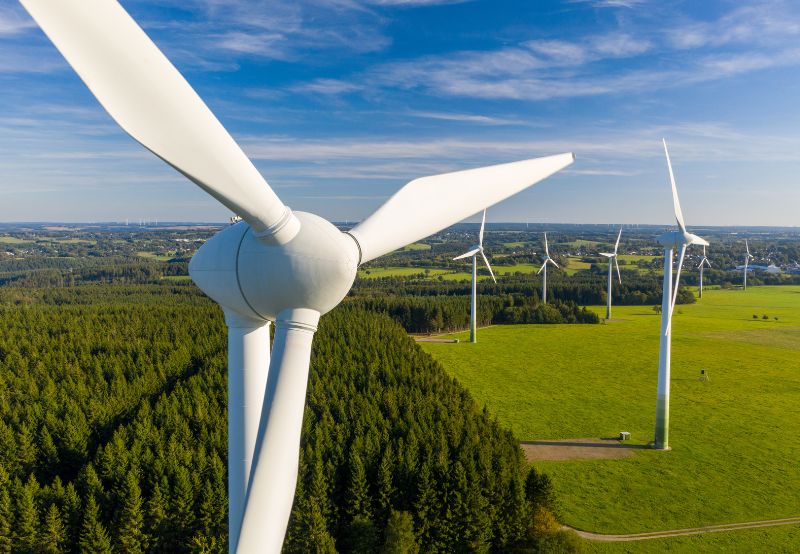
Global Wind Energy Installations Hit 165 GW In 2025, Up 40% YoY
Record capacity additions signal scale, but grid and policy gaps persist
April 22, 2026
Follow Mercom India on WhatsApp for exclusive updates on clean energy news and insights
The global wind energy sector recorded 165 GW of new grid-connected capacity installed in 2025, marking the highest annual addition on record and taking total installed capacity worldwide to 1,299 GW, a 40% year-on-year increase, according to the Global Wind Energy Council (GWEC).
In its Global Wind Report 2026, GWEC said offshore wind contributed 9 GW, up 18% from 2024 and the third-highest annual total to date. The record growth was driven primarily by Asia Pacific and supported by recoveries in key markets, even as structural bottlenecks in grid infrastructure and permitting continue to limit full deployment.
Global Projections
The market is projected to maintain a steady compounded annual growth rate of 5.2% from 2026 to 2030.
Annual installations are expected to reach 178 GW in 2026, with total additions of 969 GW over the five-year period, averaging 194 GW annually.
This growth trajectory is being shaped by rising electricity demand, energy security concerns, and policy-driven expansion of renewable capacity across major economies.
The global energy landscape remains volatile due to geopolitical tensions, including the Russia–Ukraine conflict and instability in the Middle East involving Iran, the U.S., and Israel, reinforcing the strategic importance of diversifying energy systems.
Regional Performance
Asia Pacific accounted for nearly 80% of the global installations in 2025, led by China and India, which together added over 126 GW. Europe recorded 19.1 GW of new installations, a 16% annual increase, with the EU-27 contributing 15.1 GW and cumulative capacity surpassing 300 GW.
In 2025, India added 6.3 GW of wind power capacity, an 85.2% YoY increase from 3.4 GW in 2024, according to Mercom India Research. The additions marked the highest annual wind installations recorded in the country.
North America maintained its position as the third-largest market, driven by a 71% year-on-year increase in installations in the United States.
Latin America ranked fourth but saw a 24% decline, mainly due to a slowdown in Brazil, where installations dropped by one-third to around 2.3 GW, although Chile exceeded 1 GW of annual additions for the first time.
Africa and the Middle East grew by 32%, supported by a recovery in South Africa and expansion in Saudi Arabia.
Market concentration remained high, with China, the U.S., India, Germany, and Brazil accounting for 86% of global additions and around 75% of total installed capacity, while China alone contributed 73% of global onshore installations.
Emerging Markets
Emerging markets are becoming increasingly important to the global wind landscape. Southeast Asia has renewable energy potential of approximately 8,119 GW for solar and 342 GW for wind, with targets to achieve a 32% share of renewables by 2030 and 52% by 2040.
The ASEAN Power Grid has facilitated 100 MW of cross-border electricity trade between 2022 and 2024, amounting to 266 GWh, with plans to expand capacity to 200 MW by 2026.
In Africa, Kenya is targeting 100% renewable electricity by 2030, while Egypt’s Zaafarana wind project has a capacity of 545 MW with 700 turbines and annual carbon emission reductions of around 648,000 tons, alongside plans for a 5.2 GW hybrid expansion.
In Latin America, Chile’s wind capacity has reached around 6 GW, with 1.2 GW added in 2025, representing 24% growth. Wind accounts for about 16% of installed capacity in Chile, while wind and solar together contribute approximately 38% of electricity generation.
The country also has 1.5 GW of operational storage, 7.3 GW under construction, and more than 27 GW in the pipeline, along with offshore wind potential estimated at 957 GW.
Policy Drivers
Government policies continue to define the pace of deployment across regions. China remains central to global growth, targeting approximately 3.6 TW of combined wind and solar capacity by 2035 and sustaining annual wind installations of over 100 GW.
India is targeting 500 GW of non-fossil fuel capacity by 2030, positioning wind as a key contributor to both energy security and industrial growth.
Europe is accelerating renewable deployment in response to energy security risks, supported by regulatory initiatives focused on grid expansion, market integration, and affordability.
Emerging markets across Southeast Asia, Central Asia, the Middle East, and Africa are also expected to drive incremental growth through electrification and industrial expansion.
Offshore Slowdown
Offshore wind is undergoing a period of recalibration due to cost pressures and regulatory challenges. In Europe, 6.1 GW of offshore capacity failed to secure contracts in auctions, while in the U.S., several projects were canceled due to political opposition.
No floating offshore wind projects were awarded in 2025, indicating ongoing uncertainty in this segment, despite strong long-term fundamentals.
Outlook
With 969 GW of new capacity projected by 2030 and continued geopolitical uncertainty affecting fossil fuel markets, wind energy is expected to play a central role in strengthening energy security and supporting economic growth.
Earlier this year, GWEC reported that the Asia-Pacific continued to drive global wind growth, led by China and India, and that worldwide wind capacity is expected to surpass 2 TW by 2030.