

Germany Adds 3.3 GW Solar Capacity in Q1 2026, Total Capacity Reaches 121 GW
The country added 1.4 GW of solar capacity in March 2026
April 21, 2026

Follow Mercom India on WhatsApp for exclusive updates on clean energy news and insights
Germany added a total of 3.3 GW of solar capacity during the first quarter (Q1) of 2026, according to data from the Federal Network Agency (Bundesnetzagentur). The country’s cumulative solar capacity now stands at 121 GW. The country also added 1.05 GW of onshore wind, with approximately 30,343 turbines deployed; 468 MW of offshore wind, with 1,714 units; and 39 MW of biomass, with 22,022 installations.
Solar deployment remained highly decentralized, with around 5.87 million installed systems.
Solar installations are segmented into plug-in systems, rooftop installations, ground-mounted projects, and other applications such as parking and noise barrier systems.
In Q1 2026, Germany added 64,633 small systems totaling around 87.6 MW, 72,534 rooftop systems contributing approximately 1,389 MW, and 492 ground-mounted projects accounting for around 1,836 MW, indicating that large-scale and rooftop installations are the primary drivers of capacity growth.
March 2026 Additions
In March 2026, the country added 1.4 GW of solar capacity. The additions include 1,227 MW of registered capacity and an estimated 15% more installations due to delayed registrations.
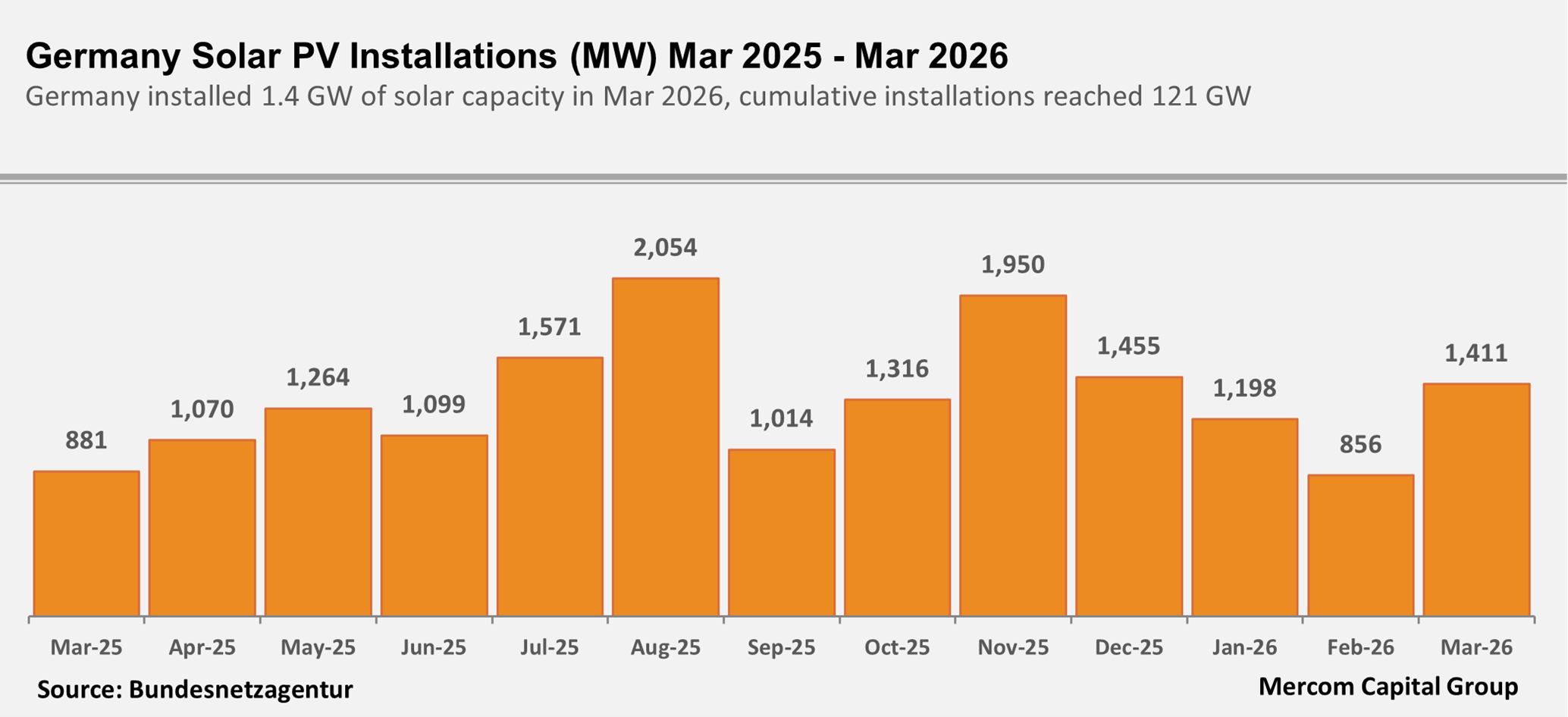
July 2025 saw a capacity addition of 1,571 MW, and November 2025 saw a capacity addition of 1,950 MW.
Installations largely remained within the 1 GW to 1.5 GW range, with higher deployment during mid-year months, indicating seasonal trends.
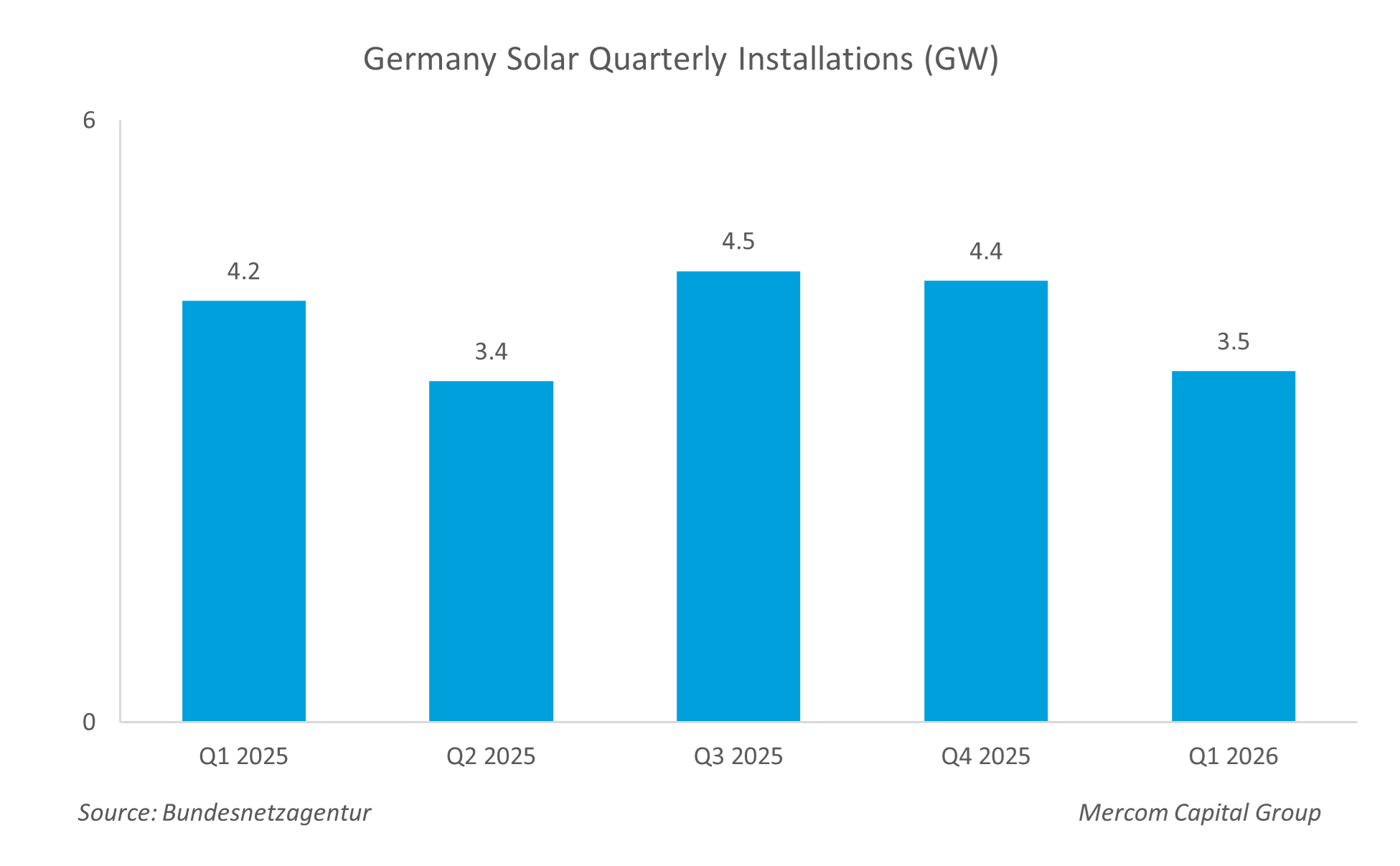
Quarterly data show similar fluctuations: installations were 4.2 GW in Q1 2025, dipped to 3.4 GW in Q2, peaked at 4.5 GW in Q3, then slightly declined to 4.4 GW in Q4, before falling to 3.5 GW in Q1 2026.
Growth Trajectory
Germany’s cumulative solar capacity has expanded from 83 GW in 2023 to 100.6 GW in 2024, 117.7 GW in 2025, and 121 GW by March 2026. Despite this growth, the current pace of monthly additions remains below the trajectory required to achieve the national target of 215 GW by 2030.
Solar remains the fastest-growing renewable energy source in the country and dominates overall renewable capacity additions.
As of March 2026, total renewable installed capacity includes 121 GW of solar, 69 GW of onshore wind, 10.2 GW of offshore wind, and 9.2 GW of biomass.
Wind Additions
Onshore wind installations recorded steady but moderate growth, with monthly additions ranging between 184 MW and 807 MW. In March 2026, Germany added approximately 392 MW of onshore wind capacity, taking the cumulative total to nearly 69 GW.
The country has set a target of 115 GW for onshore wind by 2030, requiring a significant acceleration in deployment. Offshore wind additions remained irregular, with several months recording no capacity additions.
Key commissioning months include December 2025 (approximately 503 MW) and March 2026 (approximately 182 MW), bringing total offshore capacity to about 10.2 GW.
Biomass Growth
Biomass capacity additions were minimal, ranging from -50 MW to +39 MW monthly, indicating periods in which decommissioning exceeded new installations.
Across technologies, net capacity growth reflects the balance between installations and retirements: solar shows high installation volumes and negligible retirements, while wind projects, particularly older turbines, continue to see some decommissioning.
Regional Trends
Regionally, Bavaria, North Rhine-Westphalia, Lower Saxony, and Baden-Württemberg led renewable energy additions in 2026, with southern states dominating solar deployment and northern states leading in wind energy.
Bavaria remains the largest solar market with approximately 32.3 GW of installed capacity, followed by Baden-Württemberg with 15.1 GW and North Rhine-Westphalia with 14.7 GW.
In Q1, total additions included around 3,281 MW of solar, 824 MW of onshore wind, 468 MW of offshore wind, and 23.7 MW of biomass.
Project approvals indicate a strong pipeline for future wind capacity. Authorities approved 649 onshore wind projects totaling approximately 4,178.8 MW, with North Rhine-Westphalia, Lower Saxony, and Brandenburg emerging as key regions for new developments during the quarter.
While solar continues to drive Germany’s renewable energy expansion, both onshore and offshore wind will require faster deployment rates to meet 2030 targets, particularly given current installation trends and the scale of capacity required.
Germany added 16.4 GW of solar capacity in 2025, up 1.2% year-over-year and setting a new record.
The country added 16.2 GW of solar capacity in 2024.


Meghana Prasad
More articles from Meghana Prasad.