


Four-Hour Battery Storage Now Cheaper Than Gas Turbines: Report
Lower battery costs, gas turbine shortages, and fuel volatility aid storage
October 12, 2026

Follow Mercom India on WhatsApp for exclusive updates on clean energy news and insights
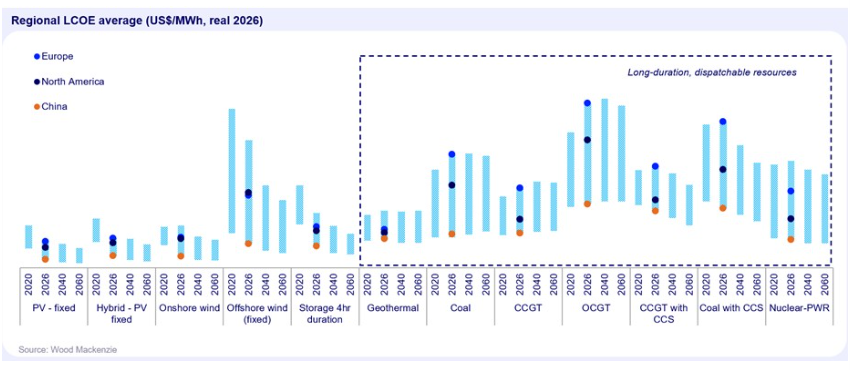
Four-hour battery energy storage systems, utility-scale energy storage systems that are designed to discharge at their full rated capacity for approximately four hours, now cost less than open-cycle gas turbines across 43 markets, according to Wood Mackenzie’s latest global report on levelized cost of electricity (LCOE). This shift is driven by technological advancements and evolving market dynamics.
Single-axis tracking solar is the lowest-cost new power generation option in 43 of the 48 markets analyzed. Wood Mackenzie attributed the shift to declining battery costs, gas turbine shortages, and volatile fuel prices.
North America
U.S. solar costs face pressure from tariffs, antidumping and countervailing duties, and Section 232 import restrictions. Utility-scale solar is partly insulated by 168 GW of safe-harbored capacity, although module prices are projected to rise 5% annually through 2030.
Residential and commercial solar projects face greater cost pressures, with module prices expected to increase 6% in 2027 and 14% in 2028.
Onshore wind’s LCOE is projected to decline 16% by 2060, driven by lower capital and operating costs, despite policy uncertainty and potential tariff impacts.
Tax credits are expected to support battery storage economics despite foreign entity of concern restrictions and supply chain constraints. Storage costs could rise after investment tax credits phase out in 2038. Technological advances and domestic manufacturing expansion are projected to reduce storage LCOE by 10% by 2060.
Growing data center demand is likely to constrain gas generation equipment supply through the late 2030s, keeping capital costs elevated.
Latin America
Single-axis tracking solar so far remains Latin America’s lowest-cost power generation technology in 2026. Its average costs are projected to decline 38% by 2060. Brazil, Chile, and Mexico benefit from strong solar resources and high capacity factors.
Onshore wind’s average LCOE is projected to fall nearly 21%, from $73/MWh to $58/MWh by 2030, supported by the expansion of Chinese manufacturers and larger turbines.
Grid-scale battery storage is expanding through renewable energy-linked mandates and standalone procurement. Its LCOE is projected to decline 42% by 2060.
Offshore wind costs are expected to approach parity with combined-cycle gas turbines, before firming, in the early 2040s.
Asia Pacific
Utility-scale solar remains the most cost-competitive power source in Asia Pacific, although costs differ substantially across markets. In 2026, solar generation costs in the region’s most expensive market are over 200% higher than in the cheapest. The gap is expected to widen to 250% by 2030, despite declining costs across all markets.
Onshore wind costs vary more than sixfold across the region. Greater penetration of Chinese turbine manufacturers and the adoption of higher-capacity turbines are expected to narrow the cost gap with coal in South and Southeast Asia.
China has the world’s lowest grid-scale storage costs, more than 55% lower than the rest of Asia Pacific’s average of $134/MWh. Chinese equipment supply is expected to reduce the regional average to $92/MWh by 2036.
Japan, Australia, and the Philippines face higher costs due to import duties, installation expenses, and domestic manufacturing policies. Offshore wind costs outside China are expected to decline significantly from the early 2030s.
Europe
Solar remains Europe’s cheapest power generation technology. The LCOE for fixed-tilt systems is projected to decline 22% by 2060, despite a 14% increase in capital expenditure (CAPEX) in 2026 due to higher module prices.
Onshore wind CAPEX is expected to decline 2.5% annually through 2030 as manufacturers benefit from improved financial stability and growing demand. Higher capacity factors are expected to bring its LCOE to $60/MWh by 2060.
Battery storage turnkey CAPEX rose 2%, the first increase in three years, as cell prices rebounded 10% from 2025 lows amid stronger demand and higher lithium prices. CAPEX is projected to decline 12% by 2031, although rising lithium prices could slow subsequent reductions.
Europe has the highest fossil fuel generation costs among the regions analyzed, with carbon costs expected to exceed fuel costs by 2030. Offshore wind costs are projected to decline from the 2030s as supply chains stabilize and turbine prices fall.
Middle East and Africa
The Middle East and Africa have the lowest regional LCOE for single-axis tracking solar, at $37/MWh in 2026. Costs are projected to decline to $24/MWh by 2035, while solar LCOE in Saudi Arabia and the UAE could fall below $20/MWh by 2033.
Onshore wind costs are declining as Chinese turbines become more competitive. Egypt and Morocco have low wind generation costs, supported by capacity factors of 40% to 45%.
Four-hour battery storage costs in the region are estimated at $120/MWh in 2026 and are projected to decline 33% to $80/MWh by 2035.
Battery storage is more cost-competitive than open-cycle gas turbines across the region’s gas markets, supporting the integration of solar and wind and reducing reliance on gas-fired peaking capacity.
According to Wood Mackenzie, renewable energy LCOE across major markets, including single-axis tracking solar in the Middle East and Africa, recorded the lowest regional LCOE of $37/MWh as of November 2025, driven by technological advances, supply chain stabilization, and improved module efficiencies.
Battery storage project costs hit an all-time low in 2025, even as other renewables rose, according to BloombergNEF’s LCOE 2026 report.


Parth Shukla
More articles from Parth Shukla.