

Energy Storage Can Turn Curtailed Solar into Reliable Power: Interview
Storage will play a central role in enabling round-the-clock renewable power as India's battery manufacturing and supply chain ecosystem matures
August 6, 2026

Follow Mercom India on WhatsApp for exclusive updates on clean energy news and insights
Rising renewable energy penetration, rapid capacity additions, and evolving regulatory environment are making energy storage an essential part of India’s power system.. In the first quarter of 2026, the country added 4.6 GWh of battery energy storage capacity, according to Mercom India Research’s Q1 2026 India’s Energy Storage Landscape report.
Rising renewable energy penetration, rapid capacity additions, and evolving market structures are making energy storage an essential part of India’s power system.
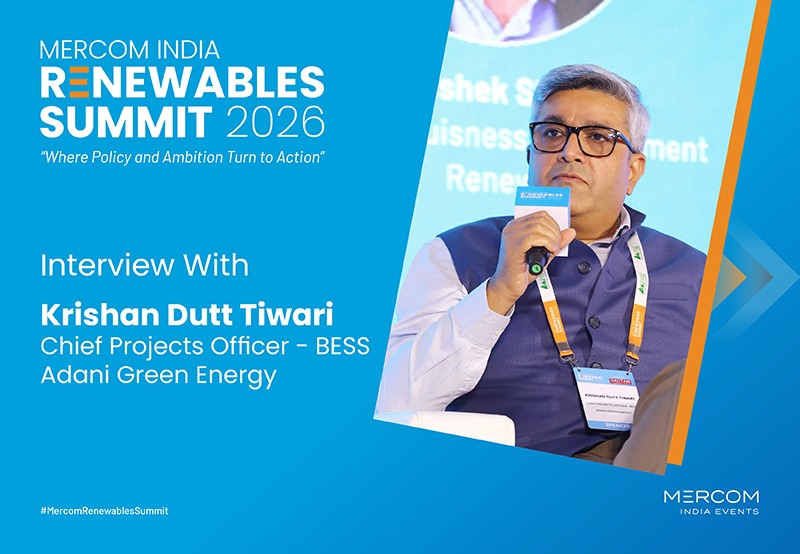
In an interview on the sidelines of the Mercom India Renewables Summit 2026, held in New Delhi on July 1 and 2, Krishan Dutt Tiwari, Chief Projects Officer (BESS) at Adani Green Energy discussed India’s transition toward round-the-clock (RTC) and firm and dispatchable renewable energy (FDRE) projects, the commercial viability of battery storage, and challenges of building a domestic supply chain.
How is the growing shift towards RTC and FDRE projects accelerating demand for battery storage in India?
Solar capacity has grown rapidly over the past few years. While solar is a clean and renewable source of energy, its generation remains intermittent. As installed solar capacity continues to outpace conventional generation, India must increasingly focus on storing excess daytime generation and dispatching it during evening peak-demand hours.
That is why FDRE and RTC projects will increasingly become the preferred procurement model for utilities, industries, and distribution companies (DISCOMs). They require clean but reliable power, not intermittent generation.
We need systems capable of supplying renewable power during non-solar hours as well to deliver continuous power while meeting India’s renewable energy commitments. Ultimately, renewable power must be available around the clock if India is to meet its long-term clean energy goals.
Given current battery and pumped storage capacity, meeting peak demand through renewable energy would itself be a significant achievement. Therefore, in the long term, we need sufficient installations to ensure solar power is available round the clock.
As renewable energy capacity expands, can transmission upgrades alone ensure grid reliability, or has energy storage become indispensable?
Storage has already become indispensable and will only become more important as renewable penetration increases.
As the share of thermal generation declines and electricity demand continues to grow, storage will be essential to capture daytime solar generation and supply it when demand peaks.
Peak electricity demand reached record levels this summer and is expected to continue rising.
Given the current demand and generation curves, solar power is being increasingly curtailed. Rather than curtailing surplus solar generation, it should be stored and dispatched when required. Battery storage systems provide that flexibility in dispatch. During peak-load hours, stored power can be dispatched accordingly.
When large volumes of solar power are injected into the grid, storage also helps address grid instability. It therefore becomes an integral part of India’s energy system.
You mentioned that battery storage can be a solution against renewable energy projects; however, are battery storage projects commercially viable at current prices?
Battery prices will stabilize as the market matures. Whenever a new business segment emerges, sufficient time must be given for the supply chain ecosystem to stabilize.
The domestic supply chain is not merely limited or fragmented; it is absent. It has to be established. India needs more domestic battery manufacturers, power conversion system suppliers, and energy management system (EMS) integrators.
Once enough EMS integrators are available, the industry can begin focusing on analytics. Analytics will help determine the type of generation, infrastructure, and installations are required.
The industry can then focus on the technological aspects. Analytics helps structure the technology. Once the technology is understood and brought under control, the supply-chain ecosystem will begin to stabilize.
The industry will know what it needs, which supplier can provide it, and which company can serve as an integrator. All these elements will gradually stabilize.
Adani Group has commissioned 3.37 GWh of battery storage capacity at Khavda and is adding another 10,000 MWh (10 GWh) of battery storage this year.
As large-scale deployments accelerate across the country, economies of scale should improve and battery prices are expected to stabilize. Once prices stabilize, battery storage will become increasingly viable.
Taking into consideration battery degradation over time, do you think developers should structure shorter power purchase agreements for storage projects?
The market will gradually evolve toward shorter-tenure PPAs for battery storage, just as it has for certain solar projects. The market needs time to evolve, but it will certainly happen.
Are state-level storage mandates, tighter banking rules, and time-of-day tariffs accelerating deployment too quickly, or are these measures necessary to build the market?
At this stage, the industry needs policy support to accelerate storage deployment. U India has made rapid progress in storage deployment over the past year, but the market still has significant room to grow. Until March this year, India was nowhere among the Top 50 countries globally. Now, due to the ongoing installation and commissioning activities, we have suddenly entered the Top 10.
However, there is no single right or wrong approach. The sector requires a continuous push. It is encouraging that utilities and the government are also providing consistent support, and we urgently need that support to establish the ecosystem.
Policies will continue to evolve as the market matures, helping establish a stable long-term ecosystem.
What are the biggest challenges currently constraining the growth of India’s battery storage market?
The biggest challenge is supply chain management. At present, raw material supplies are highly unstable, across batteries, containers, and other critical equipment.
We also need to develop the entire supporting ecosystem. Scaling storage also requires domestic manufacturing of power conversion systems, energy management systems, transformers, conductors, cables, and switchgear.
There is a supply chain gap in these segments as well. We need to ensure that a robust supply chain ecosystem is established for battery storage installations.
The government has already begun addressing many of these issues, and continued policy support will be critical to building a robust domestic storage ecosystem.


Melvin Mathew
More articles from Melvin Mathew.