


Domestic Demand Planning Critical for Solar Manufacturing Growth
Limited export opportunities make domestic demand creation critical for Indian solar manufacturers
July 1, 2026

Follow Mercom India on WhatsApp for exclusive updates on clean energy news and insights
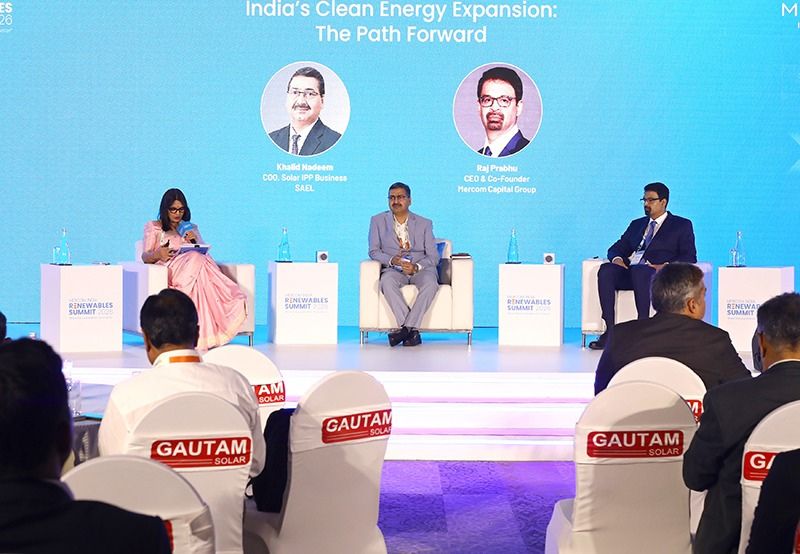
Demand creation is becoming the defining challenge for India’s solar industry as domestic manufacturing capacity expands and export opportunities remain limited, industry leaders said at Mercom India’s Mercom India’s Renewable Energy Summit 2026.
The session, titled “India’s Clean Energy Expansion: The Path Forward,” featured Khalid Nadeem, Chief Operating Officer of Solar IPP Business at SAEL, and Raj Prabhu, Chief Executive Officer and Co-founder at Mercom Capital Group.
Priya Sanjay, Managing Director at Mercom India, opened the session by highlighting India’s shift from coal-led to solar-led capacity additions. Coal dominated annual capacity additions between 2010 and 2016, while solar has led new additions since 2017. She said India’s renewable energy mix has also transitioned from being dominated by large hydro and wind projects to a solar-led market by FY 2026.
She noted that solar’s share of India’s renewable energy mix increased from 8% to 55% over the period, while large hydro’s share declined from 47% to 19% as the market expanded. Peak demand is projected to reach 345.5 GW by 2030, underscoring the need for faster capacity additions and stronger transmission infrastructure.
India’s installed power capacity is projected to increase to 582 GW by FY 2027 and 771 GW by FY 2031. Solar capacity is expected to reach 320 GW, while wind capacity is projected to grow to 103 GW, Sanjay said.
Nadeem said India’s renewable energy sector has expanded rapidly over the past decade, supported by manufacturing growth, project development, and emerging demand from sectors such as data centers, electric vehicle charging infrastructure, and green hydrogen.
He said India could sustain annual renewable energy capacity additions of 50 GW to 60 GW over the next four to five years if infrastructure development and policy support continue to keep pace with project execution.
Nadeem identified transmission infrastructure as the sector’s biggest challenge. While renewable energy projects can often be completed within two years, transmission networks typically take much longer to develop, delaying power evacuation and project revenues.
Prabhu said long-term demand visibility has become increasingly important for manufacturers. India’s module manufacturing capacity has expanded rapidly, but manufacturers now need clarity on where future demand will come from beyond the existing renewable energy targets.
He said India has largely achieved its objective of replacing imported modules with domestic manufacturing, while domestic cell manufacturing capacity is expected to catch up over the next year. However, manufacturers and developers must jointly advocate for larger renewable energy programs and long-term targets that provide confidence for future investments.
Prabhu said investors are also becoming more cautious as manufacturing capacity continues to expand. Funding for manufacturing projects could become more selective unless investors see a larger addressable domestic market.
He said manufacturers globally have historically continued adding capacity until prices decline sharply, triggering industry consolidation. Once supply tightens and prices recover, another investment cycle begins. He said India could experience a similar cycle unless capacity expansion is supported by stronger demand planning and investment discipline.
Prabhu also cautioned manufacturers against relying on exports. He said access to the U.S. market has become increasingly difficult, while European markets face competitive pressure from Chinese suppliers. As a result, Indian manufacturers should plan their expansion primarily around domestic demand.
Nadeem said India’s manufacturing ecosystem has strengthened significantly since 2019, with rapid growth in module production and substantial investments now flowing into cell manufacturing. He added that energy storage will play a critical role in supporting developers and meeting future peak power demand.
He said solar remains one of the country’s lowest-cost sources of electricity, but the sector must simultaneously develop storage, transmission infrastructure, and flexible power solutions to meet future demand.
Nadeem said SAEL’s integrated business model, spanning independent power production, module manufacturing, and cell manufacturing, allows the company to balance internal demand with external sales while managing market risks.
He also called for renewable energy targets beyond the current 2030 framework, saying that larger, long-term goals would give manufacturers and independent power producers greater confidence to continue investing.
Prabhu said manufacturers that succeed over the next decade will differentiate themselves through quality, customer service, and brand recognition rather than manufacturing capacity alone.
He said the rapid expansion of domestic manufacturing has made it increasingly difficult for customers to distinguish products. Commercial and industrial consumers understand the economic and environmental benefits of solar, but many remain uncertain when evaluating vendors and often make purchasing decisions based primarily on price.
Prabhu said manufacturers must build stronger brands by consistently delivering quality products, investing in customer relationships, and increasing market awareness.
“Manufacturers have mostly done well because demand has been strong, but that is changing,” Prabhu said. “They really have to invest in developing a unique brand.”
Nadeem said timely project completion remains critical for developers, lenders, investors, and manufacturers alike. He said infrastructure readiness is essential to ensure projects can deliver power on schedule and generate revenue across the value chain.
He also identified generation curtailment as another major concern, saying it reduces revenues not only for independent power producers but across the broader renewable energy ecosystem.
Policy decisions by regulators and government agencies directly influence project execution and investment confidence. He said realistic transmission planning, coordinated infrastructure development, and stable policy support will be essential to sustain India’s renewable energy growth trajectory.



Arjun Joshi
More articles from Arjun Joshi.