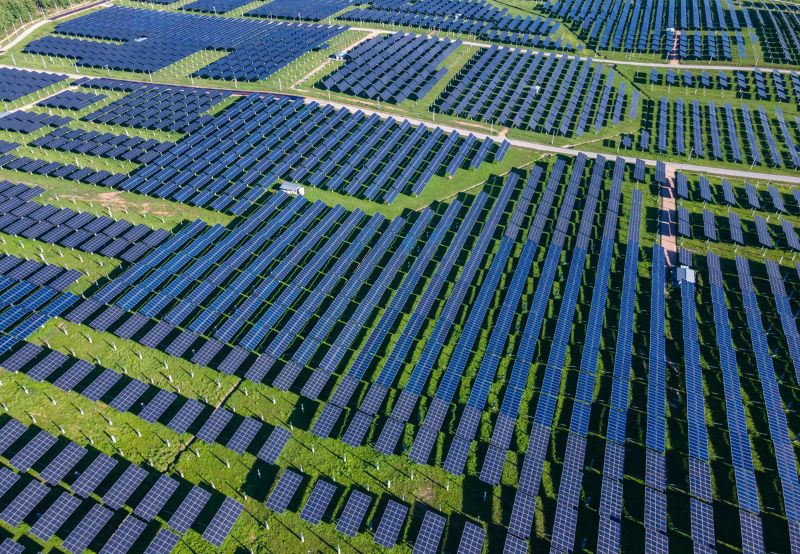
CERC Adopts Tariff for SECI’s 1,200 MW Solar Project Under CPSU Program
The Commission adopted a tariff of ₹2.45/kWh and refused to approve a higher tariff
March 25, 2026
Follow Mercom India on WhatsApp for exclusive updates on clean energy news and insights
The Central Electricity Regulatory Commission (CERC) has adopted a tariff of ₹2.45 (~$0.0260)/kWh for Solar Energy Corporation of India’s (SECI) 1,200 MW solar power projects.
The Commission refused to approve the higher tariff of ₹2.57 (~$0.0273)/kWh sought by SECI.
While rejecting the higher tariff, the Commission allowed SECI to claim compensation for the increase in goods and services tax as a change-in-law event. It permitted provisional recovery of such compensation, subject to a separate petition and final determination.
Background
SECI sought tariff approval for 1,200 MW of solar capacity under the second phase of the Central Public Sector Undertaking (CPSU) program. The projects in question were part of Tranche III, for which the Indian Renewable Energy Development Agency (IREDA) conducted a competitive bidding process for 5,000 MW capacity.
In this process, the tariff was set at ₹2.45 (~$0.0260)/kWh, while bidders competed on the basis of the required viability gap funding. The lowest bidder, identified through an electronic reverse auction, was SJVN, which quoted a viability gap funding (VGF) of ₹4.47 million (~$47,588)/MW.
SECI had participated in the bidding but was not successful, having quoted a higher VGF requirement. Subsequently, the Ministry of New and Renewable Energy allocated 1,200 MW capacity to SECI at the same terms as the lowest bidder, requiring it to match the lowest bidder’s (L1) VGF rate.
Following the award, SECI entered into power usage agreements with Madhya Pradesh Power Management Company for 500 MW and Gujarat Urja Vikas Nigam for 700 MW. The agreed tariffs in these agreements were ₹2.57 (~$0.0273)/kWh, an increase from the originally discovered tariff.
SECI justified this higher tariff on account of a change in law. The Ministry of Finance had increased the goods and services tax rate on renewable energy equipment from 5% to 12%. Based on this, the Ministry of New and Renewable Energy revised the ceiling tariff from ₹2.45 (~$0.0260)/kWh to ₹2.57 (~$0.0273)/kWh and allowed corresponding adjustments.
SECI sought the adoption of ₹2.57 (~$0.0273)/kWh along with the VGF of ₹4.47 million (~$47,588)/MW, arguing that the revised tariff was market-aligned and consistent with government directions.
Commission’s Analysis
The Commission noted that the original bidding process for Tranche III was conducted with clearly defined parameters, including a set tariff of ₹2.45 (~$0.0260)/kWh and a ceiling VGF of ₹5.5 million (~$58,554)/MW. The competitive process yielded VGF values within a narrow range, with SJVN emerging as the lowest bidder.
The Commission observed that SECI had participated in this bidding process but did not succeed. It later agreed to develop the project by matching the L1 VGF rate. While the Commission acknowledged that the Ministry had allocated 1,200 MW of capacity to SECI by exercising its powers to relax program provisions, it expressed concern that the allocation exceeded the standard limit of 50 MW permitted without bidding.
It also noted that the petitioner had not clearly cited the specific provision under which such a large allocation was made.
Despite these procedural concerns, the Commission accepted the allocation, taking into account the Ministry’s authority to modify or relax program guidelines and the petitioner’s willingness to match the discovered L1 terms.
On the issue of tariff, the Commission held that the parameters prevailing at the time of bidding must remain the reference point for tariff adoption. Any post-bidding change would undermine the sanctity and transparency of the competitive process. Therefore, the tariff of ₹2.45 (~$0.0260)/kWh, as notified in the bidding documents, was adopted for the 1,200 MW project.
At the same time, the Commission recognized that the increase in GST constituted a change-in-law event. It clarified that compensation for such changes can be claimed under the terms of the power usage agreements, but only through a separate petition. Pending such adjudication, it permitted SECI to recover the additional costs resulting from the tax increase on a provisional basis.
The Commission recently approved tariffs ranging from 2.43 (~$0.0259)/kWh to ₹2.47 (~$0.0263)/kWh discovered by NHPC for its 1,670 MW interstate transmission system-connected solar power projects (Tranche IX).
Subscribe to Mercom’s real-time Regulatory Updates to ensure you don’t miss any critical updates from the renewable industry.